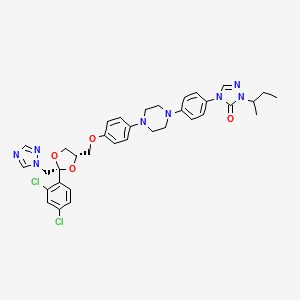
Pharmacotherapeutic group: Antimycotic for systemic use, triazole derivatives, ATC code: J02A C02
Mechanism of action
Itraconazole inhibits fungal 14α-demethylase, resulting in a depletion of ergosterol and disruption of membrane synthesis by fungi.
PK/PD relationship
The PK/PD relationship for itraconazole, and for triazoles in general, is poorly understood and is complicated by limited understanding of antifungal pharmacokinetics.
Mechanism(s) of resistance
Resistance of fungi to azoles appears to develop slowly and is often the result of several genetic mutations. Mechanisms that have been described are:
• Over-expression of ERG11, the gene that encodes 14-alpha-demethylase (the target enzyme)
• Point mutations in ERG11 that lead to decreased affinity of 14-alpha-demethylase for itraconazole
• Drug-transporter over-expression resulting in increased efflux of itraconazole from fungal cells (i.e., removal of itraconazole from its target)
• Cross-resistance. Cross-resistance amongst members of the azole class of drugs has been observed within
Candida
species though resistance to one member of the class does not necessarily confer resistance to other azoles.
Breakpoints
Breakpoints for itraconazole have not yet been established for fungi using EUCAST methods.
Using CLSI methods, breakpoints for itraconazole have only been established for
Candida
species from superficial mycotic infections. The CLSI breakpoints are: susceptible ≤ 0.125 mg/L and resistant ≥ 1 mg/L.
The prevalence of acquired resistance may vary geographically and with time for selected species, and local information on resistance is desirable, particularly when treating severe infections. As necessary, expert advice should be sought when the local prevalence of resistance is such that the utility of the agent in at least some types of infections is questionable.
The
in vitro
susceptibility of fungi to itraconazole depends on the inoculum size, incubation temperature, growth phase of the fungi, and the culture medium used. For these reasons, the minimum inhibitory concentration of itraconazole may vary widely. Susceptibility in the table below is based on MIC
90
< 1 mg itraconazole/L. There is no correlation between
in vitro
susceptibility and clinical efficacy.
Commonly susceptible species
Aspergillus spp.
2
Blastomyces dermatitidis
1
Candida albicans
Candida parapsilosis
Cladosporium spp.
Coccidioides immitis
1
Cryptococcus neoformans
Epidermophyton floccosum
Fonsecaea spp.
1
Geotrichum spp.
Histoplasma spp.
Malassezia (formerly Pityrosporum
)
spp.
Microsporum spp.
Paracoccidioides brasiliensis
1
Penicillium marneffei
1
Pseudallescheria boydii
Sporothrix schenckii
Trichophyton spp
.
Trichosporon spp.
Species for which acquired resistance may be a problem
Candida glabrata
3
Candida krusei
Candida tropicalis
3
Inherently resistant organisms
Absidia spp.
Fusarium spp.
Mucor spp.
Rhizomucor spp.
Rhizopus spp.
Scedosporium proliferans
Scopulariopsis spp.
1
These organisms may be encountered in patients who have returned from travel outside Europe.
2
Itraconazole-resistant strains of Aspergillus fumigatus have been reported.
3
Natural intermediate susceptibility.
⚠️ Warnings
Itraconazole has the potential to precipitate when 25 ml of Itraconazole concentrate are diluted in solutions other than 50 ml Sodium Chloride 0.9 % w/v solution for infusion. The full amount of 25 ml of Itraconazole concentrate from the ampoule must be diluted into the Sodium Chloride Infusion Bag, which is intended to be used exclusively in combination with Itraconazole concentrate. Only the components of a unit sales pack (e.g. saline bag, an extension line with a 2-way stopcock and 0.2 µm in-line filter, and Itraconazole ampoule) must be used. Itraconazole cannot be co- administered with other drugs or fluids (see section 6.2).
Prior to starting the admixing process, the Itraconazole concentrate and the solvent (Sodium Chloride) must be visually inspected. Only clear solutions free from foreign particles should be used for the preparation of the admixture.
The full amount of Itraconazole concentrate must be injected into the Sodium Chloride bag in a slow single action (up to 60 seconds). During the admixing process opalescence may appear but will clear after gently mixing. When visually inspecting the bag after admixing and prior to administration, product intrinsic aggregates may be observed. These aggregates do not affect the quality of the product. The dedicated extension line with the 0.2 µm in-line filter must be used to prevent aggregates from reaching the recipient’s circulation.
Itraconazole should be prepared for administration according to the following instructions:
Opening sodium chloride bag:
Tear outer wrap at notch and remove infusion bag.
Opening ampoule:
Break the ampoule as shown:
The admixing should begin immediately after opening the ampoule.
Flush procedure before the infusion:
Before the infusion, the catheter should be flushed to avoid compatibility problems between residual amounts of other drugs and itraconazole.
• Fill the extension line provided with the kit containing the 0.2 µm in-line filter with sterile Sodium Chloride 0.9 % w/v solution and connect directly to the indwelling intravenous catheter.
• Flush the extension line provided with the kit and indwelling intravenous catheter with sterile Sodium Chloride 0.9 % w/v solution.
Admixing Itraconazole concentrate and Sodium Chloride 0.9 % w/v solution for infusion:
• Each component must be at room temperature.
• Admix only in the infusion bag provided.
• Using aseptic technique and an additive delivery needle of appropriate length (not supplied with the kit), draw up all the concentrate from the ampoule and subsequently add the Itraconazole concentrate to the infusion bag by puncturing the resealable additive port and inject.
• Add the entire volume (25 ml) of Itraconazole concentrate while holding the bag in upright position in a slow single action (up to 60 seconds), this approach will avoid the concentrate collecting in the tubing which would hinder proper mixing. During the admixing process some opalescence may appear. This is a normal phenomenon for the product and will disappear after the full content of the 25 ml of Itraconazole has been diluted into the Sodium Chloride infusion bag and after gentle mixing. Withdraw needle after injecting the Itraconazole concentrate into the bag.
• Gently mix the content of the bag once the Itraconazole concentrate is completely transferred to the bag. The admixture will become clear but product intrinsic aggregates (described as fibrous to flake-like, non-crystalline, white particles) may be observed. These aggregates do not affect the quality of the product.
• The admixture should be used immediately and should be protected from direct sunlight. During administration, exposure to normal room light is acceptable (see sections 6.3 and 6.4 of the SmPC).
Infusion:
• The admixed solution is intended for single-dose infusion only. No administration should occur if the solution is a milky white colour that does not disappear after gentle mixing, or contains foreign matter, or if the infusion bag is damaged.
• The infusion bag should now contain 25 ml Itraconazole concentrate and 50 ml Sodium Chloride 0.9 % w/v solution for infusion.
• Note: An infusion line with drip chamber is not supplied with the kit. Close the flow control device (e.g., rotary clamp) on the infusion line. Remove the breakable part of the outlet port. Using aseptic technique, push the pin of the infusion line in the flexible port of the infusion bag.
• Slowly release the flow control device and fill the drip chamber to half full by squeezing (pumping) it.
• Open the flow control device until all the air has been expelled from the infusion line.
• Connect the infusion line to the two-way stopcock of the extension line.
• The Itraconazole infusion is now ready for intravenous infusion to the patient.
• Adjust the infusion rate to 1 ml/min (approximately 25 drops/min) by means of a flow control device (e.g. rotary clamp or infusion pump).
• Administer 60 ml of the solution to the patient over approximately one hour.
• Stop the infusion when 60 ml is administered.
• Note that 200 mg of itraconazole has been administered.
• Flush the line as per the flushing procedure described below.
Flush procedure after the infusion:
• After the infusion a complete flush procedure must be started to clean the catheter. This is done to avoid compatibility problems between residual amounts of itraconazole and other drugs which later could be administered through the same catheter.
• Flush the extension line and catheter with 15–20 ml of sterile Sodium Chloride 0.9 % w/v solution at the level of the 2-way stop cock, just before the 0.2 µm in-line filter.
• Perform the flush in a continuous run of 30 seconds to 15 minutes.
• After flushing, disconnect and discard the bag, the infusion line and the extension line.
• Do not re-sterilise or re-use the Itraconazole infusion set.
• To avoid precipitation, other medication should only be administered via the catheter after flushing.
• If using a multi-lumen catheter, other medication may not be administered until the Itraconazole infusion has been completed and the catheter has been flushed.
1. Sodium Chloride infusion bag
2. Itraconazole ampoule
3. Infusion line with drip chamber (not provided)
4 & 5. Extension line with 2-way stopcock and in-line filter.
No special requirements for disposal.