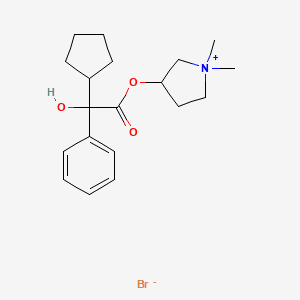
Pharmacotherapeutic group: Drugs for obstructive airway diseases, anticholinergics, ATC code: R03BB06
Mechanism of action
Glycopyrronium is an inhaled long-acting muscarinic receptor antagonist (anticholinergic) intended for once-daily maintenance bronchodilator treatment of COPD. Parasympathetic nerves are the major bronchoconstrictor neural pathway in the airways, and cholinergic tone is the key reversible component of airflow obstruction in COPD. Glycopyrronium blocks the bronchoconstrictor effect of acetylcholine on airway smooth muscle cells, thereby dilating the airways.
Glycopyrronium bromide is a muscarinic receptor antagonist with high affinity. Radiolabelled ligand binding studies demonstrated greater than 4-fold selectivity for the human M3 receptor over the human M2 receptor. It has a rapid onset of action, as demonstrated by measurement of receptor association and dissociation kinetic parameters, as well as a rapid onset of action following inhaled administration in clinical studies.
The long duration of action may be partly attributable to the sustained concentration of the active substance in the lungs, as indicated by the prolonged elimination half-life of glycopyrronium after inhalation using the inhaler, compared with the half-life after intravenous administration (see section 5.2).
Pharmacodynamic effects
The Phase III clinical development programme included 2 Phase III studies: a 6-month placebo-controlled study and a 12-month placebo- and active-controlled study (open-label tiotropium 18 micrograms once daily), both in patients with a clinical diagnosis of moderate to severe COPD.
Effects on lung function
Glycopyrronium 44 micrograms once daily produced sustained, statistically significant improvements in lung function (forced expiratory volume in 1 second – FEV1, forced vital capacity – FVC and inspiratory capacity – IC) across a range of clinical studies. In the Phase III studies, bronchodilator effects were observed within 5 minutes of the first dose and were maintained throughout the entire 24-hour dosing interval from the first dose. No attenuation of the bronchodilator effect was observed during long-term administration in the 6- and 12-month studies. The magnitude of the effect was dependent on the degree of reversibility of airflow limitation at baseline (tested by administration of a short-acting muscarinic receptor antagonist bronchodilator): patients with the lowest degree of reversibility at baseline (<5%) generally showed a lower bronchodilator response than patients with a higher degree of reversibility at baseline (≥5%). At Week 12 (primary endpoint), glycopyrronium increased trough FEV1 (pre-dose value) by 72 ml in patients with the lowest degree of reversibility (<5%) and by 113 ml in patients with a higher degree of reversibility at baseline (≥5%) compared with placebo (both p<0.05).
In the 6-month study, glycopyrronium increased FEV1 compared with placebo by 93 ml at 5 minutes and by 144 ml at 15 minutes after the first dose (both p<0.001). In the 12-month study, improvement was 87 ml at 5 minutes and 143 ml at 15 minutes (both p<0.001).
In the 12-month study, glycopyrronium showed statistically significant improvement in FEV1 compared with tiotropium in the first 4 hours post-dose on Day 1 and at Week 26, and numerically higher FEV1 values in the first 4 hours post-dose than tiotropium at Weeks 12 and 52.
Trough FEV1 values (24 hours post-dose) were similar after both the first dose and after one year of treatment. At Week 12 (primary endpoint), glycopyrronium compared with placebo increased mean FEV1 by 108 ml in the 6-month study and by 97 ml in the 12-month study (both p<0.001). In the 12-month study, the improvement with tiotropium was 83 ml compared with placebo (p<0.001).
Symptom treatment outcomes
Glycopyrronium administered at a dose of 44 micrograms once daily produced statistically significant improvement in dyspnoea assessed using the Transitional Dyspnoea Index (TDI). In a pooled analysis of the 6-month and 12-month pivotal studies, a statistically significantly higher percentage of patients receiving glycopyrronium achieved an improvement of one or more points in TDI score compared with placebo at Week 26 (58.4% vs. 46.4%, p<0.001). These findings were similar to those in patients receiving tiotropium, of whom 53.4% responded with an improvement of 1 or more points (p=0.009 vs. placebo).
Once-daily administration of glycopyrronium also produced statistically significant improvement in quality of life as assessed by the St. George's Respiratory Questionnaire (SGRQ) score. Pooled analysis of the 6- and 12-month pivotal studies showed that a statistically significantly higher proportion of patients receiving glycopyrronium responded with an improvement of 4 or more points in SGRQ score compared with placebo at Week 26 (57.8% vs. 47.6%, p<0.001). Patients receiving tiotropium responded with an improvement of 4 or more points in SGRQ score in 61.0% (p=0.004 vs. placebo).
Reduction of COPD exacerbations
COPD exacerbation data were collected in the 6-month and 12-month pivotal studies. In both studies, the percentage of patients experiencing moderate or severe exacerbations (defined as requiring treatment with systemic corticosteroids and/or antibiotics or hospitalisation) was reduced. In the 6-month study, the percentage of patients experiencing moderate or severe exacerbations was 17.5% with glycopyrronium and 24.2% with placebo (hazard ratio: 0.69, p=0.023), and in the 12-month study 32.8% with glycopyrronium and 40.2% with placebo (hazard ratio: 0.66, p=0.001). In a pooled analysis of the first 6 months of treatment in the 6-month and 12-month studies, glycopyrronium compared with placebo significantly prolonged the time to first moderate or severe exacerbation and reduced the rate of moderate or severe COPD exacerbations (0.53 exacerbations per year vs. 0.77 exacerbations per year, p<0.001). The pooled analysis also showed that fewer patients treated with glycopyrronium experienced an exacerbation requiring hospitalisation compared with placebo (1.7% vs. 4.2%, p=0.003).
Additional effects
Once-daily administration of glycopyrronium significantly reduced the need for rescue medication (salbutamol) compared with placebo, by 0.46 puffs per day (p=0.005) over 26 weeks in the 6-month study and by 0.37 puffs per day (p=0.039) over 52 weeks in the 12-month study.
In a 3-week study evaluating exercise tolerance using a bicycle ergometer at submaximal (80%) workload (submaximal exercise tolerance test), morning administration of glycopyrronium reduced dynamic hyperinflation and prolonged exercise endurance time. On the first day of treatment, inspiratory capacity during exercise improved by 230 ml and exercise endurance time by 43 seconds (an increase of 10%) compared with placebo. After three weeks of treatment with glycopyrronium, the improvement in inspiratory capacity was similar to the first day (200 ml), but exercise endurance time increased by 89 seconds (an increase of 21%) compared with placebo. Glycopyrronium administration reduced dyspnoea and lower limb fatigue during exercise (measured using the Borg scale). Glycopyrronium also reduced resting dyspnoea measured using the TDI index.
Secondary pharmacodynamic effects
No changes in mean heart rate or QTc interval were observed in COPD patients receiving glycopyrronium at doses up to 176 micrograms. In a QT study of 73 healthy volunteers, a single inhaled dose of 352 micrograms of glycopyrronium (8 times the therapeutic dose) did not prolong the QTc interval and led to a slight decrease in heart rate (maximum effect -5.9 beats/minute; mean 24-hour effect -2.8 beats/minute) compared with placebo. In young healthy subjects, the effect of intravenous administration of 150 micrograms of glycopyrronium bromide (equivalent to 120 micrograms of glycopyrronium) on heart rate and QTc interval was investigated. Approximately 50-fold the maximum concentration (Cmax) compared with inhalation of 44 micrograms of glycopyrronium at steady state was achieved, and no tachycardia or QTc prolongation occurred. A slight decrease in heart rate was recorded (mean 24-hour difference -2 beats/minute compared with placebo), which is a known effect in young healthy subjects at low exposure to anticholinergic agents.
Paediatric population
The European Medicines Agency has waived the obligation to submit the results of studies with the reference medicinal product containing glycopyrronium in all subsets of the paediatric population in COPD (see section 4.2 for information on paediatric use).
⚠️ Warnings
Not for acute use
Amidil AmiHaler is intended for once-daily long-term maintenance treatment and is not indicated for initial treatment of acute episodes of bronchospasm, i.e. as rescue therapy.
Hypersensitivity
Immediate hypersensitivity reactions have been reported following the administration of glycopyrronium. If signs suggesting allergic reactions occur, in particular angioedema (including difficulty breathing or swallowing, swelling of the tongue, lips and face), urticaria or skin rash, treatment should be discontinued immediately and alternative therapy instituted.
Paradoxical bronchospasm
Paradoxical bronchospasm was not observed in clinical studies with glycopyrronium. However, paradoxical bronchospasm has been observed with other types of inhalation therapy and may be life-threatening. If paradoxical bronchospasm occurs, treatment should be discontinued immediately and alternative therapy instituted.
Anticholinergic effect
Amidil AmiHaler should be used with caution in patients with narrow-angle glaucoma or urinary retention.
Patients should be informed of the signs and symptoms of acute narrow-angle glaucoma and should be instructed to discontinue using Amidil AmiHaler and seek immediate medical attention if any signs or symptoms of this condition develop.
Patients with severe renal impairment
In patients with mild and moderate renal impairment, an increase in mean total systemic exposure (AUClast) of up to 1.4-fold was observed, and in patients with severe renal impairment and end-stage renal disease, of up to 2.2-fold. In patients with severe renal impairment (estimated glomerular filtration rate below 30 ml/min/1.73 m2), including patients with end-stage renal disease requiring dialysis, Amidil AmiHaler should be used only if the expected benefit outweighs the potential risk (see section 5.2). These patients should be carefully monitored for potential adverse reactions.
Patients with a history of cardiovascular disease
Patients with unstable ischaemic heart disease, left ventricular heart failure, history of myocardial infarction, arrhythmia (excluding chronic stable atrial fibrillation), history of long QT syndrome, or whose QTc interval (Fridericia method) was prolonged (>450 ms for males or >470 ms for females) were excluded from clinical studies, and therefore experience in these patient groups is limited. Amidil AmiHaler should be used with caution in these patient groups.
Excipients
Patients with rare hereditary problems of galactose intolerance, total lactase deficiency or glucose-galactose malabsorption should not take this medicinal product.