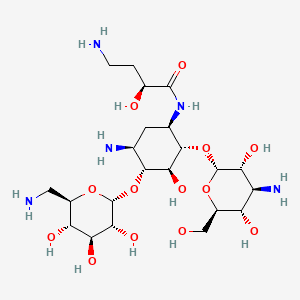
Pharmacotherapeutic group: Other aminoglycosides, ATC code: J01GB06
Amikacin is a semi-synthetic aminoglycoside antibiotic derived from kanamycin. It is obtained by acylation of the amino group at C-1 in the 2-deoxystreptamine moiety with 4-amino-2-hydroxybutyric acid.
Mechanism of action
Amikacin acts by inhibiting protein synthesis at bacterial ribosomes through interaction with ribosomal RNA, and in susceptible microorganisms, by subsequent inhibition of reproduction. The result is a bactericidal effect.
Pharmacokinetic/pharmacodynamic relationship
Of the pharmacokinetic/pharmacodynamic parameters, the most important for predicting the bactericidal effect of amikacin is the ratio of peak serum concentration (Cmax) to the minimum inhibitory concentration (MIC) for the given pathogen. A Cmax/MIC ratio of 8:1 or 10:1 is considered effective for bacterial killing and prevention of regrowth.
Amikacin exhibits a post-antibiotic effect both in vitro and in vivo. The post-antibiotic effect allows extension of the dosing interval without loss of efficacy against most gram-negative bacilli.
Mechanism(s) of resistance
Resistance to amikacin may develop through the following mechanisms:
Enzymatic inactivation: The most common mechanism of resistance development is enzymatic modification of aminoglycoside molecules. These are mediated by acetyltransferases, phosphotransferases, or nucleotidyltransferases, which are primarily encoded on plasmids. Due to its resistance to degradation by aminoglycoside-inactivating enzymes, amikacin has demonstrated efficacy against many bacterial species resistant to aminoglycosides.
Reduced penetration and active efflux: This resistance mechanism is observed in Pseudomonas aeruginosa. Recent data indicate the emergence of a similar resistance mechanism in Acinetobacter spp.
Target structure alteration: Ribosomal modifications are only occasionally observed as a cause of resistance.
Partial cross-resistance between amikacin and other aminoglycosides exists.
Breakpoints for susceptibility testing
The European Committee on Antimicrobial Susceptibility Testing (EUCAST) has established the following minimum inhibitory concentration (MIC) interpretation criteria for amikacin susceptibility testing: https://www.ema.europa.eu/documents/other/minimum-inhibitory-concentration-mic-breakpoints_en.xlsx
Spectrum of activity of amikacin:
The prevalence of acquired resistance may vary geographically and over time for selected species. Local resistance information is desirable, particularly when treating severe infections. Expert advice should be sought where appropriate if the local prevalence of resistance is such that the utility of the drug is questionable in at least some types of infection.
Generally susceptible species
Aerobic gram-positive microorganisms
Staphylococcus aureus Staphylococcus haemolyticus Staphylococcus hominis
0
Aerobic gram-negative microorganisms
Acinetobacter pittii
Citrobacter freundii
Citrobacter koseri
Enterobacter cloacae
Escherichia coli
Klebsiella aerogenes
Klebsiella oxytoca
Klebsiella pneumoniae
Morganella morganii
Proteus mirabilis
Proteus vulgaris
0
Pseudomonas aeruginosa
1
Salmonella enterica
0
Serratia liquefaciens
0
Serratia marcescens
Shigella spp.
Species for which acquired resistance may be a problem
Aerobic gram-positive microorganisms
Staphylococcus epidermidis
Aerobic gram-negative microorganisms
Acinetobacter baumannii
Intrinsically resistant organisms
Aerobic gram-positive microorganisms
Enterococcus spp.
Streptococcus spp.
Aerobic gram-negative microorganisms
Burkholderia cepacia
Stenotrophomonas maltophilia
Anaerobes
Bacteroides spp.
Prevotella spp.
Other microorganisms
Chlamydia spp.
Chlamydophila spp.
Mycoplasma spp.
Ureaplasma urealyticum
1 In specific patient groups, e.g. patients with cystic fibrosis, the proportion of resistant isolates is ≥10%.
0 At the time of publication of these tables, no updated data were available. Susceptibility is estimated from the primary literature, standard reference works, and treatment guidelines.
Additional information:
Aminoglycosides are suitable in combination with other antibiotics against gram-positive cocci.
⚠️ Warnings
Caution is required when administering to patients:
with impaired renal function,
with impaired hearing or vestibular function,
with neuromuscular disorders (e.g. myasthenia gravis, parkinsonism, as worsening of muscle weakness may occur due to a curare-like effect by which amikacin can potentially act on the neuromuscular junction), and
patients treated with other aminoglycosides immediately prior to amikacin use.
Patients treated with parenteral aminoglycosides must be carefully monitored clinically due to the potential ototoxicity and nephrotoxicity associated with their use.
Toxic effects of aminoglycosides, including amikacin, are more frequent in patients with impaired renal function, when high doses are administered, and during prolonged treatment.
The safety of treatment exceeding 14 days has not been established. Other factors that increase the risk of aminoglycoside toxicity are advanced age and dehydration.
Neuro/ototoxicity
Patients treated with aminoglycosides may develop neurotoxicity manifesting as vestibular and/or bilateral auditory ototoxicity. The risk of aminoglycoside-induced ototoxicity is higher in patients with impaired renal function and in patients, including those who are healthy, whose therapy is prolonged to 5–7 days. High-frequency deafness usually appears first and can only be detected by audiometric measurement. Vertigo may occur, which may indicate vestibular damage. Other manifestations of neurotoxicity may include numbness, tingling, muscle twitching, and convulsions.
Patients with mitochondrial DNA mutations (particularly the nucleotide 1555 A to G substitution in the 12S rRNA gene) are at increased risk of ototoxicity, even if aminoglycoside serum levels are within the recommended range during treatment. Alternative treatment options should be considered in these patients. In patients with a family history of relevant mutations or aminoglycoside-induced deafness, alternative treatment or genetic testing should be considered before administration.
Patients who develop cochlear or vestibular damage may not experience any symptoms during treatment that would alert them to developing eighth nerve toxicity, and complete or partial irreversible bilateral deafness or severe vertigo may appear after discontinuation of the product. See also section 4.8.
Aminoglycoside-induced ototoxicity is usually irreversible.
Neuromuscular toxicity
Neuromuscular blockade and respiratory paralysis have been reported following parenteral injection, topical application (such as orthopaedic or abdominal irrigation or local treatment of empyema), and after oral use of aminoglycosides.
The possibility of respiratory paralysis should be considered regardless of the route of aminoglycoside administration, particularly in patients concurrently receiving medicinal products that cause neuromuscular blockade. See also section 4.5.
If neuromuscular blockade occurs, calcium salts may reverse respiratory paralysis; however, mechanical ventilation may still be necessary. Neuromuscular blockade and muscle paralysis have been demonstrated in laboratory animals given high doses of amikacin.
Renal toxicity
Aminoglycosides are potentially nephrotoxic. Renal toxicity is independent of the plasma sample taken at peak concentration (Cmax). The risk of nephrotoxicity is higher in patients with impaired renal function and in patients receiving high doses or on prolonged therapy.
Patients must be well hydrated during treatment and renal function must be assessed by standard methods prior to initiation of therapy and daily during treatment. See section 4.2.
Reduction of daily doses and/or extension of the dosing interval is required if signs of renal dysfunction occur, such as: cylindruria, presence of leucocytes or erythrocytes in urine, albuminuria, decreased creatinine clearance, decreased urine specific gravity, hyperazotaemia, increased BUN, increased serum creatinine, and oliguria. Treatment must be discontinued if azotaemia increases or if urine output progressively decreases.
Patient monitoring
Renal function and eighth cranial nerve function must be carefully monitored, particularly in patients with known or suspected renal impairment at the start of therapy, and also in patients whose renal function is initially normal but who develop renal impairment during therapy. Wherever possible, amikacin serum concentrations should be monitored to ensure adequate levels and to avoid potentially toxic levels. Urine should be examined for decreased specific gravity, increased protein excretion, and presence of cells or casts. Blood urea nitrogen, serum creatinine, or creatinine clearance should be measured regularly. Where possible, serial audiograms should be obtained in patients who are old enough to be tested, particularly high-risk patients. Evidence of ototoxicity (dizziness, vertigo, tinnitus, roaring in the ears, and hearing loss) or nephrotoxicity requires discontinuation of treatment or dosage adjustment. See section 4.8.
Amikacin treatment should be discontinued upon occurrence of tinnitus, subjective deterioration of hearing, or when repeated audiograms demonstrate significant high-frequency perception loss.
As with other antibiotics, use of amikacin may lead to overgrowth of non-susceptible organisms. If this occurs, appropriate treatment should be initiated. Aminoglycosides used locally as part of surgical procedures are rapidly and almost completely absorbed (with the exception of the urinary bladder).
In association with aminoglycoside irrigation of the surgical field (regardless of extent), the following have been reported: development of irreversible deafness, renal failure, and death caused by neuromuscular blockade.
Macular infarction has been reported following intravitreal administration of amikacin (injection into the eye), which in some cases led to permanent loss of vision.
Elderly patients
Elderly patients may have reduced renal function that may not be apparent from routine screening tests such as BUN or serum creatinine. Determination of creatinine clearance may be more useful. Monitoring of renal function during aminoglycoside treatment is very important in elderly patients.
Paediatric population
Administration of aminoglycosides to premature infants and neonates requires caution due to the renal immaturity of these patients, which leads to prolongation of the serum half-life of these drugs.
Special warnings/precautions regarding excipients
This medicinal product contains 354 mg sodium per 100 ml, equivalent to 17.7% of the WHO recommended maximum daily dietary sodium intake of 2 g for an adult.
Interference with laboratory tests
When cephalosporins are administered concomitantly, serum creatinine tests may yield falsely elevated values. In samples (e.g. serum, cerebrospinal fluid, etc.) collected for aminoglycoside testing, mutual inactivation of amikacin and beta-lactam antibiotics may continue, leading to inaccurate results. Samples should therefore be analysed immediately after collection or frozen, or beta-lactam antibiotics must be inactivated by adding beta-lactamase. Inactivation of aminoglycosides is clinically significant only in patients with severe renal impairment.