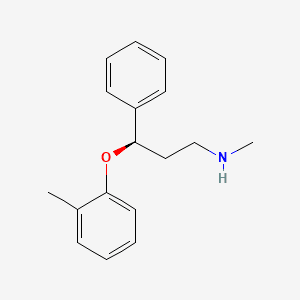
Pharmacotherapeutic group: Psychoanaleptics, centrally acting sympathomimetics ATC code: N06BA09
Mechanism of action and Pharmacodynamic effects
Atomoxetine is a highly selective and potent inhibitor of the pre-synaptic noradrenaline transporter, its presumed mechanism of action, without directly affecting the serotonin or dopamine transporters. Atomoxetine has minimal affinity for other noradrenergic receptors or for other neurotransmitter transporters or receptors. Atomoxetine has two major oxidative metabolites: 4-hydroxyatomoxetine and N-desmethylatomoxetine. 4-Hydroxyatomoxetine is equipotent to atomoxetine as an inhibitor of the noradrenaline transporter but unlike atomoxetine, this metabolite also exerts some inhibitory activity at the serotonin transporter. However, any effect on this transporter is likely to be minimal as the majority of 4-hydroxyatomoxetine is further metabolised such that it circulates in plasma at much lower concentrations (1% of atomoxetine concentration in extensive metabolisers and 0.1% of atomoxetine concentration in poor metabolisers). N-Desmethylatomoxetine has substantially less pharmacological activity compared with atomoxetine. It circulates in plasma at lower concentrations in extensive metabolisers and at comparable concentrations to the parent drug in poor metabolisers at steady state.
Atomoxetine is not a psychostimulant and is not an amphetamine derivative. In a randomised, double-blind, placebo-controlled, abuse-potential study in adults comparing effects of atomoxetine and placebo, atomoxetine was not associated with a pattern of response that suggested stimulant or euphoriant properties.
Clinical efficacy and safety
Paediatric population
Atomoxetine has been studied in trials in over 5000 children and adolescents with ADHD. The acute efficacy of Atomoxetine in the treatment of ADHD was initially established in six randomised, double-blind, placebo-controlled trials of six to nine weeks duration. Signs and symptoms of ADHD were evaluated by a comparison of mean change from baseline to endpoint for Atomoxetine treated and placebo treated patients. In each of the six trials, atomoxetine was statistically significantly superior to placebo in reducing ADHD signs and symptoms.
Additionally, the efficacy of atomoxetine in maintaining symptom response was demonstrated in a 1 year, placebo-controlled trial with over 400 children and adolescents, primarily conducted in Europe (approximately 3 months of open label acute treatment followed by 9 months of double-blind, placebo-controlled maintenance treatment). The proportion of patients relapsing after 1 year was 18.7% and 31.4% (atomoxetine and placebo, respectively). After 1 year of atomoxetine treatment, patients who continued atomoxetine for 6 additional months were less likely to relapse or to experience partial symptom return compared with patients who discontinued active treatment and switched to placebo (2% vs. 12% respectively). For children and adolescents periodic assessment of the value of ongoing treatment during long-term treatment should be performed.
Atomoxetine was effective as a single daily dose and as a divided dose administered in the morning, and late afternoon/early evening. Atomoxetine administered once daily demonstrated statistically significantly greater reduction in severity of ADHD symptoms compared with placebo as judged by teachers and parents.
Active Comparator Studies
In a randomised, double-blind, parallel group, 6 week paediatric study to test the noninferiority of atomoxetine to a standard extended-release methylphenidate comparator, the comparator was shown to be associated with superior response rates compared to atomoxetine. The percentage of patients classified as responders was 23.5% (placebo), 44.6% (atomoxetine) and 56.4% (methylphenidate). Both atomoxetine and the comparator were statistically superior to placebo and methylphenidate was statistically superior to atomoxetine (p=0.016). However, this study excluded patients who were stimulant nonresponders.
Adult population
Atomoxetine has been studied in trials in over 4800 adults who met DSM-IV diagnostic criteria for ADHD. The acute efficacy of Atomoxetine in the treatment of adults was established in six randomised, double-blind, placebo-controlled trials of ten to sixteen weeks' duration. Signs and symptoms of ADHD were evaluated by a comparison of mean change from baseline to endpoint for atomoxetine treated and placebo treated patients. In each of the six trials, atomoxetine was statistically significantly superior to placebo in reducing ADHD signs and symptoms (Table X). Atomoxetine-treated patients had statistically significantly greater improvements in clinical global impression of severity (CGI-S) at endpoint compared to placebo-treated patients in all of the 6 acute studies, and statistically significantly greater improvements in ADHD related functioning in all 3 of the acute studies in which this was assessed (Table X).
Long-term efficacy was confirmed in 2 six-month placebo controlled studies, but not demonstrated in a third (Table X).
Table X Mean Changes in Efficacy Measures for Placebo-Controlled Studies
Changes from Baseline in Patients with at Least One Post baseline Value (LOCF)
CAARS-Inv:SV or AISRS
a
CGI-S
AAQoL
Study
Treatment
N
Mean Change
p-value
Mean Change
p-value
Mean Change
p-value
Acute Studies
LYAA
ATX
PBO
133
134
-9.5
-6.0
0.006
-0.8
-0.4
0.011
-
-
LYAO
ATX
PBO
124
124
-10.5
-6.7
0.002
-0.9
-0.5
0.002
-
-
LYBY
ATX
PBO
72
75
-13.6
-8.3
0.007
-1.0
-0.7
0.048
-
-
LYDQ
ATX
PBO
171
158
-8.7
-5.6
<0.001
-0.8
-0.6
0.022
14.9
11.1
0.030
LYDZ
ATX
PBO
192
198
-10.7
-7.2
<0.001
-1.1
-0.7
<0.001
15.8
11.0
0.005
LYEE
ATX
PBO
191
195
-14.3
-8.8
<0.001
-1.3
-0.8
<0.001
12.83
8.20
<0.001
Long-Term Studies
LYBV
ATX
PBO
185
109
-11.6
-11.5
0.412
-1.0
-0.9
0.173
13.90
11.18
0.045
LYCU
ATX
PBO
214
216
-13.2
-10.2
0.005
-1.2
-0.9
0.001
13.14
8.62
0.004
LYCW
ATX
PBO
113
120
-14.3
-8.3
<0.001
-1.2
-0.7
<0.001
-
-
Abbreviations: AAQoL = Adult ADHD Quality of Life Total Score; AISRS = Adult
ADHD Investigator Symptom Rating Scale Total Score; ATX = atomoxetine; CAARS-Inv:SV = Conners Adult ADHD Rating Scale, Investigator Rated, screening version Total ADHD Symptom Score; CGI-S = Clinical Global Impression of Severity; LOCF = last observation carried forward; PBO = placebo. a ADHD symptom scales; results shown for Study LYBY are for AISRS; results for all others are for CAARS-Inv:SV.
In sensitivity analyses using a baseline-observation-carried-forward method for patients with no postbaseline measure (i.e. all patients treated), results were consistent with results shown in Table X.
In analyses of clinically meaningful response in all 6 acute and both successful longterm studies, using a variety of a priori and post hoc definitions, atomoxetine-treated patients consistently had statistically significantly higher rates of response than placebo-treated patients (Table Y).
Table Y Number (n) and Percent of Patients Meeting Criteria for Response in Pooled Placebo-Controlled Studies
Group Treatment
Response Defined by Improvement of at least 1 point on CGI-S
Response Defined by 40% Improvement on CAARS-Inv:SV at Endpoint
N
n (%)
p-value
N
n (%)
p-value
Pooled Acute Studies
a
ATX
PBO
640
652
401 (62.7%)
283 (43.4%)
<0.001
841
851
347 (41.3%)
215 (25.3%)
<0.001
Pooled Long-Term Studies
a
ATX
PBO
758
611
482 (63.6%)
301 (49.3%)
<0.001
663
557
292 (44.0%)
175 (31.4%)
<0.001
a
Includes all studies in Table X except: Acute CGI-S response analysis excludes 2 studies in patients with comorbid disorders (LYBY, LYDQ); Acute CAARS response analysis excludes 1 study in which the CAARS was not administered (LYBY).
In two of the acute studies, patients with ADHD and comorbid alcoholism or social anxiety disorder were studied and in both studies ADHD symptoms were improved. In the study with comorbid alcohol abuse, there were no differences between atomoxetine and placebo with respect to alcohol use behaviours. In the study with comorbid anxiety, the comorbid condition of anxiety did not deteriorate with atomoxetine treatment.
The efficacy of atomoxetine in maintaining symptom response was demonstrated in a study where after an initial active treatment period of 24 weeks, patients who met criteria for clinically meaningful response (as defined by improvement on both CAARS-Inv:SV and CGI-S scores) were randomized to receive atomoxetine or placebo for an additional 6 months of double-blind treatment. Higher proportions of atomoxetine-treated patients than placebo-treated patients met criteria for maintaining clinically meaningful response at the end of 6 months (64.3% vs. 50.0%; p=0.001).
Atomoxetine-treated patients demonstrated statistically significantly better maintenance of functioning than placebo-treated patients as shown by lesser mean change on the Adult ADHD Quality of Life (AAQoL) total score at the 3-month interval (p=0.003) and at the 6-month interval (p=0.002).
QT/QTc study
A thorough QT/QTc study, conducted in healthy adult CYP2D6 poor metabolizer (PM) subjects dosed up to 60 mg of atomoxetine BID, demonstrated that at maximum expected concentrations the effect of atomoxetine on QTc interval was not significantly different from placebo. There was a slight increase in QTc interval with increased atomoxetine concentration.
⚠️ Warnings
Any unused medicinal product or waste material should be disposed of in accordance with local requirements.