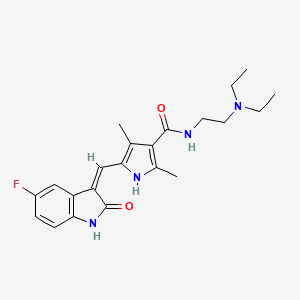
Pharmacotherapeutic group: Antineoplastic agents, protein kinase inhibitors; ATC code: L01EX01
Mechanism of action
Sunitinib inhibits multiple RTKs that are implicated in tumour growth, neoangiogenesis, and metastatic progression of cancer. Sunitinib was identified as an inhibitor of platelet-derived growth factor receptors (PDGFRα and PDGFRβ), VEGF receptors (VEGFR1, VEGFR2, and VEGFR3), stem cell factor receptor (KIT), Fms-like tyrosine kinase-3 (FLT3), colony stimulating factor receptor (CSF-1R), and the glial cell-line derived neurotrophic factor receptor (RET). The primary metabolite exhibits similar potency compared to sunitinib in biochemical and cellular assays.
Clinical efficacy and safety
The clinical safety and efficacy of sunitinib has been studied in the treatment of patients with GIST who were resistant to imatinib (i.e., those who experienced disease progression during or following treatment with imatinib) or intolerant to imatinib (i.e., those who experienced significant toxicity during treatment with imatinib that precluded further treatment), the treatment of patients with MRCC, and the treatment of patients with unresectable pNET.
Efficacy is based on time-to-tumour progression (TTP) and an increase in survival in GIST, on progression-free survival (PFS) and objective response rates (ORR) for treatment-naïve and cytokine-refractory MRCC respectively, and on PFS for pNET.
Gastrointestinal stromal tumours
An initial open-label, dose-escalation study was conducted in patients with GIST after failure of imatinib (median maximum daily dose 800 mg) due to resistance or intolerance. Ninety-seven patients were enrolled at various doses and schedules; 55 patients received 50 mg at the recommended treatment Schedule 4 weeks on /2 weeks off (“Schedule 4/2”).
In this study, the median TTP was 34.0 weeks (95% CI: 22.0, 46.0).
A Phase 3, randomised, double-blind, placebo-controlled study of sunitinib was conducted in patients with GIST who were intolerant to, or had experienced disease progression during or following treatment with imatinib (median maximum daily dose 800 mg). In this study, 312 patients were randomised (2:1) to receive either 50 mg sunitinib or placebo, orally once daily on Schedule 4/2 until disease progression or withdrawal from the study for another reason (207 patients received sunitinib and 105 patients received placebo). The primary efficacy endpoint of the study was TTP, defined as the time from randomisation to first documentation of objective tumour progression. At the time of the prespecified interim analysis, the median TTP on sunitinib was 28.9 weeks (95% CI: 21.3, 34.1) as assessed by the investigator and 27.3 weeks (95% CI: 16.0, 32.1) as assessed by the independent review and was statistically significantly longer than the TTP on placebo of 5.1 weeks
(95% CI: 4.4, 10.1) as assessed by the investigator and 6.4 weeks (95% CI: 4.4, 10.0) as assessed by the independent review. The difference in overall survival (OS) was statistically in favour of sunitinib [hazard ratio (HR): 0.491; (95% CI: 0.290, 0.831)]; the risk of death was 2 times higher in patients in the placebo arm compared to the sunitinib arm.
After the interim analysis of efficacy and safety, at the recommendation of the independent Data and Safety Monitoring Board (DSMB), the study was unblinded and patients on the placebo arm were offered open-label sunitinib treatment.
A total of 255 patients received sunitinib in the open-label treatment phase of the study, including 99 patients who were initially treated with placebo.
The analyses of primary and secondary endpoints in the open-label phase of the study reaffirmed the results obtained at the time of the interim analysis, as shown in Table 2:
Table 2. GIST summary of efficacy endpoints (ITT population)
Double-blind treatment
a
Median (95% CI)
Hazard ratio
Placebo cross-over group treatment
b
Endpoint
Sunitinib
Placebo
(95% CI)
p-value
Primary
TTP (weeks)
Interim
27.3 (16.0, 32.1)
6.4 (4.4, 10.0)
0.329 (0.233, 0.466)
< 0.001
-
Final
26.6 (16.0, 32.1)
6.4 (4.4, 10.0)
0.339 (0.244, 0.472)
< 0.001
10.4 (4.3, 22.0)
Secondary
PFS (weeks)
c
Interim
24.1 (11.1, 28.3)
6.0 (4.4, 9.9)
0.333 (0.238, 0.467)
< 0.001
-
Final
22.9 (10.9, 28.0)
6.0 (4.4, 9.7)
0.347 (0.253, 0.475)
< 0.001
-
ORR (%)
d
Interim
6.8 (3.7, 11.1)
0 (-)
NA
0.006
-
Final
6.6 (3.8, 10.5)
0 (-)
NA
0.004
10.1 (5.0, 17.8)
OS (weeks)
e
Interim
-
-
0.491 (0.290, 0.831)
0.007
-
Final
72.7 (61.3, 83.0)
64.9 (45.7, 96.0)
0.876 (0.679, 1.129)
0.306
-
Abbreviations: CI=confidence interval; ITT=intent-to-treat; NA=not applicable; ORR=objective response rate; OS=overall survival; PFS=progression-free survival; TTP=time-to-tumour progression.
a
Results of double-blind treatment are from the ITT population and using central radiologist measurement, as appropriate.
b
Efficacy results for the 99 subjects who crossed over from placebo to sunitinib after unblinding. Baseline was reset at cross-over and efficacy analyses were based on investigators assessment.
c
The interim PFS numbers have been updated based on a recalculation of the original data.
d
Results for ORR are given as percent of subjects with confirmed response with the 95% CI.
e
Median not achieved because the data were not yet mature.
Median OS in the ITT population was 72.7 weeks and 64.9 weeks (HR: 0.876; 95% CI: 0.679, 1.129; p=0.306), in the sunitinib and placebo arms, respectively. In this analysis, the placebo arm included those patients randomised to placebo who subsequently received open-label sunitinib treatment.
Treatment-naïve metastatic renal cell carcinoma
A Phase 3, randomised, multi-centre, international study evaluating the efficacy and safety of sunitinib compared with IFN-α in treatment-naïve MRCC patients was conducted. Seven hundred and fifty patients were randomised 1:1 to the treatment arms; they received treatment with either sunitinib in repeated 6-week cycles, consisting of 4 weeks of 50 mg daily oral administration followed by 2 weeks of rest (Schedule 4/2), or IFN-α, administered as a subcutaneous injection of 3 million units (MU) the first week, 6 MU the second week, and 9 MU the third week and thereafter, on 3 nonconsecutive days each week.
The median duration of treatment was 11.1 months (range: 0.4-46.1) for sunitinib treatment and 4.1 months (range: 0.1-45.6) for IFN-α treatment. Treatment-related serious adverse events (TRSAEs) were reported in 23.7% of patients receiving sunitinib and in 6.9% of patients receiving IFN-α. However, the discontinuation rates due to adverse events were 20% for sunitinib and 23% for IFN-α. Dose interruptions occurred in 202 patients (54%) on sunitinib and 141 patients (39%) on IFN-α. Dose reductions occurred in 194 patients (52%) on sunitinib and 98 patients (27%) on IFN-α. Patients were treated until disease progression or withdrawal from the study. The primary efficacy endpoint was PFS. A planned interim analysis showed a statistically significant advantage for sunitinib over IFN-α, in this study, the median PFS for the sunitinib-treated group was 47.3 weeks, compared with 22.0 weeks for the IFN-α-treated group; the HR was 0.415 (95% CI: 0.320, 0.539; p-value < 0.001). Other endpoints included ORR, OS, and safety. Core radiology assessment was discontinued after the primary endpoint had been met. At the final analysis, the ORR as determined by the investigator's assessment was 46% (95% CI: 41%, 51%) for the sunitinib arm and 12.0% (95% CI: 9%, 16%) for the IFN-α arm (p<0.001).
Sunitinib treatment was associated with longer survival compared to IFN-α. The median OS was 114.6 weeks for the sunitinib arm (95% CI: 100.1, 142.9) and 94.9 weeks for the IFN-α arm (95% CI: 77.7, 117.0) with a hazard ratio of 0.821 (95% CI: 0.673, 1.001; p=0.0510 by unstratified log-rank).
The overall PFS and OS, observed in the ITT population, as determined by the core radiology laboratory assessment, are summarised in Table 3.
Table 3. Treatment-naïve mRCC summary of efficacy endpoints (ITT population)
Summary of progression-free survival
Sunitinib
(N = 375)
IFN-
α
(N = 375)
Subject did not progress or die [n (%)]
161 (42.9)
176 (46.9)
Subject observed to have progressed or died [n (%)]
214 (57.1)
199 (53.1)
PFS (weeks)
Quartile (95% CI)
25%
22.7 (18.0, 34.0)
10.0 (7.3, 10.3)
50%
48.3 (46.4, 58.3)
22.1 (17.1, 24.0)
75%
84.3 (72.9, 95.1)
58.1 (45.6, 82.1)
Unstratified analysis
Hazard ratio (sunitinib versus IFN-α)
0.5268
95% CI for hazard ratio
(0.4316, 0.6430)
p-value
a
< 0.0001
Summary of overall survival
Subject not known to have died [n (%)]
185 (49.3)
175 (46.7)
Subject observed to have died [n (%)]
190 (50.7)
200 (53.3)
OS (weeks)
Quartile (95% CI)
25%
56.6 (48.7, 68.4)
41.7 (32.6, 51.6)
50%
114.6 (100.1, 142.9)
94.9 (77.7, 117.0)
75%
NA (NA, NA)
NA (NA, NA)
Unstratified analysis
Hazard ratio (sunitinib versus IFN-α)
0.8209
95% CI for hazard ratio
(0.6730, 1.0013)
p-value
a
0.0510
Abbreviations: CI=confidence interval; INF-α=interferon-alfa; ITT=intent-to-treat; N=number of patients; NA=not applicable; OS=overall survival; PFS=progression-free survival.
a
From a 2-sided log-rank test.
Cytokine-refractory metastatic renal cell carcinoma
A Phase 2 study of sunitinib was conducted in patients who were refractory to prior cytokine therapy with interleukin-2 or IFN-α. Sixty-three patients received a starting dose of 50 mg sunitinib orally, once daily for 4 consecutive weeks followed by a 2-week rest period, to comprise a complete cycle of 6 weeks (Schedule 4/2). The primary efficacy endpoint was ORR, based on Response Evaluation Criteria in Solid Tumours (RECIST).
In this study the objective response rate was 36.5% (95% CI: 24.7%, 49.6%) and the median TTP was 37.7 weeks (95% CI: 24.0, 46.4).
A confirmatory
,
open-label
,
single-arm, multi-centre study evaluating the efficacy and safety of sunitinib was conducted in patients with MRCC who were refractory to prior cytokine therapy
.
One hundred and 6 patients received at least one 50 mg dose of sunitinib on Schedule 4/2
.
The primary efficacy endpoint of this study was ORR. Secondary endpoints included TTP, duration of response (DR) and OS.
In this study the ORR was 35.8% (95% CI: 26.8% , 47.5 %). The median DR and OS had not yet been reached.
Pancreatic neuroendocrine tumours
A supportive Phase 2, open-label, multi-centre study evaluated the efficacy and safety of single-agent sunitinib 50 mg daily on Schedule 4/2 in patients with unresectable pNET. In a pancreatic islet cell tumour cohort of 66 patients, the primary endpoint of response rate was 17%.
A pivotal Phase 3, multi-centre, international, randomised, double-blind, placebo-controlled study of single-agent sunitinib was conducted in patients with unresectable pNET.
Patients were required to have documented progression, based on RECIST, within the prior 12 months and were randomised (1:1) to receive either 37.5 mg sunitinib once daily without a scheduled rest period (N = 86) or placebo (N = 85).
The primary objective was to compare PFS in patients receiving sunitinib versus patients receiving placebo. Other endpoints included OS, ORR, PROs, and safety.
Demographics were comparable between the sunitinib and placebo groups. Additionally, 49% of sunitinib patients had nonfunctioning tumours versus 52% of placebo patients and 92% of patients in both arms had liver metastases.
Use of somatostatin analogues was allowed in the study.
A total of 66% of sunitinib patients received prior systemic therapy compared with 72% of placebo patients. In addition, 24% of sunitinib patients had received somatostatin analogues compared with 22% of placebo patients.
A clinically significant advantage in investigator-assessed PFS for sunitinib over placebo was observed. The median PFS was 11.4 months for the sunitinib arm compared to 5.5 months for the placebo arm [hazard ratio: 0.418 (95% CI: 0.263, 0.662), p-value=0.0001]; similar results were observed when derived tumour response assessments based upon application of RECIST to investigator tumour measurements were used to determine disease progression, as shown in Table 4. A hazard ratio favouring sunitinib was observed in all subgroups of baseline characteristics evaluated, including an analysis by number of prior systemic therapies. A total of 29 patients in the sunitinib arm and 24 in the placebo arm had received no prior systemic treatment; among these patients, the hazard ratio for PFS was 0.365 (95% CI: 0.156, 0.857), p=0.0156. Similarly, among 57 patients in the sunitinib arm (including 28 with 1 prior systemic therapy and 29 with 2 or more prior systemic therapies) and 61 patients in the placebo arm (including 25 with 1 prior systemic therapy and 36 with 2 or more prior systemic therapies), the hazard ratio for PFS was 0.456 (95% CI: 0.264, 0.787), p=0.0036.
A sensitivity analysis of PFS was conducted where progression was based upon investigator-reported tumour measurements and where all subjects censored for reasons other than study termination were treated as PFS events. This analysis provided a conservative estimate of the treatment effect of sunitinib and supported the primary analysis, demonstrating a hazard ratio of 0.507 (95% CI: 0.350, 0.733), p=0.000193. The pivotal study in pancreatic NET was terminated prematurely at the recommendation of an independent drug monitoring committee and the primary endpoint was based upon investigator assessment, both of which may have affected the estimates of the treatment effect.
In order to rule out bias in the investigator-based assessment of PFS, a BICR of scans was performed; this review supported the investigator assessment, as shown in Table 4.
Table 4 - pNET efficacy results from the Phase 3 study
Efficacy parameter
Sunitinib
(N = 86)
Placebo
(N = 85)
Hazard Ratio (95% CI)
p-value
Progression-free survival [median, months (95% CI)] by Investigator Assessment
11.4
(7.4, 19.8)
5.5
(3.6, 7.4)
0.418
(0.263, 0.662)
0.0001
a
Progression-free survival [median, months (95% CI)] by derived tumour response assessment based upon application of RECIST to investigator tumour assessments
12.6
(7.4, 16.9)
5.4
(3.5, 6.0)
0.401
(0.252, 0.640)
0.000066
a
Progression-free survival [median, months (95% CI)] by blinded independent central review of
tumour assessments
12.6
(11.1, 20.6)
5.8
(3.8, 7.2)
0.315
(0.181, 0.546)
0.000015
a
Overall survival [5 years follow-up] [median, months (95% CI)]
38.6
(25.6, 56.4)
29.1
(16.4, 36.8)
0.730
(0.504, 1.057)
0.0940
a
Objective response rate [%, (95% CI)]
9.3
(3.2, 15.4)
0
NA
0.0066
b
Abbreviations: CI=confidence interval; N=number of patients; NA=not applicable; pNET=pancreatic neuroendocrine tumours; RECIST=response evaluation criteria in solid tumours.
a
2-sided unstratified log-rank test
b
Fisher's Exact test
Figure 1. Kaplan-Meier plot of PFS in the pNET Phase 3 study
Abbreviations: CI=confidence interval; N=number of patients; PFS=progression-free survival; pNET=pancreatic neuroendocrine tumours.
OS data were not mature at the time of the study closure [20.6 months (95% CI: 20.6, NR) for the sunitinib arm compared to NR (95% CI: 15.5, NR) for the placebo arm, hazard ratio: 0.409 (95% CI: 0.187, 0.894), p-value=0.0204]. There were 9 deaths in the sunitinib arm and 21 deaths in the placebo arm.
Upon disease progression, patients were unblinded and placebo patients were offered access to open-label sunitinib in a separate extension study. As a result of the early study closure, remaining patients were unblinded and offered access to open-label sunitinib in an extension study. A total of 59 out of 85 patients (69.4%) from the placebo arm crossed over to open-label sunitinib following disease progression or unblinding at study closure. OS observed after 5 years of follow-up in the extension study showed a hazard ratio of 0.730 (95% CI: 0.504, 1.057).
Results from the European Organisation for Research and Treatment of Cancer Quality of Life Questionnaire (EORTC QLQ-C30) showed that the overall global health-related quality of life and the 5 functioning domains (physical, role, cognitive, emotional, and social) were maintained for patients on sunitinib treatment as compared to placebo with limited adverse symptomatic effects.
A Phase 4 multinational, multi-centre, single-arm, open-label study evaluating the efficacy and safety of sunitinib was conducted in patients with progressive, advanced/metastatic, well-differentiated, unresectable pNET.
One hundred six patients (61 patients in the treatment-naïve cohort and 45 patients in the later-line cohort) received treatment with sunitinib orally at 37.5 mg once a day on a continuous daily dosing (CDD) schedule.
The investigator-assessed median PFS was 13.2 months, both in the overall population (95% CI: 10.9, 16.7) and in the treatment-naïve cohort (95% CI: 7.4, 16.8).
Paediatric population
Experience on the use of sunitinib in paediatric patients is limited (see section 4.2).
A Phase 1 dose-escalation study of oral sunitinib was conducted in 35 patients comprised of 30 paediatric patients (aged 3 years to 17 years) and 5 young adult patients (aged: 18 years to 21 years), with refractory solid tumours, the majority of whom were enrolled with a primary diagnosis of brain tumour. Dose-limiting cardiotoxicity was observed in the first part of the study which was therefore amended to exclude patients with previous exposure to potentially cardiotoxic therapies (including anthracyclines) or cardiac radiation. In the second part of the study, including patients with prior anticancer therapy but without risk factors for cardiac toxicity, sunitinib was generally tolerable and clinically manageable at the dose of 15 mg/m
2
daily (MTD) on Schedule 4/2. None of the subjects achieved complete response or partial response. Stable disease was observed in 6 patients (17%). One patient with GIST was enrolled at the 15 mg/m
2
dose level with no evidence of benefit. The observed adverse drug reactions were similar overall to those seen in adults (see section 4.8).
A Phase 2 open-label study was conducted in 29 patients comprised of 27 paediatric patients (aged 3 years to 16 years) and 2 young adult patients (aged 18 years to 19 years) with HGG or ependymoma. The study was closed at the time of planned interim analysis due to the lack of disease control. Median PFS was 2.3 months in the HGG group and 2.7 months in the ependymoma group. Median overall OS was 5.1 months in the HGG group and 12.3 months in the ependymoma group. The most common (≥10%) reported treatment-related adverse events in patients in both groups combined were neutrophil count decreased (6 patients [20.7%]) and haemorrhage intracranial (3 patients [10.3%]) (see section 4.8).
Evidence from a Phase 1/2 study of oral sunitinib conducted in 6 paediatric patients with GIST aged 13 years to 16 years who received sunitinib on Schedule 4/2, at doses ranging between 15 mg/m
2
daily and 30 mg/m
2
daily, and available published data (20 paediatric or young adult patients with GIST) indicated that sunitinib treatment resulted in disease stabilization in 18 of 26 (69.2%) patients, either after imatinib failure or intolerance (16 patients with stable disease out of 21), or de novo/after surgery (2 patients with stable disease out of 5). In the Phase 1/2 study, stable disease and disease progression was observed in 3 out of 6 patients each (1 patient received neo adjuvant and 1 patient received adjuvant imatinib, respectively). In the same study, 4 out of 6 patients (66.7%) experienced Grade 3-4 treatment-related adverse events (Grade 3 hypophosphataemia, neutropenia, and thrombocytopenia in 1 patient each and a Grade 4 neutropenia in 1 patient). In addition, the publications reported the following Grade 3 adverse drug reactions experienced by 5 patients: fatigue (2), gastrointestinal adverse drug reactions (including diarrhoea) (2), haematologic adverse drug reactions (including anaemia) (2), cholecystitis (1), hyperthyroidism (1), and mucositis (1).
A population pharmacokinetic (PK) and pharmacokinetic/pharmacodynamic (PK/PD) analysis was conducted with the scope to extrapolate the PK and key safety and efficacy endpoints of sunitinib in paediatric patients with GIST (aged: 6 years to 17 years). This analysis was based on data collected from adults with GIST or solid tumours and from paediatric patients with solid tumours. Based on the modelling analyses, the younger age and lower body size did not appear to affect negatively the safety and efficacy responses to sunitinib plasma exposures. Sunitinib benefit/risk did not appear to be negatively affected by younger age or lower body size, and was mainly driven by its plasma exposure.
The EMA has waived the obligation to submit the results of studies with sunitinib in all subsets of the paediatric population for the treatment of kidney or renal pelvis carcinoma (excluding nephroblastoma, nephroblastomatosis, clear cell sarcoma, mesoblastic nephroma, renal medullary carcinoma, and rhabdoid tumour of the kidney) (see section 4.2).
The EMA has waived the obligation to submit the results of the studies with sunitinib in all subsets of the paediatric population for the treatment of gastroenteropancreatic neuroendocrine tumours (excluding neuroblastoma, neuroganglioblastoma, and phaeochromocytoma) (see section 4.2).
⚠️ Warnings
Any unused medicinal product or waste material should be disposed of in accordance with local requirements.