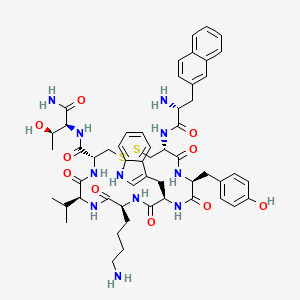
Pharmacotherapeutic group: Pituitary and hypothalamic hormones and analogues, somatostatin and analogues, ATC code: H01C B03
Lanreotide is an octapeptide analogue of natural somatostatin. Like somatostatin, lanreotide is an inhibitor of various endocrine, neuroendocrine, exocrine and paracrine functions. Lanreotide has a high affinity for human somatostatin receptors (SSTR) 2 and 5, and a reduced binding affinity for human SSTR 1, 3 and 4. Activity at human SSTR 2 and 5 is the primary mechanism considered to be responsible for GH inhibition. Lanreotide is more active than natural somatostatin and shows a longer duration of action.
Lanreotide, like somatostatin, exhibits a general exocrine anti-secretory action. It inhibits the basal secretion of motilin, gastric inhibitory peptide and pancreatic polypeptide, but has no significant effect on fasting secretin or gastrin secretion. Additionally, it decreases the levels of plasma chromogranin A and urinary 5-HIAA (5 Hydroxyindolacetic acid) in patients with GEP-NETs and elevated levels of these tumour markers. Lanreotide markedly inhibits meal-induced increases in superior mesenteric artery blood flow and portal venous blood flow. Lanreotide significantly reduces prostaglandin E1-stimulated jejunal secretion of water, sodium, potassium and chloride. Lanreotide reduces prolactin levels in patients with acromegaly patients treated long term.
In an open-label study, lanreotide 120mg was administered every 28 days for 48 weeks in 90 previously untreated acromegalic patients diagnosed with pituitary macroadenoma. Patients expected to require pituitary surgery or radiotherapy during the study period were excluded.
At week 48, a reduction in tumour volume of ≥ 20% (which was the primary efficacy endpoint) was observed in 63% of the patients, although statistical significance was not reached (95% CI: 52%-73%). A less than 20% reduction was obtained in 24 patients (27%) and an increase in tumour volume was observed in 9 patients (10%). The mean percentage reduction of tumour volume was 26.8%, GH levels were below 2.5 µg/L in 77.8% of the patients and IGF-1 levels normalised in 50%. Normalised IGF-1 levels combined with GH levels below 2.5 µg/L were observed in 43.5% of the patients. Patients reported a clear relief of acromegaly symptoms such as fatigue (56.5%), excess perspiration (66.1%), arthralgia (59.7%) and soft tissue swelling (66.1%). Less patients had relief of headache (38.7 %)..A reduction in tumour volume and concentrations of GH and IGF-1 was shown from week 12 and was maintained for 48weeks)..
During an open-label, controlled study involving patients with acromegaly treated with a stable dose of Lanreotide for at least 4 months, 93% of the patients who received self or partner administered injections of Lanreotide after appropriate training were considered competent to perform unsupervised injections (maintenance of GH and IGF-1 levels).
A phase III, 96-week, fixed duration, randomized, double-blind, multi-centre, placebo-controlled trial of lanreotide was conducted in patients with gastroenteropancreatic neuroendocrine tumours to assess the antiproliferative effect of lanreotide.
Patients were randomized 1:1 to receive either lanreotide 120 mg every 28 days (n=101) or placebo (n=103). Randomization was stratified by previous therapy at entry and the presence/absence of progression at baseline as assessed by RECIST 1.0 (Response Evaluation Criteria in Solid Tumours) during a 3 to 6 month screening phase.
Patients had metastatic and /or locally advanced inoperable disease with histologically confirmed well or moderately well differentiated tumours primarily localized in the pancreas (44.6% patients), midgut (35.8%), hindgut (6.9%) or of other/unknown primary location (12.7%).
69% of patients with GEP-NETs had tumour grade 1 (G1), defined by either a proliferation index Ki67 ≤ 2% (50.5% of the overall patient population) or a mitotic index < 2 mitosis/10 HPF (18.5% of the overall patient population) and 30% of patients with GEP-NETs had tumours in the lower range of grade 2 (G2) (defined by a Ki67 index > 2% - ≤ 10%). Grade was not available in 1% of the patients. The study excluded patients with G2 GEP-NETs with a higher cellular proliferation index (Ki 67 >10% - ≤ 20%) and G3 GEP neuroendocrine carcinomas (Ki 67 index > 20%).
Overall, 52.5% of the patients had a hepatic tumour load ≤10%, 14.5% had a hepatic tumour load > 10 and ≤25% and 33% had a hepatic tumour load >25%.
The primary endpoint was progression-free survival (PFS) measured as time to either disease progression by RECIST 1.0 or death within 96 weeks after first treatment administration. Analysis of PFS utilized independent centrally-reviewed radiological assessment of progression.
Table 1: Efficacy results of the phase III study
Median Progression free survival
(weeks)
Hazard Ratio (95% CI)
Reduction in risk of progression or death
p-value
lanreotide
(n=101 )
Placebo
(n=103 )
> 96 weeks
72.00 weeks
(95% CI : 48.57, 96.00)
0.470
(0.304, 0.729)
53%
0.0002
Figure 1: Kaplan-Meier Progression Free Survival Curves
The beneficial effect of lanreotide in reducing the risk of progression or death was consistent regardless of the location of primary tumour, hepatic tumour load, previous chemotherapy, baseline Ki67, tumour grade or other pre-specified characteristics as shown in Figure 2.
A clinically-relevant benefit of treatment with lanreotide was seen in patients with tumours of pancreatic, midgut and other/unknown origin as in the overall study population. The limited number of patients with hindgut tumours (14/204) contributed to difficulty in interpreting the results in this subgroup. The available data suggested no benefit of lanreotide in these patients
.
Figure 2 – Results of the Cox Proportional Hazards Covariates Analysis of PFS
Crossover from placebo to open-label lanreotide, in the extension study, occurred in 45.6% (47/103) of the patients
.
Paediatric population
The licensing authority has waived the obligation to submit the results of studies with the reference medicinal product containing lanreotide in all subsets of the paediatric population in acromegaly and pituitary gigantism (see section 4.2 for information on paediatric use). The licensing authority has listed gastroenteropancreatic neuroendocrine tumours (excluding neuroblastoma, neuroganglioblastoma, phaechromocytoma) on the list of class waivers.
⚠️ Warnings
The solution for injection in a pre-filled syringe is ready for use.
For immediate and single use following first opening. Do not use if the pouch is damaged or opened.
It is important that the injection of the product is performed exactly according to the instructions in the package leaflet.
The used injection device should be disposed of in a designated sharps container.
Any unused medicinal product or waste material should be disposed of in accordance with local requirements.