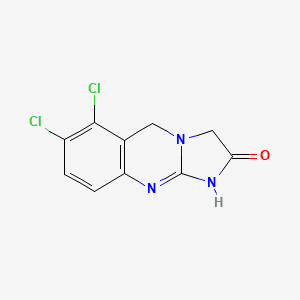
Pharmacotherapeutic group: Other antineoplastic agents, ATC Code: L01XX35.
Mechanism of action
The precise mechanism by which anagrelide reduces blood platelet count is unknown. In cell culture studies, anagrelide suppressed expression of transcription factors including GATA-1 and FOG-1 required for megakaryocytopoiesis, ultimately leading to reduced platelet production.
In vitro studies of human megakaryocytopoiesis established that anagrelide's inhibitory actions on platelet formation in man are mediated via retardation of maturation of megakaryocytes, and reducing their size and ploidy. Evidence of similar in vivo actions was observed in bone marrow biopsy samples from treated patients.
Anagrelide is an inhibitor of cyclic AMP phosphodiesterase III.
Clinical efficacy and safety
The safety and efficacy of anagrelide as a platelet lowering agent have been evaluated in four open-label, non-controlled clinical trials (study numbers 700-012, 700-014, 700-999 and 13970-301) including more than 4000 patients with myeloproliferative neoplasms (MPNs). In patients with essential thrombocythaemia complete response was defined as a decrease in platelet count to ≤600 x 109/l or a ≥50% reduction from baseline and maintenance of the reduction for at least 4 weeks. In studies 700-012, 700-014, 700-999 and study 13970-301 the time to complete response ranged from 4 to 12 weeks. Clinical benefit in terms of thrombohaemorrhagic events has not been convincingly demonstrated.
Effects on heart rate and QTc interval
The effect of two dose levels of anagrelide (0.5 mg and 2.5 mg single doses) on the heart rate and QTc interval was evaluated in a double-blind, randomised, placebo- and active-controlled, cross-over study in healthy adult men and women.
A dose-related increase in heart rate was observed during the first 12 hours, with the maximum increase occurring around the time of maximal concentrations. The maximum change in mean heart rate occurred at 2 hours after administration and was +7.8 beats per minute (bpm) for 0.5 mg and +29.1 bpm for 2.5 mg.
A transient increase in mean QTc was observed for both doses during periods of increasing heart rate and the maximum change in mean QTcF (Fridericia correction) was +5.0 msec occurring at 2 hours for 0.5 mg and +10.0 msec occurring at 1 hour for 2.5 mg.
Paediatric population
In an open-label clinical study in 8 children and 10 adolescents (including patients who were anagrelide treatment naïve or who had been receiving anagrelide for up to 5 years pre-study), median platelet counts were decreased to controlled levels after 12 weeks of treatment. The average daily dose tended to be higher in adolescents.
In a paediatric registry study, median platelet counts were reduced from diagnosis and maintained for up to 18 months in 14 paediatric patients with ET (4 children, 10 adolescents) with anagrelide treatment. In earlier, open-label studies, median platelet count reductions were observed in 7 children and 9 adolescents treated for between 3 months and 6.5 years.
The average total daily dose of anagrelide across all studies in paediatric patients with ET was highly variable, but overall the data suggest that adolescents could follow similar starting and maintenance doses to adults and that a lower starting dose of 0.5 mg/day would be more appropriate for children over 6 years (see sections 4.2, 4.4, 4.8, 5.2). In all paediatric patients, careful titration to a patient-specific daily dose is needed.
⚠️ Warnings
Any unused medicinal product or waste material should be disposed of in accordance with local requirements.