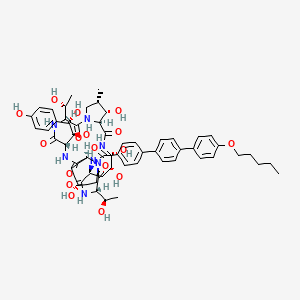
Pharmacotherapeutic group: antimycotics for systemic use, other antimycotics for systemic use, ATC code: J02AX06
Mechanism of action
Anidulafungin is a semi-synthetic echinocandin, a lipopeptide synthesised by fermentation of products of the mould Aspergillus nidulans.
Anidulafungin selectively inhibits 1,3-β-D-glucan synthase, an enzyme present in fungal cells but not in mammalian cells. This leads to inhibition of 1,3-β-D-glucan formation, an essential component of the fungal cell wall. Anidulafungin exhibits fungicidal activity against Candida species and activity against regions of active cell growth of Aspergillus fumigatus hyphae.
In vitro efficacy
Anidulafungin is active in vitro against Candida species including C. albicans, C. glabrata, C. parapsilosis, C. krusei and C. tropicalis. The clinical significance of these findings is described in the section "Clinical efficacy and safety".
Isolates with mutations in hot spot regions of the target gene have been associated with clinical treatment failure or breakthrough infections. The majority of clinical cases involved caspofungin treatment. However, in animal experiments these mutations cause cross-resistance to all three echinocandins, and therefore these isolates are classified as echinocandin-resistant until further clinical experience with anidulafungin is gained.
The in vitro efficacy of anidulafungin against Candida species is not uniform. Specifically for C. parapsilosis, anidulafungin MIC values are higher than for other Candida species. A standardised susceptibility testing procedure for Candida species against anidulafungin and the corresponding interpretive breakpoints have been established by the European Committee on Antimicrobial Susceptibility Testing (EUCAST).
Susceptibility testing breakpoints
The European Committee on Antimicrobial Susceptibility Testing (EUCAST) has established the following minimum inhibitory concentration (MIC) interpretive criteria for susceptibility testing of anidulafungin: https://www.ema.europa.eu/documents/other/minimum-inhibitory-concentration-mic-breakpoints_en.xlsx
In vivo efficacy
Parenterally administered anidulafungin was effective against Candida species in immunocompetent and immunocompromised mouse and rabbit models. Treatment with anidulafungin prolonged survival and also reduced Candida species organ burden when treatment with anidulafungin was initiated within the interval of 24 to 96 hours after the last treatment.
Experimental infections included disseminated C. albicans infection in neutropenic rabbits, oesophageal/oral infection in neutropenic rabbits with a fluconazole-resistant strain of C. albicans and disseminated infection in neutropenic mice with a fluconazole-resistant strain of C. glabrata.
Clinical efficacy and safety
Candidaemia and other forms of invasive candidiasis
The safety and efficacy of anidulafungin were evaluated in a pivotal randomised, double-blind, multicentre, multinational phase 3 study primarily in non-neutropenic patients with candidaemia and in a limited number of patients with deep-tissue Candida infection or abscess-forming infection. Patients with Candida endocarditis, osteomyelitis or meningitis, or with infection caused by C. krusei were excluded from the study. Randomised patients received anidulafungin i.v. (200 mg loading dose followed by 100 mg daily), or fluconazole i.v. (800 mg loading dose followed by 400 mg daily). Patients were stratified by APACHE II score (≤ 20 and > 20) and presence or absence of neutropenia. Treatment was administered for at least 14 days and no longer than 42 days.
Patients in both study arms could switch to oral fluconazole after at least 10 days of intravenous therapy, provided they were able to tolerate oral medicinal products, had been afebrile for at least the last 24 hours and the last blood cultures were Candida-negative.
Patients who received at least one dose of study drug and who had a positive culture for Candida species from a normally sterile site prior to study entry were included in the MITT (modified intent-to-treat) population. In the primary efficacy analysis of overall response in the MITT population at the end of intravenous therapy, anidulafungin was compared with fluconazole in a pre-specified two-step statistical comparison (non-inferiority followed by superiority). A successful overall response required clinical improvement and microbiological eradication. Patients were followed for 6 weeks after the end of treatment.
Two hundred and fifty-six patients (aged 16–91 years) were randomised and received at least one dose of study medication. The most frequently isolated species at baseline were C. albicans (63.8% anidulafungin, 59.3% fluconazole), followed by C. glabrata (15.7%; 25.4%), C. parapsilosis (10.2%; 13.6%) and C. tropicalis (11.8%; 9.3%), with 20, 13 and 15 isolates of the last 3 species in the anidulafungin group, respectively. The majority of patients had an APACHE II score of 20 or less and very few were neutropenic.
Efficacy data, overall and for subgroups, are presented in Table 3.
Table 3. Overall success in the MITT population: primary and secondary endpoints
Anidulafungin
Fluconazole
Treatment difference
a
(95% CI)
End of i.v. therapy (primary endpoint)
96/127 (75.6%)
71/118 (60.2%)
15.42 (3.9; 27.0)
Candidaemia only
88/116 (75.9%)
63/103 (61.2%)
14.7 (2.5; 26.9)
Other sterile sites
b
8/11 (72.7%)
8/15 (53.3%)
-
Peritoneal fluid/IA
c
abscess
6/8
5/8
Other
2/3
3/7
C. albicans
d
60/74 (81.1%)
38/61 (62.3%)
-
Non-albicans species
d
32/45 (71.1%)
27/45 (60.0%)
-
APACHE II score ≤ 20
82/101 (81.2%)
60/98 (61.2%)
-
APACHE II score > 20
14/26 (53.8%)
11/20 (55.0%)
-
Non-neutropenic (ANC, cells/mm
3
> 500)
94/124 (75.8%)
69/114 (60.5%)
-
Neutropenic (ANC, cells/mm
3
≤ 500)
2/3
2/4
-
Other endpoints
End of all therapy
94/127 (74.0%)
67/118 (56.8%)
17.24 (2.9; 31.6)
e
2-week follow-up
82/127 (64.6%)
58/118 (49.2%)
15.41 (0.4; 30.4)
e
6-week follow-up
71/127 (55.9%)
52/118 (44.1%)
11.84 (-3.4; 27.0)
e
a Calculated as anidulafungin minus fluconazole
b With or without concomitant candidaemia
c Intra-abdominal
d Data presented for patients with a single baseline pathogen
e
98.3% confidence intervals adjusted post hoc for multiple comparisons of secondary
endpoints
Mortality rates in both arms with anidulafungin and fluconazole are presented in Table 4.
Table 4. Mortality
Anidulafungin
Fluconazole
Overall study mortality
29/127 (22.8%)
37/118 (31.4%)
Mortality during study treatment
10/127 (7.9%)
17/118 (14.4%)
Mortality attributed to Candida infection
2/127 (1.6%)
5/118 (4.2%)
Additional data in neutropenic patients
The efficacy of anidulafungin (200 mg intravenous loading dose followed by 100 mg intravenous daily dose) in adult neutropenic patients (defined as absolute neutrophil count ≤ 500 cells/mm
3
, white blood cell count ≤ 500 cells/mm
3
or patients classified by the investigator as having neutropenia at study entry) with microbiologically confirmed invasive candidiasis was evaluated in a pooled analysis of data from 5 prospective studies (1 comparative versus caspofungin and 4 open-label, non-comparative).
Patients were treated for a minimum of 14 days. In clinically stable patients, step-down to oral azole therapy was permitted after at least 5 to 10 days of anidulafungin treatment. A total of 46 patients were included in the analysis. The majority of patients had candidaemia only (84.8%; 39/46). The most frequent pathogens isolated at baseline were C. tropicalis (34.8%; 16/46), C. krusei (19.6%; 9/46), C. parapsilosis (17.4%; 8/46), C. albicans (15.2%; 7/46) and C. glabrata (15.2%; 7/46). The rate of successful overall response at the end of intravenous therapy (primary endpoint) was 26/46 (56.5%) and at the end of all therapy was 24/46 (52.2%). All-cause mortality up to the end of the study (6-week follow-up visit) was 21/46 (45.7%).
The efficacy of anidulafungin in adult neutropenic patients (defined as absolute neutrophil count ≤ 500 cells/mm
3
at study entry) with invasive candidiasis was evaluated in a prospective, double-blind, randomised clinical trial. Eligible patients received either anidulafungin (200 mg intravenous loading dose followed by 100 mg intravenous daily dose) or caspofungin (70 mg intravenous loading dose followed by 50 mg intravenous daily dose) (2:1 randomisation). Patients were treated for a minimum of 14 days. In clinically stable patients, step-down to oral azole therapy was permitted after at least 10 days of study treatment. A total of 14 neutropenic patients with microbiologically confirmed invasive candidiasis (MITT population) were enrolled in the study (11 receiving anidulafungin, 3 caspofungin). The majority of patients had candidaemia only. The most frequent pathogens isolated at baseline were C. tropicalis (4 anidulafungin, 0 caspofungin), C. parapsilosis (2 anidulafungin, 1 caspofungin), C. krusei (2 anidulafungin, 1 caspofungin) and C. ciferrii (2 anidulafungin, 0 caspofungin). The rate of successful overall response at the end of intravenous therapy (primary endpoint) was 8/11 (72.7%) for anidulafungin and 3/3 (100.0%) for caspofungin (difference -27.3, 95% CI -80.9, 40.3). The rate of successful overall response at the end of all therapy was 8/11 (72.7%) for anidulafungin and 3/3 (100.0%) for caspofungin (difference -27.3, 95% CI -80.9, 40.3). All-cause mortality up to the 6-week follow-up visit was 4/11 (36.4%) for anidulafungin (MITT population) and 2/3 (66.7%) for caspofungin.
Patients with microbiologically confirmed invasive candidiasis (MITT population) and neutropenia were identified in a pooled analysis of data from 4 studies with a similar design in a prospective, open-label clinical trial without comparator. The efficacy of anidulafungin (200 mg intravenous loading dose followed by 100 mg intravenous daily dose) was evaluated in 35 adult neutropenic patients, defined as absolute neutrophil count ≤ 500 cells/mm
3
in 22 patients, or white blood cell count ≤ 500 cells/mm
3
in 13 patients classified by the investigator as having neutropenia at study entry. Patients were treated for a minimum of 14 days. In clinically stable patients, step-down to oral azole therapy was permitted after at least 5 to 10 days of anidulafungin treatment. The majority of patients had candidaemia only (85.7%). The most frequent pathogens isolated at baseline were C. tropicalis (12 patients), C. albicans (7 patients), C. glabrata (7 patients), C. krusei (7 patients) and C. parapsilosis (6 patients). The rate of successful overall response at the end of intravenous therapy (primary endpoint) was 18/35 (51.4%) and at the end of all therapy was 16/35 (45.7%). All-cause mortality at day 28 was 10/35 (28.6%). The rate of successful overall response at the end of intravenous therapy and at the end of all therapy was 7/13 (53.8%) in 13 patients with investigator-assessed neutropenia at study entry.
Additional data in patients with deep-tissue infections
The efficacy of anidulafungin (200 mg intravenous loading dose followed by 100 mg intravenous daily dose) in adult patients with microbiologically confirmed deep-tissue candidiasis was evaluated in a pooled analysis of data from 5 prospective studies (1 comparative and 4 open-label). Patients were treated for a minimum of 14 days. In the 4 open-label studies, step-down to oral azole therapy was permitted after at least 5 to 10 days of anidulafungin treatment. A total of 129 patients were included in the analysis. Twenty-one (16.3%) had concomitant candidaemia. The mean APACHE II score was 14.9 (range 2–44). The most frequent sites of infection included the peritoneal cavity (54.3%; 70 of 129), biliary tract (7.0%; 9 of 129), pleural cavity (5.4%; 7 of 129) and kidneys (3.1%; 4 of 129). The most frequent pathogens isolated from deep tissues at baseline included C. albicans (64.3%; 83 of 129), C. glabrata (31.0%; 40 of 129), C. tropicalis (11.6%; 15 of 129) and C. krusei (5.4%; 7 of 129). The rate of successful overall response at the end of intravenous therapy (primary endpoint) and at the end of all therapy, and all-cause mortality up to the 6-week follow-up visit are presented in Table 5.
Table 5. Rate of successful overall response
a
and all-cause mortality in patients with deep-tissue candidiasis – pooled analysis
MITT population n/N (%)
Successful overall response at EOIVT
b
Total
102/129 (79.1)
Peritoneal cavity
51/70 (72.9)
Biliary tract
7/9 (77.8)
Pleural cavity
6/7 (85.7)
Kidneys
3/4 (75.0)
Successful overall response at EOT
b
94/129 (72.9)
All-cause mortality
40/129 (31.0)
a Successful overall response was defined as clinical and microbiological treatment success.
b EOIVT, End of Intravenous Treatment; EOT, End of All Treatment
Paediatric population
In a prospective, open-label, non-comparative, multinational study, the safety and efficacy of anidulafungin were evaluated in 68 paediatric patients aged 1 month to < 18 years with invasive candidiasis including candidaemia (ICC). Patients were divided by age group (1 month to < 2 years, 2 years to < 5 years and 5 years to < 18 years) and received anidulafungin intravenously once daily (loading dose of 3.0 mg/kg on day 1 followed by a maintenance dose of 1.5 mg/kg daily) for up to 35 days, after which patients could be switched to oral fluconazole (6–12 mg/kg/day, maximum 800 mg/day). Patients were assessed at 2 and 6 weeks after EOT.
Of 68 patients who received anidulafungin, 64 patients had microbiologically confirmed Candida infection and efficacy was evaluated in the MITT (modified intent-to-treat) population. A total of 61 patients (92.2%) had a Candida pathogen isolated from blood only.
The most frequently isolated pathogens were Candida albicans (25 [39.1%] patients), Candida parapsilosis (17 [26.6%] patients) and Candida tropicalis (9 [14.1%] patients). Successful overall response was defined as successful clinical response (cure or improvement) and successful microbiological response (eradication or presumed eradication). Rates of successful overall response in the MITT population are presented in Table 6.
Table 6. Summary of successful overall response by age, MITT population
Successful overall response, n (%)
Endpoint
Overall
1 month to < 2 years
2 years to
5 years to < 18 years
Total
response
(N = 16) n (n/N, %)
< 5 years (N = 18) n (n/N, %)
(N = 30) n (n/N, %)
(N = 64) n (n/N, %)
EOIVT
successful
11 (68.8)
14 (77.8)
20 (66.7)
45 (70.3)
95% CI
(41.3; 89.0)
(52.4; 93.6)
(47.2; 82.7)
(57.6; 81.1)
EOT
successful
11 (68.8)
14 (77.8)
21 (70.0)
46 (71.9)
95% CI
(41.3; 89.0)
(52.4; 93.6)
(50.6; 85.3)
(59.2; 82.4)
2-week follow-up
successful
11 (68.8)
13 (72.2)
22 (73.3)
46 (71.9)
95% CI
(41.3; 89.0)
(46.5; 90.3)
(54.1; 87.7)
(59.2; 82.4)
6-week follow-up
successful
11 (68.8)
12 (66.7)
20 (66.7)
43 (67.2)
95% CI
(41.3; 89.0)
(41.0; 86.7)
(47.2; 82.7)
(54.3; 78.4)
95% CI = confidence interval for binomial distribution parameter using the Clopper-Pearson method; EOIVT = End of Intravenous Treatment; EOT = End of All Treatment; FU = follow-up; MITT = modified intent-to-treat; N = number of subjects in the population; n = number of subjects responding to treatment
⚠️ Warnings
Anidulafungin Accord has not been studied in patients with Candida endocarditis, osteomyelitis or meningitis.
The efficacy of Anidulafungin Accord has been evaluated in only a limited number of neutropenic patients (see section 5.1).
Paediatric population
Treatment with ECALTA is not recommended in neonates (< 1 month). When treating neonates, therapy for disseminated candidiasis involving the central nervous system (CNS) must be taken into consideration.
Non-clinical models of infection indicate that higher doses of anidulafungin are needed for adequate CNS penetration (see section 5.3), which leads to higher doses of the excipient polysorbate 80. According to the literature, high doses of polysorbates are associated with potentially life-threatening toxicity in neonates.
There are no clinical data supporting the efficacy and safety of anidulafungin doses higher than those recommended in section 4.2.
Effects on the liver
Elevated liver enzymes have been observed in healthy volunteers and patients treated with anidulafungin. Clinically significant abnormalities in liver function tests occurred in some patients with serious underlying medical conditions who were receiving multiple concomitant medications alongside anidulafungin. Cases of significant hepatic dysfunction, hepatitis and hepatic failure were uncommon in clinical studies. Patients who develop elevated liver enzymes during anidulafungin therapy should be carefully monitored for signs of worsening hepatic function and the benefit/risk of continuing anidulafungin therapy should be evaluated.
Anaphylactic reactions
Anaphylactic reactions, including shock, have been reported with the use of anidulafungin. If such reactions occur, anidulafungin should be discontinued and appropriate treatment administered.
Infusion-related reactions
Infusion-related reactions have been reported with anidulafungin treatment, including rash, urticaria, flushing, pruritus, dyspnoea, bronchospasm and hypotension. Infusion-related reactions are infrequent when the rate of infusion of anidulafungin does not exceed 1.1 mg/min.
Exacerbation of infusion-related reactions concomitant with administration of anaesthetics was observed in a non-clinical study in rats (see section 5.3). The clinical significance of this finding is unknown. However, caution should be exercised when anidulafungin is co-administered with anaesthetics.
Fructose content
Anidulafungin Accord contains fructose.
This medicinal product must not be given to patients with hereditary fructose intolerance unless strictly necessary.
In infants and young children (below 2 years of age), hereditary fructose intolerance (HFI) may not yet be diagnosed. Intravenously administered medicinal products (containing fructose) may be life-threatening and must be contraindicated in this population, except in cases where there is an overwhelming clinical need and no alternatives are available.
A detailed history with regard to symptoms of HFI must be obtained for each patient before administration of this medicinal product.
Sodium content
Anidulafungin Accord contains less than 1 mmol sodium (23 mg) per vial. Patients on a controlled sodium diet may be informed that this medicinal product is essentially "sodium-free".
Anidulafungin Accord may be diluted with sodium-containing solutions (see section 6.6); this should be taken into account in relation to the total sodium content from all sources that will be administered to the patient.