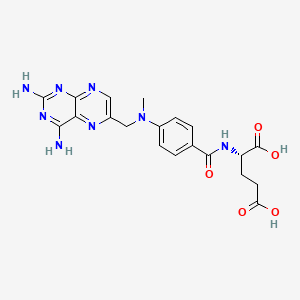
Pharmacotherapeutic group: Antineoplastic and immunomodulating agents, immunosuppressants, other immunosuppressants, ATC code: L04AX03
Mechanism of action
Methotrexate is a folic acid antagonist that, as an antimetabolite, belongs to the class of cytotoxic active substances. It acts by competitive inhibition of the enzyme dihydrofolate reductase and thus inhibits DNA synthesis.
It has not yet been possible to date to clarify whether the efficacy of methotrexate in the management of psoriasis, psoriatic arthritis and chronic polyarthritis is due either to an anti-inflammatory or immunosuppressive effect, or to what extent a methotrexate-induced increase in extracellular adenosine concentration at inflamed sites contributes to this effect.
Highly proliferating tissue such as malignant cells, bone marrow, foetal cells, skin epithelium and mucosa is generally more sensitive to this effect of methotrexate. Cell proliferation is usually greater in malignant tumours than in normal tissue and methotrexate can therefore exert a sustained effect on malignant growth without causing irreversible damage to normal tissue.
In psoriasis, cell proliferation of the epithelium is markedly increased compared with normal skin. This difference in cell proliferation rate is the starting point for the use of methotrexate in particularly severe, generalised, treatment-resistant psoriasis and psoriatic arthritis.
⚠️ Warnings
Safe handling
Anyone handling methotrexate should wash their hands before and after administering a dose. To decrease the risk of exposure, parents and care givers should wear disposable gloves when handling methotrexate.
Contact with the skin or mucous membrane must be avoided. If methotrexate comes into contact with skin or mucosa, it should be washed immediately and thoroughly with soap and water.
Spillages must be wiped immediately.
Women who are pregnant, planning to be or breast-feeding should not handle methotrexate.
Parents, care givers and patients should be advised to keep methotrexate out of the reach of children, preferably in a locked cupboard.
Accidental ingestion can be lethal for children.
Keep the bottle tightly closed to protect the integrity of the product and minimise the risk of accidental spillage.
The usual caution should be exercised in handling cytostatics.
Instructions for use of the syringe provided in the pack
1. Put on disposable gloves before handling.
2. Shake the bottle.
3. Remove the bottle cap and push the adaptor firmly into the top of the bottle.
4. Push the tip of the dosing syringe into the hole in the adaptor.
5. Turn the bottle upside down.
6. Pull the syringe plunger back SLOWLY so that the medicine is drawn from the bottle into the syringe until the
WIDEST part of the white syringe plunger
is lined up to the black syringe marking of the dose required.
DO NOT measure to the narrow tip of the plunger
. If there are air bubbles in the syringe, repeat until bubbles are eliminated.
7. Turn the bottle back the right way up and carefully remove the syringe from the adaptor, holding the syringe by the barrel rather than the plunger.
8. Confirm that the dose in the syringe is correct.
9. Ensure that the patient is sitting up or standing before giving the medicine.
10 Gently place the tip of the syringe into the patient's mouth and direct it to the inside of the cheek.
11. Slowly and gently push the plunger down to gently squirt the medicine into the inside of the cheek. DO NOT push down the plunger too hard or squirt the medicine to the back of the mouth or throat as this may cause choking. The plunger should be pushed back gently to the seated position until it clicks into place.
12. Remove the syringe from the patient's mouth.
13. Ask the patient to swallow the medicine and then to drink some water, making sure no medicine is left in the mouth.
14. Put the cap back on the bottle with the adaptor left in place. Ensure that the cap is tightly closed.
15. Wash the syringe immediately after use with fresh warm, soapy water and rinse well. The syringe should be held under water and the plunger drawn in and out several times until all traces of medicine are removed from inside the syringe including the tip. The plunger and barrel should then be separated and both washed thoroughly in the warm soapy water. They should then be rinsed thoroughly under COLD water and excess water shaken off before wiping dry with a clean paper towel. The plunger and barrel should be stored in a clean dry container with the medicine and reassembled before next use. All parts of the syringe should be completely dry before using it for the next dose.
Any unused medicinal product or waste material should be disposed of in accordance with local requirements for cytotoxic products.