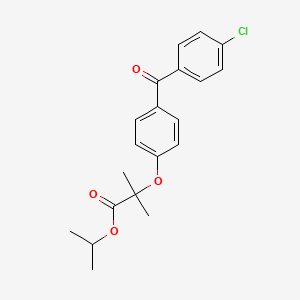
Serum Lipid Reducing Agents / Cholesterol and Triglycerides Reducers / Fibrates.
ATC code: C10 AB 05
Fenofibrate is a fibric acid derivative whose lipid modifying effects reported in humans are mediated via activation of Peroxisome Proliferator Activated Receptor type alpha (PPARα).
Through activation of PPARα, fenofibrate increases the lipolysis and elimination of atherogenic triglyceride-rich particles from plasma by activating lipoprotein lipase and reducing production of apoprotein CIII. Activation of PPARα also induces an increase in the synthesis of apoproteins AI and AII.
The above stated effects of fenofibrate on lipoproteins lead to a reduction in very low- and low density fractions (VLDL and LDL) containing apoprotein B and an increase in the high density lipoprotein fraction (HDL) containing apoprotein AI and AII.
In addition, through modulation of the synthesis and the catabolism of VLDL fractions fenofibrate increases the LDL clearance and reduces small dense LDL, the levels of which are elevated in the atherogenic lipoprotein phenotype, a common disorder in patients at risk for coronary heart disease.
During clinical trials with fenofibrate, total cholesterol was reduced by 20 to 25%, triglycerides by 40 to 55% and HDL cholesterol was increased by 10 to 30%.
In hypercholesterolaemic patients, where LDL cholesterol levels are reduced by 20 to 35%, the overall effect on cholesterol results in a decrease in the ratios of total cholesterol to HDL cholesterol, LDL cholesterol to HDL cholesterol, or Apo B to Apo AI, all of which are markers of atherogenic risk.
Because of its significant effect on LDL cholesterol and triglycerides, treatment with fenofibrate should be beneficial in hypercholesterolaemic patients with or without hypertriglyceridaemia, including secondary hyperlipoproteinaemia such as type 2 diabetes mellitus.
At the present time, no results of long-term controlled clinical trials are available to demonstrate the efficacy of fenofibrate in the primary or secondary prevention of atherosclerotic complications.
Extravascular deposits of cholesterol (tendinous and tuberous xanthoma) may be markedly reduced or even entirely eliminated during fenofibrate therapy.
Patients with raised levels of fibrinogen treated with fenofibrate have shown significant reductions in this parameter, as have those with raised levels of Lp (a). Other inflammatory markers such as C Reactive Protein are reduced with fenofibrate treatment.
The uricosuric effect of fenofibrate leading to reduction in uric acid levels of approximately 25% should be of additional benefit in those dyslipidaemic patients with hyperuricaemia.
Fenofibrate has been shown to possess an anti-aggregatory effect on platelets in animals and in a clinical study, which showed a reduction in platelet aggregation induced by ADP, arachidonic acid and epinephrine.
There is evidence that treatment with fibrates may reduce coronary heart disease events but they have not been shown to decrease all cause mortality in the primary or secondary prevention of cardiovascular disease.
The Action to Control Cardiovascular Risk in Diabetes (ACCORD) lipid trial was a randomized placebo-controlled study of 5518 patients with type 2 diabetes mellitus treated with fenofibrate in addition to simvastatin. Fenofibrate plus simvastatin therapy did not show any significant differences compared to simvastatin monotherapy in the composite primary outcome of non-fatal myocardial infarction, non-fatal stroke, and cardiovascular death (hazard ratio [HR] 0.92, 95% CI 0.79-1.08, p = 0.32 ; absolute risk reduction: 0.74%). In the pre-specified subgroup of dyslipidaemic patients, defined as those in the lowest tertile of HDL-C (≤34 mg/dl or 0.88 mmol/L) and highest tertile of TG (≥204 mg/dl or 2.3 mmol/L) at baseline, fenofibrate plus simvastatin therapy demonstrated a 31% relative reduction compared to simvastatin monotherapy for the composite primary outcome (hazard ratio [HR] 0.69, 95% CI 0.49-0.97, p = 0.03 ; absolute risk reduction: 4.95%). Another prespecified subgroup analysis identified a statistically significant treatment-by-gender interaction (p = 0.01) indicating a possible treatment benefit of combination therapy in men (p=0.037) but a potentially higher risk for the primary outcome in women treated with combination therapy compared to simvastatin monotherapy (p=0.069). This was not observed in the aforementioned subgroup of patients with dyslipidaemia but there was also no clear evidence of benefit in dyslipidaemic women treated with fenofibrate plus simvastatin, and a possible harmful effect in this subgroup could not be excluded.