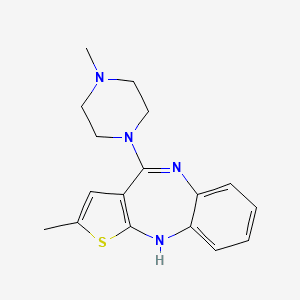
Pharmacotherapeutic group: psycholeptics, diazepines, oxazepines, thiazepines and oxepines, ATC code: N05AH03.
Pharmacodynamic effects
Olanzapine is an antipsychotic, antimanic and mood stabilising agent that demonstrates a broad pharmacologic profile across a number of receptor systems.
In preclinical studies, olanzapine exhibited a range of receptor affinities (Ki < 100 nM) for serotonin 5 HT
2A/2C
, 5 HT
3
, 5 HT
6
; dopamine D
1
, D
2
, D
3
, D
4
, D
5
; cholinergic muscarinic receptors M
1
-M
5
; α
1
adrenergic; and histamine H
1
receptors. Animal behavioural studies with olanzapine indicated 5HT, dopamine, and cholinergic antagonism, consistent with the receptor-binding profile. Olanzapine demonstrated a greater
in vitro
affinity for serotonin 5 HT
2
than dopamine D
2
receptors and greater 5 HT
2
than D
2
activity
in vivo,
models. Electrophysiological studies demonstrated that olanzapine selectively reduced the firing of mesolimbic (A10) dopaminergic neurons, while having little effect on the striatal (A9) pathways involved in motor function. Olanzapine reduced a conditioned avoidance response, a test indicative of antipsychotic activity, at doses below those producing catalepsy, an effect indicative of motor side-effects. Unlike some other antipsychotic agents, olanzapine increases responding in an “anxiolytic” test.
In a single oral dose (10 mg) Positron Emission Tomography (PET) study in healthy volunteers, olanzapine produced a higher 5 HT
2A
than dopamine D
2
receptor occupancy. In addition, a Single Photon Emission Computed Tomography (SPECT) imaging study in schizophrenic patients revealed that olanzapine-responsive patients had lower striatal D
2
occupancy than some other antipsychotic- and risperidone-responsive patients, while being comparable to clozapine-responsive patients.
Clinical efficacy
In two of two placebo and two of three comparator controlled trials with over 2,900 schizophrenic patients presenting with both positive and negative symptoms, olanzapine was associated with statistically significantly greater improvements in negative as well as positive symptoms.
In a multinational, double-blind, comparative study of schizophrenia, schizoaffective, and related disorders which included 1,481 patients with varying degrees of associated depressive symptoms (baseline mean of 16.6 on the Montgomery-Asberg Depression Rating Scale), a prospective secondary analysis of baseline to endpoint mood score change demonstrated a statistically significant improvement (p=0.001) favouring olanzapine (-6.0) versus haloperidol (-3.1).
In patients with a manic or mixed episode of bipolar disorder, olanzapine demonstrated superior efficacy to placebo and valproate semisodium (divalproex) in reduction of manic symptoms over 3 weeks. Olanzapine also demonstrated comparable efficacy results to haloperidol in terms of the proportion of patients in symptomatic remission from mania and depression at 6 and 12 weeks. In a co-therapy study of patients treated with lithium or valproate for a minimum of 2 weeks, the addition of olanzapine 10 mg (co-therapy with lithium or valproate) resulted in a greater reduction in symptoms of mania than lithium or valproate monotherapy after 6 weeks.
In a 12-month recurrence prevention study in manic episode patients who achieved remission on olanzapine and were then randomised to olanzapine or placebo, olanzapine demonstrated statistically significant superiority over placebo on the primary endpoint of bipolar recurrence. Olanzapine also showed a statistically significant advantage over placebo in terms of preventing either recurrence into mania or recurrence into depression.
In a second 12-month recurrence prevention study in manic episode patients who achieved remission with a combination of olanzapine and lithium and were then randomised to olanzapine or lithium alone, olanzapine was statistically non-inferior to lithium on the primary endpoint of bipolar recurrence (olanzapine 30.0%, lithium 38.3%; p=0.055).
In an 18-month co-therapy study in manic or mixed episode patients stabilised with olanzapine plus a mood stabiliser (lithium or valproate), long-term olanzapine cotherapy with lithium or valproate was not statistically significantly superior to lithium or valproate alone in delaying bipolar recurrence, defined according to syndromic (diagnostic) criteria.
Paediatric population
Controlled efficacy data in adolescents (ages 13 to 17 years) are limited to short term studies in schizophrenia (6 weeks) and mania associated with bipolar I disorder (3 weeks), involving less than 200 adolescents. Olanzapine was used as a flexible dose starting with 2.5 and ranging up to 20 mg/day. During treatment with olanzapine, adolescents gained significantly more weight compared with adults. The magnitude of changes in fasting total cholesterol, LDL cholesterol, triglycerides, and prolactin (see sections 4.4 and 4.8) were greater in adolescents than in adults. There are no controlled data on maintenance of effect or long term safety (see sections 4.4 and 4.8)
.
Information on long term safety is primarily limited to open-label, uncontrolled data.
⚠️ Warnings
Any unused product or waste material should be disposed of in accordance with local requirements.