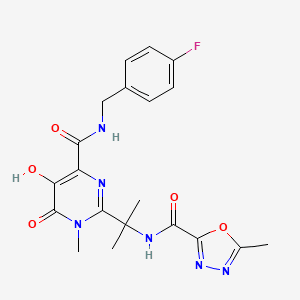
Pharmacotherapeutic group: antivirals for systemic use, integrase inhibitors, ATC code: J05AJ01.
Mechanism of action
Raltegravir is an integrase strand transfer inhibitor active against the Human Immunodeficiency Virus (HIV-1). Raltegravir inhibits the catalytic activity of integrase, an HIV-encoded enzyme that is required for viral replication. Inhibition of integrase prevents the covalent insertion, or integration, of the HIV genome into the host cell genome. HIV genomes that fail to integrate cannot direct the production of new infectious viral particles, so inhibiting integration prevents propagation of the viral infection.
Antiviral activity
in vitro
Raltegravir at concentrations of 31 ± 20 nM resulted in 95 % inhibition (IC
95
) of HIV-1 replication (relative to an untreated virus-infected culture) in human T-lymphoid cell cultures infected with the cell-line adapted HIV-1 variant H9IIIB. In addition, raltegravir inhibited viral replication in cultures of mitogen-activated human peripheral blood mononuclear cells infected with diverse, primary clinical isolates of HIV-1, including isolates from 5 non-B subtypes, and isolates resistant to reverse transcriptase inhibitors and protease inhibitors. In a single-cycle infection assay, raltegravir inhibited infection of 23 HIV isolates representing 5 non-B subtypes and 5 circulating recombinant forms with IC
50
values ranging from 5 to 12 nM.
Resistance
Most viruses isolated from patients failing raltegravir had high-level raltegravir resistance resulting from the appearance of two or more mutations in integrase. Most had a signature mutation at amino acid 155 (N155 changed to H), amino acid 148 (Q148 changed to H, K, or R), or amino acid 143 (Y143 changed to H, C, or R), along with one or more additional integrase mutations (e.g., L74M, E92Q, T97A, E138A/K, G140A/S, V151I, G163R, S230R). The signature mutations decrease viral susceptibility to raltegravir and addition of other mutations results in a further decrease in raltegravir susceptibility. Factors that reduced the likelihood of developing resistance included lower baseline viral load and use of other active anti-retroviral agents. Mutations conferring resistance to raltegravir generally also confer resistance to the integrase strand transfer inhibitor elvitegravir. Mutations at amino acid 143 confer greater resistance to raltegravir than to elvitegravir, and the E92Q mutation confers greater resistance to elvitegravir than to raltegravir. Viruses harbouring a mutation at amino acid 148, along with one or more other raltegravir resistance mutations, may also have clinically significant resistance to dolutegravir.
Clinical experience
The evidence of efficacy of raltegravir was based on the analyses of 96-week data from two randomised, double-blind, placebo-controlled trials (BENCHMRK 1 and BENCHMRK 2, Protocols 018 and 019) in antiretroviral treatment-experienced HIV-1 infected adult patients and the analysis of 240-week data from a randomised, double-blind, active-control trial (STARTMRK, Protocol 021) in antiretroviral treatment-naïve HIV-1 infected adult patients.
Efficacy
Treatment-experienced adult patients
BENCHMRK 1 and BENCHMRK 2 (multi-centre, randomised, double-blind, placebo-controlled trials) evaluated the safety and anti-retroviral activity of raltegravir 400 mg twice daily vs. placebo in a combination with optimised background therapy (OBT), in HIV-infected patients, 16 years or older, with documented resistance to at least 1 drug in each of 3 classes (NRTIs, NNRTIs, PIs) of anti-retroviral therapies. Prior to randomisation, OBT were selected by the investigator based on the patient's prior treatment history, as well as baseline genotypic and phenotypic viral resistance testing.
Patient demographics (gender, age and race) and baseline characteristics were comparable between the groups receiving raltegravir 400 mg twice daily and placebo. Patients had prior exposure to a median of 12 anti-retrovirals for a median of 10 years. A median of 4 ARTs was used in OBT.
Results 48 week and 96 week analyses
Durable outcomes (Week 48 and Week 96) for patients on the recommended dose raltegravir 400 mg twice daily from the pooled studies BENCHMRK 1 and BENCHMRK 2 are shown in Table 4.
Table 4
Efficacy Outcome at Weeks 48 and 96
BENCHMRK 1 and 2 Pooled
Parameter
48 Weeks
96 Weeks
Raltegravir 400 mg twice daily + OBT
(N = 462)
Placebo + OBT
(N = 237)
Raltegravir 400 mg twice daily + OBT
(N = 462)
Placebo + OBT
(N = 237)
Percent HIV-RNA < 400 copies/mL (95 % CI)
All patients
†
72 (68, 76)
37 (31, 44)
62 (57, 66)
28 (23, 34)
Baseline Characteristic
‡
HIV-RNA > 100,000 copies/mL
62 (53, 69)
17 (9, 27)
53 (45, 61)
15 (8, 25)
≤ 100,000 copies/mL
82 (77, 86)
49 (41, 58)
74 (69, 79)
39 (31, 47)
CD4-count ≤ 50 cells/mm
3
61 (53, 69)
21 (13, 32)
51 (42, 60)
14 (7, 24)
> 50 and ≤ 200 cells/mm
3
80 (73, 85)
44 (33, 55)
70 (62, 77)
36 (25, 48)
> 200 cells/mm
3
83 (76, 89)
51 (39, 63)
78 (70, 85)
42 (30, 55)
Sensitivity score (GSS)
§
0
52 (42, 61)
8 (3, 17)
46 (36, 56)
5 (1, 13)
1
81 (75, 87)
40 (30, 51)
76 (69, 83)
31 (22, 42)
2 and above
84 (77, 89)
65 (52, 76)
71 (63, 78)
56 (43, 69)
Percent HIV-RNA < 50 copies/mL (95 % CI)
All patients
†
62 (57, 67)
33 (27, 39)
57 (52, 62)
26 (21, 32)
Baseline Characteristic
‡
HIV-RNA > 100,000 copies/mL
48 (40, 56)
16 (8, 26)
47 (39, 55)
13 (7, 23)
≤ 100,000 copies/mL
73 (68, 78)
43 (35, 52)
70 (64, 75)
36 (28, 45)
CD4-count ≤ 50 cells/mm
3
50 (41, 58)
20 (12, 31)
50 (41, 58)
13 (6, 22)
> 50 and ≤ 200 cells/mm
3
67 (59, 74)
39 (28, 50)
65 (57, 72)
32 (22, 44)
> 200 cells/mm
3
76 (68, 83)
44 (32, 56)
71 (62, 78)
41 (29, 53)
Sensitivity score (GSS)
§
0
45 (35, 54)
3 (0, 11)
41 (32, 51)
5 (1, 13)
1
67 (59, 74)
37 (27, 48)
72 (64, 79)
28 (19, 39)
2 and above
75 (68, 82)
59 (46, 71)
65 (56, 72)
53 (40, 66)
Mean CD4 Cell Change (95 % CI), cells/mm
3
All patients
‡
109 (98, 121)
45 (32, 57)
123 (110, 137)
49 (35, 63)
Baseline Characteristic
‡
HIV-RNA > 100,000 copies/mL
126 (107, 144)
36 (17, 55)
140 (115, 165)
40 (16, 65)
≤ 100,000 copies/mL
100 (86, 115)
49 (33, 65)
114 (98, 131)
53 (36, 70)
CD4-count ≤ 50 cells/mm
3
121 (100, 142)
33 (18, 48)
130 (104, 156)
42 (17, 67)
> 50 and ≤ 200 cells/mm
3
104 (88, 119)
47 (28, 66)
123 (103, 144)
56 (34, 79)
> 200 cells/mm
3
104 (80, 129)
54 (24, 84)
117 (90, 143)
48 (23, 73)
Sensitivity score (GSS)
§
0
81 (55, 106)
11 (4, 26)
97 (70, 124)
15 (-0, 31)
1
113 (96, 130)
44 (24, 63)
132 (111, 154)
45 (24, 66)
2 and above
125 (105, 144)
76 (48, 103)
134 (108, 159)
90 (57, 123)
†
Non-completer is failure imputation: patients who discontinued prematurely are imputed as failure thereafter. Percent of patients with response and associated 95 % confidence interval (CI) are reported.
‡
For analysis by prognostic factors, virologic failures were carried forward for percent < 400 and 50 copies/mL. For mean CD4 changes, baseline-carry-forward was used for virologic failures.
§
The Genotypic Sensitivity Score (GSS) was defined as the total oral ARTs in the optimised background therapy (OBT) to which a patient's viral isolate showed genotypic sensitivity based upon genotypic resistance test. Enfuvirtide use in OBT in enfuvirtide-naïve patients was counted as one active drug in OBT. Similarly, darunavir use in OBT in darunavir-naïve patients was counted as one active drug in OBT.
Raltegravir achieved virologic responses (using Not Completer=Failure approach) of HIV RNA < 50 copies/mL in 61.7 % of patients at Week 16, in 62.1 % at Week 48 and in 57.0 % at Week 96. Some patients experienced viral rebound between Week 16 and Week 96. Factors associated with failure include high baseline viral load and OBT that did not include at least one potent active agent.
Switch to raltegravir
The SWITCHMRK 1 & 2 (Protocols 032 & 033) studies evaluated HIV-infected patients receiving suppressive (screening HIV RNA < 50 copies/mL; stable regimen > 3 months) therapy with lopinavir 200 mg (+) ritonavir 50 mg 2 tablets twice daily plus at least 2 nucleoside reverse transcriptase inhibitors and randomised them 1:1 to continue lopinavir (+) ritonavir 2 tablets twice daily (n=174 and n=178, respectively) or replace lopinavir (+) ritonavir with raltegravir 400 mg twice daily (n=174 and n=176, respectively). Patients with a prior history of virological failure were not excluded and the number of previous antiretroviral therapies was not limited.
These studies were terminated after the primary efficacy analysis at Week 24 because they failed to demonstrate non-inferiority of raltegravir versus lopinavir (+) ritonavir. In both studies at Week 24, suppression of HIV RNA to less than 50 copies/mL was maintained in 84.4 % of the raltegravir group versus 90.6 % of the lopinavir (+) ritonavir group, (Non-completers = Failure). See section 4.4 regarding the need to administer raltegravir with two other active agents.
Treatment-naïve adult patients
STARTMRK (multi-centre, randomised, double-blind, active-control trial) evaluated the safety and anti-retroviral activity of raltegravir 400 mg twice daily vs. efavirenz 600 mg at bedtime, in a combination with emtricitabine (+) tenofovir disoproxil fumarate, in treatment-naïve HIV-infected patients with HIV RNA > 5,000 copies/mL. Randomisation was stratified by screening HIV RNA level (≤ 50,000 copies/mL; and > 50,000 copies/mL) and by hepatitis B or C status (positive or negative).
Patient demographics (gender, age and race) and baseline characteristics were comparable between the group receiving raltegravir 400 mg twice daily and the group receiving efavirenz 600 mg at bedtime.
Results 48-week and 240-week analyses
With respect to the primary efficacy endpoint, the proportion of patients achieving HIV RNA < 50 copies/mL at Week 48 was 241/280 (86.1 %) in the group receiving raltegravir and 230/281 (81.9 %) in the group receiving efavirenz. The treatment difference (raltegravir – efavirenz) was 4.2 % with an associated 95 % CI of (-1.9, 10.3) establishing that raltegravir is non-inferior to efavirenz (p-value for non-inferiority < 0.001). At Week 240, the treatment difference (raltegravir – efavirenz) was 9.5 % with an associated 95 % CI of (1.7, 17.3). Week 48 and Week 240 outcomes for patients on the recommended dose of raltegravir 400 mg twice daily from STARTMRK are shown in Table 5.
Table 5
Efficacy Outcome at Weeks 48 and 240
STARTMRK Study
Parameter
48 Weeks
240 Weeks
Raltegravir 400 mg twice daily
(N = 281)
Efavirenz 600 mg at bedtime
(N = 282)
Raltegravir 400 mg twice daily
(N = 281)
Efavirenz 600 mg at bedtime
(N = 282)
Percent HIV-RNA < 50 copies/mL (95 % CI)
All patients
†
86 (81, 90)
82 (77, 86)
71 (65, 76)
61 (55, 67)
Baseline Characteristic
‡
HIV-RNA > 100,000 copies/mL
91 (85, 95)
89 (83, 94)
70 (62, 77)
65 (56, 72)
≤ 100,000 copies/mL
93 (86, 97)
89 (82, 94)
72 (64, 80)
58 (49, 66)
CD4-count ≤ 50 cells/mm
3
84 (64, 95)
86 (67, 96)
58 (37, 77)
77 (58, 90)
> 50 and ≤ 200 cells/mm
3
89 (81, 95)
86 (77, 92)
67 (57, 76)
60 (50, 69)
> 200 cells/mm
3
94 (89, 98)
92 (87, 96)
76 (68, 82)
60 (51, 68)
Viral Subtype Clade B
90 (85, 94)
89 (83, 93)
71 (65, 77)
59 (52, 65)
Non-Clade B
96 (87, 100)
91 (78, 97)
68 (54, 79)
70 (54, 82)
Mean CD4 Cell Change (95 % CI), cells/mm
3
All patients
‡
189 (174, 204)
163 (148, 178)
374 (345, 403)
312 (284, 339)
Baseline Characteristic
‡
HIV-RNA > 100,000 copies/mL
196 (174, 219)
192 (169, 214)
392 (350, 435)
329 (293, 364)
≤ 100,000 copies/mL
180 (160, 200)
134 (115, 153)
350 (312, 388)
294 (251, 337)
CD4-count ≤ 50 cells/mm
3
170 (122, 218)
152 (123, 180)
304 (209, 399)
314 (242, 386)
> 50 and ≤ 200 cells/mm
3
193 (169, 217)
175 (151, 198)
413 (360, 465)
306 (264, 348)
> 200 cells/mm
3
190 (168, 212)
157 (134, 181)
358 (321, 395)
316 (272, 359)
Viral Subtype Clade B
187 (170, 204)
164 (147, 181)
380 (346, 414)
303 (272, 333)
Non-Clade B
189 (153, 225)
156 (121, 190)
332 (275, 388)
329 (260, 398)
†
Non-completer is failure imputation: patients who discontinued prematurely are imputed as failure thereafter. Percent of patients with response and associated 95 % confidence interval (CI) are reported.
‡
For analysis by prognostic factors, virologic failures were carried forward for percent < 50 and 400 copies/mL. For mean CD4 changes, baseline-carry-forward was used for virologic failures.
Notes: The analysis is based on all available data.
Raltegravir and efavirenz were administered with emtricitabine (+) tenofovir disoproxil fumarate.
Paediatric population
Children and adolescents 2 to 18 years of age
IMPAACT P1066 is a Phase I/II open label multicenter trial to evaluate the pharmacokinetic profile, safety, tolerability, and efficacy of raltegravir in HIV infected children. This study enrolled 126 treatment experienced children and adolescents 2 to 18 years of age. Patients were stratified by age, enrolling adolescents first and then successively younger children. Patients received either the 400 mg tablet formulation (6 to 18 years of age) or the chewable tablet formulation (2 to less than 12 years of age). Raltegravir was administered with an optimised background regimen.
The initial dose finding stage included intensive pharmacokinetic evaluation. Dose selection was based upon achieving similar raltegravir plasma exposure and trough concentration as seen in adults, and acceptable short-term safety. After dose selection, additional patients were enrolled for evaluation of long-term safety, tolerability and efficacy. Of the 126 patients, 96 received the recommended dose of raltegravir (see section 4.2).
Table 6
Baseline Characteristics and Efficacy Outcomes at Weeks 24 and 48 from IMPAACT P1066
(2 to 18 years of age)
Parameter
Final dose population
N=96
Demographics
Age
(years), median [range]
13 [2 – 18]
Male Gender
49 %
Race
Caucasian
34 %
Black
59 %
Baseline Characteristics
Plasma HIV-1 RNA
(log
10
copies/mL), mean [range]
4.3 [2.7 - 6]
CD4 cell count
(cells/mm
3
), median [range]
481 [0 – 2361]
CD4 percent,
median [range]
23.3 % [0 – 44]
HIV-1 RNA >100,000 copies/mL
8 %
CDC HIV category B or C
59 %
Prior ART Use by Class
NNRTI
78 %
PI
83 %
Response
Week 24
Week 48
Achieved ≥1 log
10
HIV RNA drop from baseline or <400 copies/mL
72 %
79 %
Achieved HIV RNA <50 copies/mL
54 %
57 %
Mean CD4 cell count (%) increase from baseline
119 cells/mm
3
(3.8 %)
156 cells/mm
3
(4.6 %)
Infants and toddlers 4 weeks to less than 2 years of age
IMPAACT P1066 also enrolled HIV-infected, infants and toddlers 4 weeks to less than 2 years of age who had received prior antiretroviral therapy either as prophylaxis for prevention of mother to child transmission (PMTCT) and/or as combination antiretroviral therapy for treatment of HIV infection. Raltegravir was administered as granules for oral suspension formulation without regard to food in combination with an optimised background regimen that included lopinavir plus ritonavir in two-thirds of patients.
Table 7
Baseline Characteristics and Efficacy Outcomes at Weeks 24 and 48 from IMPAACT P1066
(4 weeks to less than 2 years of age)
Parameter
N=26
Demographics
Age
(weeks), median [range]
28 [4 -100]
Male Gender
65 %
Race
Caucasian
8 %
Black
85 %
Baseline Characteristics
Plasma HIV-1 RNA
(log
10
copies/mL), mean [range]
5.7 [3.1 - 7]
CD4 cell count
(cells/mm
3
), median [range]
1,400 [131 -3,648]
CD4 percent,
median [range]
18.6 % [3.3 – 39.3]
HIV-1 RNA >100,000 copies/mL
69 %
CDC HIV category B or C
23 %
Prior ART Use by Class
NNRTI
73 %
NRTI
46%
PI
19 %
Response
Week 24
Week 48
Achieved ≥1 log
10
HIV RNA drop from baseline or <400 copies/mL
91 %
85 %
Achieved HIV RNA <50 copies/mL
43 %
53 %
Mean CD4 cell count (%) increase from baseline
500 cells/mm
3
(7.5 %)
492 cells/mm
3
(7.8 %)
Virologic failure
Week 24
Week 48
Non-responder
0
0
Rebounder
0
4
Number with genotype available*
0
2
*One patient had a mutation at the 155 position.