This information is for educational purposes only. It is not intended as medical advice. Always consult a qualified healthcare professional.
Rx
Raxone
150 mg, Tabletki powlekane
INN: Idebenonum
Data updated: 2026-04-13
Available in:
🇨🇿🇩🇪🇬🇧🇫🇷🇵🇱🇺🇦
Form
Tabletki powlekane
Dosage
150 mg
Route
doustna
Storage
—
About This Product
User Reviews
Reviews reflect personal experiences and are not medical advice. Always consult your doctor.
Manufacturer
Chiesi Farmaceutici S.p.A. (Niemcy)
Composition
Idebenonum 150 mg
ATC Code
N06BX13
Source
URPL
Pharmacotherapeutic group: Psychoanaleptics, Other psychostimulants and nootropics;
ATC code: N06BX13
Mechanism of action
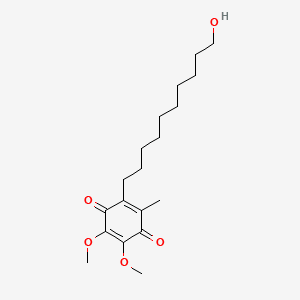
Idebenone, a short-chain benzoquinone, is an anti-oxidant assumed to be capable of transferring electrons directly to complex III of the mitochondrial electron transport chain, thereby circumventing complex I and restoring cellular energy (ATP) generation under experimental conditions of complex I deficiency. Similarly, in LHON idebenone can transfer electrons directly to complex III of the electron transport chain, thereby bypassing complex I which is affected by all three primary mtDNA mutations causing LHON, and restoring cellular ATP generation.
According to this biochemical mode of action, idebenone may re-activate viable-but-inactive retinal ganglion cells (RGCs) in LHON patients. Depending on the time since symptom onset and the proportion of RGCs already affected, idebenone can promote recovery of vision in patients who experience vision loss.
Clinical efficacy and safety
Clinical safety and efficacy of idebenone in LHON have been assessed in one double-blind, randomised, placebo-controlled study (RHODOS). Long term efficacy and safety have been studied in a post-approval open-label study (LEROS). Long term safety has been studied in a non-interventional post-authorisation safety study (PAROS).
In RHODOS a total of 85 LHON patients, 14-66 years of age, with any of the 3 primary mtDNA mutations (G11778A, G3460A or T14484C) and disease duration of not more than 5 years were enrolled. Patients received either 900 mg/day Raxone or placebo for a period of 24 weeks (6 months). Raxone was given as 3 doses of 300 mg daily, each with meals.
The primary endpoint “best recovery of visual acuity (VA)” was defined as the result from the eye experiencing the most positive improvement in VA from baseline to week 24 using ETDRS charts. The main secondary endpoint “change in best VA” was measured as the difference between best VA in either the left or right eye at 24 weeks compared to baseline (Table 1).
Table 1: RHODOS: Best recovery of VA and change in best VA from baseline to week 24
Endpoint (ITT)
Raxone (N=53)
Placebo (N=29)
Primary endpoint:
Best recovery of VA
(mean ± SE; 95%CI)
logMAR* –0.135 ± 0.041
logMAR –0.071 ± 0.053
logMAR –0.064, 3 letters (–0.184; 0.055)
p=0.291
Main secondary endpoint:
Change in best VA
(mean ± SE; 95% CI)
logMAR –0.035 ± 0.046
logMAR 0.085 ± 0.060
logMAR –0.120, 6 letters (–0.255; 0.014)
p=0.078
Analysis according to Mixed Model of Repeated Measures
One patient in the placebo group presented with ongoing spontaneous recovery of vision at baseline. Exclusion of this patient yielded similar results as in the ITT population; as could be expected, the difference between idebenone and placebo arm was slightly larger.
*logMAR - Logarithm of the
M
inimum
A
ngle of
R
esolution
A pre-specified analysis in RHODOS determined the proportion of patients with an eye with baseline VA of ≤0.5 logMAR in whom the VA deteriorated to ≥1.0 logMAR. In this small subgroup of patients (n=8), 0 of 6 patients in the idebenone group deteriorated to ≥1.0 logMAR whereas 2 of 2 patients in the placebo group showed such a deterioration.
In a single-visit observational follow-up study of RHODOS VA assessments from 58 patients obtained on average 131 weeks after discontinuation of treatment indicates that the effect of Raxone may be maintained.
A
post-hoc
responder analysis was performed in RHODOS evaluating the proportion of patients who had a clinically relevant recovery of VA from baseline in at least one eye, defined as either: (i) improvement in VA from unable to read a single letter to able to read at least 5 letters on the ETDRS chart; or (ii) improvement in VA by at least 10 letters on the ETDRS chart. Results are shown in Table 2 including supporting data from 62 LHON patients using Raxone in an Expanded Access Programme (EAP) and from 94 untreated patients in a Case Record Survey (CRS).
Table 2: Proportion of patients with clinically relevant recovery of VA after 6 months from baseline
RHODOS (ITT)
RHODOS Raxone (N=53)
RHODOS Placebo (N=29)
Responders (N, %)
16 (30.2 %)
3 (10.3 %)
EAP and CRS
EAP-Raxone (N=62)
CRS-untreated (N=94)
Responders (N, %)
19 (30.6 %)
18 (19.1 %)
In the EAP the number of responders increased with longer treatment duration, from 19 out of 62 patients (30.6%) at 6 months to 17 out of 47 patients (36.2%) at 12 months.
In LEROS; a total of 199 LHON patients were enrolled in this open – label study. Over half (112 [56.6%]) had the G11778A mutation, whereas 34 (17.2%) had the T14484C mutation and 35 (17.7%) had the G3460A mutation. The mean age at Baseline (BL) was 34.2 years. Patients received 900 mg/day Raxone for a period of 24 months. Raxone was given as 3 doses of 300 mg daily, each with meals.
The primary endpoint in LEROS was the proportion of eyes that achieved a Clinically Relevant Benefit (CRB) (that is, in which there was either a Clinically Relevant Recovery [CRR] of VA from Baseline or a Clinically Relevant Stabilization [CRS]) at Month 12 in those patients that started treatment with Raxone ≤1 year after the onset of symptoms, compared to eyes of patients from an external Natural History (NH) control group. CRB was observed in 42.3% of eyes from LEROS patients, in contrast to 20.7% eyes from NH patients. Clinically, this represents a relevant 104% relative improvement compared to spontaneous CRB that may occur in the control NH eyes. The estimated difference between treatment and control was statistically significant (p-value 0.0020) in favor of Raxone presenting an Odds Ratio (OR) of 2.286 (95% confidence limits 1.352, 3.884).
One of the secondary endpoints in LEROS was the proportion of eyes with CRB in patients treated with Raxone >1 year after the onset of symptoms, with CRR of VA from Baseline or CRS in which Baseline VA better than 1.0 logMAR was maintained at Month 12 compared to an external NH control group. CRB was observed in 50.3% eyes of LEROS patients and 38.6% eyes of NH patients. The difference between the two groups was statistically significant in favor of Raxone presenting a p-value of 0.0087 and OR [95% CI] of 1.925 [1.179, 3.173].
A total of 198 patients received treatment with Raxone and were included in the Safety Population. The mean duration of treatment in the Safety Population was 589.17 days (range: 1 – 806 days), which was equivalent to a total exposure of 319.39 person-years. A total of 154 (77.8%) of the patients undertook treatment for >12 months. A total of 149 (75.3%) patients underwent treatment at the >18-month timeframe; at the >24-month timeframe, this was 106 (53.5%). A total of 154 (77.8%) patients reported Treatment Emergent Adverse Events. The Adverse Events (AE) reported were mainly of mild or moderate severity; 13 (6.6%) patients who received Raxone treatment reported severe AEs. Forty-nine (24.7%) patients reported AEs that were considered by the Investigator to be treatment-related. Twenty-seven (13,6%) patients experienced Serious Adverse Events and ten (5.1%) had AEs that led to permanent discontinuation of study treatment. No new safety concerns have emerged in patients with LHON enrolled in the LEROS study.
PAROS was a post-authorization non-interventional safety study designed to collect longitudinal safety and effectiveness data in routine clinical settings in patients prescribed with Raxone for the treatment of LHON. This study was conducted at 26 centres in 6 European countries (Austria, France, Germany, Greece, Italy and The Netherlands).
In the long-term safety study PAROS, a total of 224 LHON patients with a median age of 32.2 years at baseline received treatments with Raxone and were included in the Safety population. Over half of the patients (52.2%) had the G11778A mutation; 17.9% had the T14484C mutation, 14.3% had the G3460A mutation, and 12.1% had other mutations. Time in treatment of these patients is displayed in the table 3 below.
Table 3: Time in treatment (Safety Population)
Time in treatment
Idebenone-naïve at baseline
Idebenone non-naïve at baseline
All
N
39
185
224
Day 1
39 (100.0%)
185 (100.0%)
224 (100.0%)
≥ 6 months
35 (89.7%)
173 (93.5%)
208 (92.9%)
≥ 12 months
30 (76.9%)
156 (84.3%)
186 (83.0%)
≥ 18 months
20 (51.3%)
118 (63.8%)
138 (61.6%)
≥ 24 months
14 (35.9%)
93 (50.3%)
107 (47.8%)
≥ 30 months
8 (20.5%)
68 (36.8%)
76 (33.9%)
≥ 36 months
8 (20.5%)
54 (29.2%)
62 (27.7%)
The mean duration of exposure is of 765.4 days (SD 432.6 days)
The long-term safety profile of Raxone in the treatment of patients with LHON was evaluated when used under conditions of routine clinical care.
A total of 130 patients (58.0% of the Safety population) reported 382 Treatment Emergent Adverse Events (TEAEs). Eleven (4.9%) patients reported severe Adverse Events (AEs). Fifty (22.3%) patients reported 82 TEAEs that were considered by the Investigator to be drug-related. Thirty-four (15.2%) patients had 39 TEAEs that led to discontinuation of Raxone treatment. Twenty-five (11.2%) patients experienced 31 serious TEAEs.
There was one death in the study, in an 81-year-old male patient who died of terminal prostate carcinoma, which was assessed by the Investigator as unrelated to Raxone.
No new safety concerns have been identified with long-term treatment with Raxone in patients with LHON when used under conditions of routine clinical care in the PAROS study. The safety profile of Raxone observed in PAROS was similar to that from a previous open-label study (the LEROS study).
Paediatric population
In clinical trials in Friedreich's Ataxia, 32 patients between the ages of 8 and 11 years and 91 patients between the ages of 12 and 17 years received idebenone at ≥ 900 mg/day for up to 42 months.
In RHODOS and the EAP in LHON, a total of 3 patients between the ages of 9 and 11 years and 27 patients between the ages of 12 and 17 years received idebenone at 900 mg/day for up to 33 months.
In PAROS, only nine patients under 14 years of age were included and received Raxone at 900 mg/day.
This medicinal product has been authorised under 'exceptional circumstances'.
This means that due to the rarity of the disease it has not been possible to obtain complete information on this medicinal product.
⚠️ Warnings
Any unused medicinal product or waste material should be disposed of in accordance with local requirements.