Reviews reflect personal experiences and are not medical advice. Always consult your doctor.
ATC Code
A02BC01
Source
OPENFDA_NDC
USDailyMed:Esomeprazole
AU:B3
A02BC05(WHO)
AU:S2(Pharmacy medicine) / S4 (Prescription Only Medicine)CA:℞-onlyUK:General sales list(GSL, OTC)US:OTC/ Rx-onlyEU:OTC
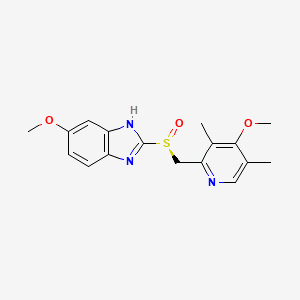
(S)-(−)-5-Methoxy-2-[(4-methoxy-3,5-dimethylpyridin-2-yl)methylsulfinyl]-3H-benzoimidazole
119141-88-7N
9579578
DB00736Y
7843323N
N3PA6559FT
D07917Yas salt:D01984Y
CHEBI:50275Y
ChEMBL1201320N
DTXSID4044292
Interactive image
COc1ccc2nc([nH]c2c1)[S@](=O)Cc1ncc(C)c(OC)c1C
InChI=1S/C17H19N3O3S/c1-10-8-18-15(11(2)16(10)23-4)9-24(21)17-19-13-6-5-12(22-3)7-14(13)20-17/h5-8H,9H2,1-4H3,(H,19,20)/t24-/m1/s1YKey:SUBDBMMJDZJVOS-XMMPIXPASA-NY
Esomeprazole, sold under the brand nameNexium(orNeksium)among others,is a medication which reducesstomach acid.It is used to treatgastroesophageal reflux disease,peptic ulcer disease, andZollinger–Ellison syndrome.Its effectiveness is similar to that of otherproton pump inhibitors(PPIs).It is taken by mouth orinjection into a vein.
Common side effects include headache, constipation, dry mouth, and abdominal pain.Serious side effects may includeangioedema,Clostridioides difficile infection, andpneumonia.Use inpregnancyappears to be safe, while safety duringbreastfeedingis unclear.Esomeprazole is the (S)-(−)-enantiomer(or less specifically the S-isomer) ofomeprazole.It works by blockingH+/K+-ATPasein theparietal cellsof the stomach.
It was patented in 1993 and approved for medical use in 2000.It is available as ageneric medicationand soldover the counterin several countries.In 2023, it was the 147th most commonly prescribed medication in the United States, with more than 3million prescriptions.In Australia, it was one of the top ten most-prescribed medications between 2017 and 2023.It is also available in lower dose formulations without a prescription in the United States,the United Kingdomas well as Australia, Canada, and New Zealand.
⚠️ Warnings
•Caution needed for children, pregnancy and breastfeeding women.
• It may cause malignancy and liver impairment.
While taking this medication, there is an increased risk of developing certain infections such as community-acquired pneumonia.