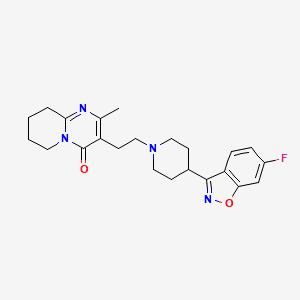
Pharmacotherapeutic group: Psycholeptics, other antipsychotics, ATC code: N05AX08.
Mechanism of action
Risperidone is a selective monoaminergic antagonist with unique properties. It has a high affinity for serotoninergic 5-HT2 and dopaminergic D2 receptors. Risperidone binds also to alpha 1-adrenergic receptors, and, with lower affinity, to H1-histaminergic and alpha 2-adrenergic receptors. Risperidone has no affinity for cholinergic receptors. Although risperidone is a potent D2 antagonist, which is considered to improve the positive symptoms of schizophrenia, it causes less depression of motor activity and induction of catalepsy than classical antipsychotics. Balanced central serotonin and dopamine antagonism may reduce extrapyramidal side effect liability and extend the therapeutic activity to the negative and affective symptoms of schizophrenia.
Pharmacodynamic effects
Clinical efficacy
The efficacy of OKEDI (75 mg and 100 mg) in the treatment of schizophrenia in adults was established in one Phase 3, multicentre, randomised, DB, placebo-controlled, parallel groups study. The study admitted patients with an acute exacerbation or relapse of schizophrenia (DSM-5 criteria), who had a baseline Positive and Negative Syndrome Scale (PANSS) score of 80-120. At the screening visit, all risperidone naïve patients received 2 mg/day oral risperidone for 3 days to ensure a lack of hypersensitivity reactions before the trial. Patients with previous history of being treated with risperidone did not receive oral risperidone at the screening and started directly with OKEDI (75 mg or 100 mg) or placebo after randomization. Four hundred and thirty-eight (438) patients were randomised to receive 3 intramuscular doses of OKEDI (75 mg or 100 mg) or placebo every 28 days. The mean age of patients was 42.0 (SD: 11.02) years. No patients < 18 years or > 65 years were included. Demographic and other baseline characteristics were similar in each treatment group. No supplemental oral risperidone was permitted during the study.
The primary endpoint was the change in PANSS total score from baseline to end of study (Day 85). Both OKEDI 75 and 100 mg doses demonstrated a statistically significant improvement compared with placebo based on the primary endpoint (
Table 1
and Figure 1). These results support efficacy across the entire duration of treatment and improvement in PANSS and was observed as early as day 4 with significant separation from placebo in the 100 mg and 75 mg groups by day 8 and 15, respectively. Similar to the PANSS Total Score, the three PANSS positive, negative and general psychopathological subscale scores also showed an improvement (decrease) from baseline over time.
Table 1: Mean change in PANSS and CGI-S total score from baseline to the end of study (day 85) (mITT Population)
Placebo N=132
OKEDI 75 mg
N=129
OKEDI 100 mg
N=129
PANSS total score
(a)
Mean baseline score (SD)
96.4 (7.21)
96.3 (8.47)
96.1 (8.42)
LS Mean Change, 95% CI
(a)
-11.0,
-14.1 to -8.0
-24.6,
-27.5 to -21.6
-24.7,
-27.7 to -21.6
Treatment Difference, 95% CI
(b)
-13.0,
-17.3 to -8.8
-13.3,
-17.6 to -8.9
P-value
< 0.0001
< 0.0001
CGI-S total score
(c)
Mean baseline score (SD)
4.9 (0.52)
5.0 (0.65)
4.9 (0.48)
LS Mean Change, 95% CI
(a)
-0.6,
-0.8 to -0.4
-1.3,
-1.5 to -1.2
-1.3,
-1.5 to -1.2
Treatment Difference, 95% CI
(b)
-0.7, -1.0 to -0.5
-0.7, -1.0 to -0.5
P-value
< 0.0001
< 0.0001
a
Data were analyzed using a mixed model repeated measures (MMRM) approach.
b
Difference (OKEDI minus placebo) in least squares mean change from baseline adjusted by Lawrence and Hung method.
c
The Clinical Global Impression – Severity (CGI-S) score asks the clinician one question: “Considering your total clinical experience with this particular population, how mentally ill is the patient at this time?” which is rated on the following seven-point scale: 1=normal, not at all ill; 2=borderline mentally ill; 3=mildly ill; 4=moderately ill; 5=markedly ill; 6=severely ill; 7=among the most extremely ill patients.
vs Placebo
OKEDI 75 mg
***
****
****
****
OKEDI 100 mg
**
****
****
****
****
** p < 0.01, *** p < 0.001, **** p < 0.0001.
Figure 1: PANSS Total Score Change from Baseline at Each Time Point in DB Phase (mITT Population)
The key secondary efficacy endpoint was defined as the mean change from baseline at Day 85 on the Clinical Global Impression – Severity (CGI-S) score. Both OKEDI treatment groups demonstrated statistically significantly better CGI-S scores versus placebo from day 8 onwards (-0.4 (0.05) and -0.6 (0.05) score reduction from baseline for 75 mg and 100 mg, respectively).
Overall Response (PANSS total score reduction > 30% and/or CGI-I of 2 “much improved“ or 1 “very much improved“) rate at endpoint for OKEDI was 56% and statistically significant from Day 8 and 15 onwards for both doses in comparison to placebo.
The long-term (12 months) efficacy of OKEDI was evaluated in an open-label extension of the main study in 215 patients with schizophrenia. The extension study was open to enrolment for patients from the DB phase (rollover patients) and stable patients not previously enrolled in the study (de novo patients). The de novo patients were switched from oral risperidone to OKEDI 75 mg or 100 mg. Efficacy was maintained over time with a relapse rate of 10.7% (95% CI, 6.9% to 15.6%) and a remittance rate of 61.0% (95% CI, 53.7% to 68.4%).
⚠️ Warnings
IMPORTANT INFORMATION
• For intramuscular use only.
• Patient should be given the injection immediately after reconstitution.
• Two administration sterile needles with safety shield are included for a deltoid or gluteus injection site. You will choose one prior to administration.
• Read the complete instructions before use. Full instructions for use and handling of OKEDI are provided in the package leaflet (See
Instructions for healthcare professionals
).
Any unused medicinal product or waste material should be disposed of in accordance with local requirements.