Reviews reflect personal experiences and are not medical advice. Always consult your doctor.
A10BB12
Source
OPENFDA_NDC
USDailyMed:Glimepiride
AU:C
A10BB12(WHO)
AU:S4(Prescription only)US:℞-onlyIn general: ℞ (Prescription only)
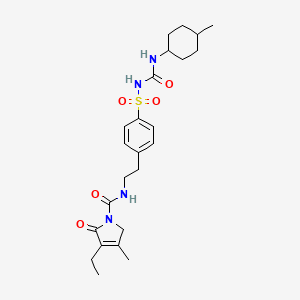
3-Ethyl-4-methyl-N-[2-(4-{[(trans-4-methylcyclohexyl)carbamoyl]sulfamoyl}phenyl)ethyl]-2-oxo-2,5-dihydro-1H-pyrrole-1-carboxamide
93479-97-1Y
3476
6820
DB00222N
16740595Y
6KY687524K
D00593Y
CHEBI:5383N
ChEMBL1481Y
DTXSID20861130 DTXSID5040675, DTXSID20861130
Interactive image
O=C3C(/CC)=C(/C)CN3C(=O)NCCc1ccc(cc1)S(=O)(=O)NC(=O)N[C@H]2CC[C@H](C)CC2
InChI=1S/C24H34N4O5S/c1-4-21-17(3)15-28(22(21)29)24(31)25-14-13-18-7-11-20(12-8-18)34(32,33)27-23(30)26-19-9-5-16(2)6-10-19/h7-8,11-12,16,19H,4-6,9-10,13-15H2,1-3H3,(H,25,31)(H2,26,27,30)/t16-,19-YKey:WIGIZIANZCJQQY-RUCARUNLSA-NY
Glimepirideis anantidiabetic medicationwithin thesulfonylureaclass, primarily prescribed for the management oftype 2 diabetes.It is regarded as a second-line option compared tometformin, due to metformin's well-established safety and efficacy.Use of glimepiride is recommended in conjunction withlifestyle modificationssuch as diet and exercise.It is taken by mouth,reaching a peak effect within three hours and lasting for about a day.
Common side effects include headache, nausea, and dizziness.Serious side effects may includelow blood sugar.Use duringpregnancyandbreastfeedingis not recommended.It works predominantly by increasing the amount ofinsulinreleased from thepancreas.It is classified as a second-generationsulfonylurea.
Glimepiride was patented in 1979 and approved for medical use in 1995.It is available as ageneric medication.In 2023, it was the 80th most commonly prescribed medication in the United States, with more than 8million prescriptions.