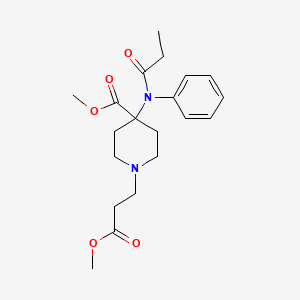
Pharmacotherapeutic group: Nervous system; anesthetics, Opioid anesthetics,
ATC code: N01AH06
Remifentanil is a selective µ-opioid agonist with a rapid onset and very short duration of action. The µ-opioid activity of remifentanil is antagonized by narcotic antagonists, such as naloxone.
Assays of histamine in patients and normal volunteers have shown no elevation in histamine levels after administration of remifentanil in bolus doses up to 30 micrograms/kg.
Neonates/infants (aged less than 1 year)
In a randomised (ratio of 2:1, remifentanil:halothane), open label, parallel group, multicentre study in 60 young infants and neonates 8 weeks of age (mean 5.5 weeks) with an ASA physical status of I-II who were undergoing pyloromyotomy, the efficacy and safety of remifentanil (given as a 0.4 µg/kg/min initial continuous infusion plus supplemental doses or infusion rate changes as needed) was compared with halothane (given at 0.4% with supplemental increases as needed). Maintenance of anaesthesia was achieved by the additional administration of 70% nitrous oxide (N20) plus 30% oxygen. Recovery times were superior in the remifentanil relative to the halothane groups (not significant).
Use for Total Intravenous anaesthesia (TIVA) - children aged 6 months to 16 years
TIVA with remifenanil in paediatric surgery was compared to inhalation anaesthesia in three randomised, open- label studies. The results are summarised in the table below.
Surgical intervention
Age (y), (N)
Study condition (maintenance)
Extubation (min)
(mean (SD))
Lower abdominal/urological surgery
0.5 – 16
(120)
TIVA: propofol (5-10 mg/kg/h) + remifentanil (0.125 – 1.0 µg/kg/min)
11.8 (4.2)
Inhalation anaesthesia: sevoflurane (1.0 – 1.5 MAC) and remifentanil (0.125 – 1.0 µg/kg/min)
15.0 (5.6)
(p<0.05)
ENT-surgery
4-11
(50)
TIVA: propofol (3 mg/kg/h) + remifentanil (0.5 µg/kg/min)
11 (3.7)
Inhalation anaesthesia: desflurane (1.3 MAC) and N
2
O mixture
9.4 (2.9)
Not significant
General or ENT surgery
2-12
(153)
TIVA: remifentanil (0.2 – 0.5 µg/kg/min) + propofol (100 – 200 µg/kg/min)
Comparable extubation times (based on limited data)
Inhalation anaesthesia: sevoflurane (1-1.5 MAC) + N
2
O mixture
In the study in lower abdominal/urological surgery comparing remifentanil/propofol with remifentanil/sevoflurane, hypotension occurred significantly more often under remifentanil/sevoflurane, and bradycardia occurred significantly more often under remifentanil/propofol. In the study in ENT surgery comparing remifentanil/propofol with desflurane/nitrous oxide, a significantly higher heart rate was seen in subjects receiving desflurane/nitrous oxide compared with remifentanil/propofol and with baseline values.
⚠️ Warnings
Remifentanil should be prepared for intravenous use by adding, as appropriate 1, 2 or 5ml of diluent to give a reconstituted solution with a concentration of approximately 1 mg/ml remifentanil.
The appearance of the solution is clear, colourless and practically free from particulate material.
After reconstitution the solution should be visually inspected on contaminations, colour or a defective container. The solution should be discarded, if any of these modifications should appear. The reconstituted solution should be used immediately. Residuals must be discarded.
Remifentanil should not be administered by manually-controlled infusion without further dilution to concentrations of 20 to 250 micrograms/ml (50 micrograms/ml is the recommended dilution for adults and 20 to 25 micrograms/ml in paediatric patients aged 1 year and over).
Remifentanil should not be administered by target-controlled infusion (TCI) without further dilution (20 to 50 micrograms/ml is the recommended dilution for TCI).
The dilution is dependent upon the technical capability of the infusion device and the anticipated requirements of the patient.
Remifentanil has been shown to be compatible with the following intravenous fluids when administered into a running IV catheter:
Water for Injections
Glucose 50 mg/ml (5%) solution for injection
Glucose 50 mg/ml (5%) and Sodium Chloride 9 mg/ml (0.9%) solution for injection
Sodium Chloride 9 mg/ml (0.9%) solution for injection
Sodium Chloride 4,5 mg/ml (0.45%) solution for injection
After dilution, the solution should be inspected visually to ensure it is clear, colourless, practically free from particulate matter and the container is undamaged. Any solution where such defects are observed must be discarded.
Remifentanil has been shown to be compatible with the following intravenous fluids when administered into a running IV catheter:
Lactated Ringer's solution for injection
Lactated Ringer's and Glucose 50 mg/ml (5%) solution for injection
Remifentanil has been shown to be compatible with propofol when administered into a running IV catheter.
The following tables give guidelines for infusion rates of remifentanil for manually-controlled infusion:
Table 1: Remifentanil – Infusion Rates (ml/kg/h)
Drug Delivery Rate (µg/kg/min)
Infusion Rate (ml/kg/h) for Solution Concentrations of
20µg/ml
1mg/50ml
25µg/ml
1mg/40ml
50µg/ml
1mg/20ml
250µg/ml
10 mg/40ml
0.0125
0.025
0.038
0.075
0.03
0.06
0.015
0.03
Not recommended
Not recommended
0.05
0.15
0.12
0.06
0.012
0.075
0.23
0.18
0.09
0.018
0.1
0.3
0.24
0.12
0.024
0.15
0.45
0.36
0.18
0.036
0.2
0.6
0.48
0.24
0.048
0.25
0.75
0.6
0.3
0.06
0.5
1.5
1.2
0.6
0.12
0.75
2.25
1.8
0.9
0.18
1.0
3.0
2.4
1.2
0.24
1.25
3.75
3.0
1.5
0.3
1.5
4.5
3.6
1.8
0.36
1.75
5.25
4.2
2.1
0.42
2.0
6.0
4.8
2.4
0.48
Table 2: Remifentanil - Infusion Rates (ml/h) for a 20µg/ml Solution
Infusion Rate
(µg/kg/min)
Patient Weight (kg)
5
10
20
30
40
50
60
0.0125
0.188
0.375
0.75
1.125
1.5
1.875
2.25
0.025
0.375
0.75
1.5
2.25
3.0
3.75
4.5
0.05
0.75
1.5
3.0
4.5
6.0
7.5
9.0
0.075
1.125
2.25
4.5
6.75
9.0
11.25
13.5
0.1
1.5
3.0
6.0
9.0
12.0
15.0
18.0
0.15
2.25
4.5
9.0
13.5
18.0
22.5
27.0
0.2
3.0
6.0
12.0
18.0
24.0
30.0
36.0
0.25
3.75
7.5
15.0
22.5
30.0
37.5
45.0
0.3
4.5
9.0
18.0
27.0
36.0
45.0
54.0
0.35
5.25
10.5
21.0
31.5
42.0
52.5
63.0
0.4
6.0
12.0
24.0
36.0
48.0
60.0
72.0
Table 3: Remifentanil – Infusion Rates (ml/h) for a 25 µg/ml Solution
Infusion Rate
(µg/kg/min)
Patient Weight (kg)
10
20
30
40
50
60
70
80
90
100
0.0125
0.3
0.6
0.9
1.2
1.5
1.8
2.1
2.4
2.7
3.0
0.025
0.6
1.2
1.8
2.4
3.0
3.6
4.2
4.8
5.4
6.0
0.05
1.2
2.4
3.6
4.8
6.0
7.2
8.4
9.6
10.8
12.0
0.075
1.8
3.6
5.4
7.2
9.0
10.8
12.6
14.4
16.2
18.0
0.1
2.4
4.8
7.2
9.6
12.0
14.4
16.8
19.2
21.6
24.0
0.15
3.6
7.2
10.8
14.4
18.0
21.6
25.2
28.8
32.4
36.0
0.2
4.8
9.6
14.4
19.2
24.0
28.8
33.6
38.4
43.2
48.0
Table 4: Remifentanil – Infusion Rates (ml/h) for a 50 µg/ml Solution
Infusion Rate
(µg/kg/min)
Patient Weight (kg)
30
40
50
60
70
80
90
100
0.025
0.9
1.2
1.5
1.8
2.1
2.4
2.7
3.0
0.05
1.8
2.4
3.0
3.6
4.2
4.8
5.4
6.0
0.075
2.7
3.6
4.5
5.4
6.3
7.2
8.1
9.0
0.1
3.6
4.8
6.0
7.2
8.4
9.6
10.8
12.0
0.15
5.4
7.2
9.0
10.8
12.6
14.4
16.2
18.0
0.2
7.2
9.6
12.0
14.4
16.8
19.2
21.6
24.0
0.25
9.0
12.0
15.0
18.0
21.0
24.0
27.0
30.0
0.5
18.0
24.0
30.0
36.0
42.0
48.0
54.0
60.0
0.75
27.0
36.0
45.0
54.0
63.0
72.0
81.0
90.0
1.0
36.0
48.0
60.0
72.0
84.0
96.0
108.0
120.0
1.25
45.0
60.0
75.0
90.0
105.0
120.0
135.0
150.0
1.5
54.0
72.0
90.0
108.0
126.0
144.0
162.0
180.0
1.75
63.0
84.0
105.0
126.0
147.0
168.0
189.0
210.0
2.0
72.0
96.0
120.0
144.0
168.0
192.0
216.0
240.0
Table 5: Remifentanil - Infusion Rates (ml/h) for a 250 µg/ml Solution
Infusion Rate
(µg/kg/min)
Patient Weight (kg)
30
40
50
60
70
80
90
100
0.1
0.72
0.96
1.20
1.44
1.68
1.92
2.16
2.40
0.15
1.08
1.44
1.80
2.16
2.52
2.88
3.24
3.60
0.2
1.44
1.92
2.40
2.88
3.36
3.84
4.32
4.80
0.25
1.80
2.40
3.00
3.60
4.20
4.80
5.40
6.00
0.5
3.60
4.80
6.00
7.20
8.40
9.60
10.80
12.00
0.75
5.40
7.20
9.00
10.80
12.60
14.40
16.20
18.00
1.0
7.20
9.60
12.00
14.40
16.80
19.20
21.60
24.00
1.25
9.00
12.00
15.00
18.00
21.00
24.00
27.00
30.00
1.5
10.80
14.40
18.00
21.60
25.20
28.80
32.40
36.00
1.75
12.60
16.80
21.00
25.20
29.40
33.60
37.80
42.00
2.0
14.40
19.20
24.00
28.80
33.60
38.40
43.20
48.00
The following table provides the equivalent blood remifentanil concentration using a TCI approach for various manually-controlled infusion rates at steady state:
Table 6: Remifentanil Blood Concentrations (nanograms/ml) estimated using the Minto (1997) Pharmacokinetic Model in a 70 kg, 170 cm, 40 Year Old Male Patient for Various Manually-Controlled Infusion rates (micrograms/kg/min) at Steady State.
Remifentanil Infusion Rate
(micrograms/kg/min)
Remifentanil Blood Concentration
(nanograms/ml)
0.05
1.3
0.10
2.6
0.25
6.3
0.40
10.4
0.50
12.6
1.0
25.2
2.0
50.5