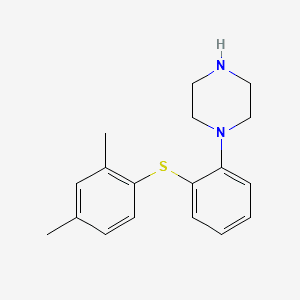
The mechanism of action of vortioxetine is thought to be related to its direct modulation of serotonergic receptor activity and inhibition of the serotonin (5-HT) transporter.
Non-clinical data indicate that vortioxetine is an antagonist of the 5-HT3, 5-HT7 and 5-HT1D receptors, a partial agonist of the 5-HT1B receptor, an agonist of the 5-HT1A receptor and an inhibitor of the 5-HT transporter, leading to modulation of neurotransmission in several systems, including predominantly the serotonin system, but probably also the norepinephrine, dopamine, histamine, acetylcholine, GABA and glutamate systems.
This multimodal activity is considered responsible for the antidepressant and anxiolytic-like effects and the improvement in cognitive function, learning and memory observed with vortioxetine in animal studies.
However, the exact contribution of individual targets to the observed pharmacodynamic profile remains unclear and caution should be exercised when extrapolating animal data directly to humans.
In humans, two positron emission tomography (PET) studies were conducted using 5-HT transporter ligands (11C-MADAM or 11C-DASB) to quantify 5-HT transporter occupancy in the brain across different dose levels. Mean 5-HT transporter occupancy in the raphe nuclei was approximately 50% at 5 mg/day, 65% at 10 mg/day and increased to more than 80% at 20 mg/day.
⚠️ Warnings
Pregnancy
Pregnancy:
This medicine should not be used during pregnancy unless the clinical condition of the woman requires treatment with vortioxetine.
Driving
Driving:
Patients should exercise caution when driving or operating dangerous machinery, especially when starting treatment with vortioxetine or when changing the dose.
Breast-feeding
Breast-feeding:
A decision must be made whether to discontinue breast-feeding or to discontinue/abstain from therapy with this medicine, taking into account the benefit of breast-feeding for the child and the benefit of therapy for the woman.
Talk to your doctor or pharmacist before taking this medicine if:
- you are taking medicines with so-called serotonergic effect, such as:
- tramadol (a strong painkiller)
- sumatriptan and similar medicines whose active substance names end in "triptans" (used to treat migraine).
Taking these medicines together with vortioxetine may increase the risk of serotonin syndrome. This syndrome may be associated with hallucinations, involuntary sudden muscle contraction, rapid heart rate, high blood pressure, fever, nausea and diarrhoea.
- you have had seizures (convulsions).
Your doctor will treat you with caution if you have a history of seizures or if you have unstable seizure disorders/epilepsy. Seizures are a potential risk associated with medicines used to treat depression. Treatment should be discontinued in any patient who develops seizures or where there is an increase in seizure frequency.
- you have had mania
- you have a tendency to bleed or bruise easily.
- you have a low level of sodium in your blood.
- you are 65 years of age or older.
- you have severe kidney disease.
- you have severe liver disease or a liver disease called cirrhosis.
Suicidal thoughts and worsening of your depression
If you are depressed and/or have anxiety disorders you may sometimes think about self-harm or suicide.
These thoughts may increase at the beginning of treatment with antidepressants, since these medicines need time to work, usually about two weeks but sometimes longer.
You may be more likely to have such thoughts if:
- you have a history of suicidal thoughts or self-harm.
- you are a young adult.
Information from clinical studies has shown an increased risk of suicidal behaviour in adults under 25 years of age with psychiatric disorders who were treated with an antidepressant.
If at any time you have thoughts of self-harm or suicide, contact your doctor or go to the hospital immediately. You may find it helpful to tell a close relative or friend that you are depressed or have anxiety disorders.
This medicine is not recommended in children and adolescents under 18 years of age due to lack of information in this age group.