This information is for educational purposes only. It is not intended as medical advice. Always consult a qualified healthcare professional.
Ammonia N 13 — Description, Dosage, Side Effects | PillsCard
OTC
Ammonia N 13
30mCi-300mCi/8ML (3.75-37.5mCi/ML), Injectable
INN: AMMONIA N-13
Data updated: 2026-05-02
Available in:
🇩🇪🇬🇧🇫🇷
Form
INJECTABLE
Dosage
30mCi-300mCi/8ML (3.75-37.5mCi/ML)
Route
INTRAVENOUS
Storage
Store at 25°C (77°F); excursions permitted to 15-30°C (59-86°F). Use the solution within 45 minutes of the End of Synthesis (EOS) calibration.
About This Product
User Reviews
Reviews reflect personal experiences and are not medical advice. Always consult your doctor.
Manufacturer
UCSF RADIOPHARMACEUTICAL FACILITY
Source
FDA_OB · 204496
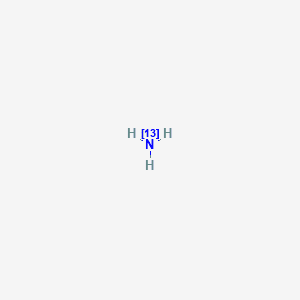
11 DESCRIPTION 11.1 Chemical Characteristics Ammonia N 13 Injection is a positron emitting radiopharmaceutical that is used for diagnostic purposes in conjunction with positron emission tomography (PET) imaging. The active ingredient, [ 13 N] ammonia, has the molecular formula of 13 NH 3 with a molecular weight of 16.02, and has the following chemical structure: Ammonia N 13 Injection is provided as a ready to use sterile, pyrogen-free, clear and colorless solution. Each mL of the solution contains between 0.138 GBq to 1.387 GBq (3.75 mCi to 37.5mCi) of [ 13 N] ammonia, at the end of synthesis (EOS) reference time, in 0.9% aqueous sodium chloride. The pH of the solution is between 4.5 to 7.5. The recommended dose of radioactivity (10-20 mCi) is associated with a theoretical mass dose of 0.5-1.0 picomoles (8.47-16.94 picograms) of ammonia. 11.2 Physical Characteristics Nitrogen N13 decays by emitting positron to Carbon C13 (stable) and has a physical half-life of 9.96 minutes. The principal photons useful for imaging are the dual 511 keV gamma photons that are produced and emitted simultaneously in opposite direction when the positron interacts with an electron (Table 2). Table 2: Principal Radiation Emission Data for Nitrogen 13 Radiation/Emission %Per Disintegration Energy Positron(β+) 100 1190 keV (Max.) Gamma(±) Produced by positron annihilation 200 511 keV The specific gamma ray constant (point source air kerma coefficient) for nitrogen N13 is 5.9 R/hr/mCi (1.39 x 10 -6 Gy/hr/kBq) at 1 cm. The half-value layer (HVL) of lead (Pb) for 511 keV photons is 4 mm. Selected coefficients of attenuation are listed in Table 3 as a function of lead shield thickness. For example, the use of 39 mm thickness of lead will attenuate the external radiation by a factor of about 1000. Table 3: Radiation Attenuation of 511 keV Photons by lead (Pb) shielding Shield Thickness (Pb) mm Coefficient of Attenuation 4 0.5 8 0.25 13 0.1 26 0.01 39 0.001 52 0.0001 Table 4 lists fractions remaining at selected time intervals from the calibration time. This information may be used to correct for physical decay of the radionuclide. Table 4: Physical Decay Chart for Nitrogen N 13 Minutes Fraction Remaining 0 Calibration time 1.000 5 0.706 10 0.499 15 0.352 20 0.249 25 0.176 30 0.124