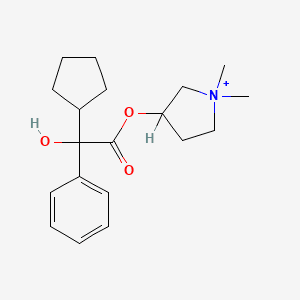
Pharmacotherapeutic group: Synthetic anticholinergics, quaternary ammonium compounds;
ATC code: A03AB02
Mechanism of action
Glycopyrronium bromide is a synthetic muscarinic anticholinergic agent that binds competitively to the muscarinic acetylcholine receptor. Like other anticholinergic (antimuscarinic) agents, it inhibits the action of acetylcholine on structures innervated by postganglionic cholinergic nerves and on smooth muscles that respond to acetylcholine but lack cholinergic innervation. These peripheral cholinergic receptors are present in the autonomic effector cells of smooth muscle, cardiac muscle, the sinoatrial node, the atrioventricular node, exocrine glands and, to a limited degree, in the autonomic ganglia. Thus, it diminishes the volume and free acidity of gastric secretions and controls excessive pharyngeal, tracheal, and bronchial secretions.
Aside from differences in the CNS actions, the spectrum of pharmacological actions by glycopyrronium bromide is qualitatively similar to that of the naturally occurring alkaloids atropine and scopolamine, but differs with regard to duration and intensity. Within the peripheral nervous system, glycopyrronium bromide acts as a potent competitive antagonist at muscarinic receptors and attenuates physiological processes regulated by the parasympathetic nervous system, including predictable actions within the respiratory tract, gastrointestinal tract, and heart. The highly polar quaternary ammonium group of glycopyrronium bromide limits its passage across lipid membranes, such as the blood-brain barrier.
Pharmacodynamic effects
Glycopyrronium competitively inhibits cholinergic muscarinic receptors in salivary glands and other peripheral tissues, thus indirectly reducing the rate of salivation. Glycopyrronium has little effect on cholinergic stimuli at nicotinic acetylcholine receptors, on structures innervated by sympathetic postganglionic neurons, and on smooth muscles that respond to acetylcholine but have no cholinergic innervation. Peripheral antimuscarinic effects that are produced as the dose increases are: decreased production of secretions from the salivary, bronchial and sweat glands; dilatation of the pupils (mydriasis) and paralysis of accommodation (cyclopegia); increased heart rate; inhibition of micturition and reduction in gastrointestinal tone; inhibition of gastric acid secretion. Specific effects include dryness of the mouth, reduced bronchial secretions, dilation of pupils with loss of accommodation, photophobia, flushing, inhibition of sweating, transient bradycardia followed by tachycardia with palpitations and arrhythmias, urinary urgency and retention, reduced gastrointestinal motility and tone.
Due to its limited passage across lipid membranes, CNS effects such as drowsiness are unlikely.
Clinical efficacy and safety
The medicinal use of glycopyrronium bromide for its anticholinergic effects is well-established. Studies published in the scientific literature demonstrate reduction in gastric secretions and acidity, and delayed gastric emptying by glycopyrronium bromide in peptic ulcer patients. Some efficacy of glycopyrronium bromide as monotherapy was shown in peptic ulcer healing, recurrence rate of duodenal ulcer, chronic gastric ulcer, duodenal ulcer, peptic ulcer, gastrointestinal disorders and acid-peptic disease. Published studies of glycopyrronium bromide in adults as add-on therapy with antacids in the treatment of peptic ulcer also demonstrate some efficacy.
Placebo-controlled efficacy data for sialorrhoea in children includes patients with a treatment duration of 8 weeks. There is no placebo or comparator-controlled data beyond 8 weeks.
Zeller et al 2012 evaluated the efficacy of glycopyrronium bromide oral solution (1 mg/5mL) in managing problem drooling associated with cerebral palsy and other neurological conditions.
Thirty-eight patients aged 3-23 years weighing at least 12.2 kg with severe drooling (clothing damp 5-7 days/week) were randomized to 8 weeks treatment with glycopyrronium (n = 20), 20-100 μg/kg (not exceeding 3 mg in total), or matching placebo (n = 18) tds. The first 4 weeks were an individual titration period in fixed steps depending on response, followed by 4-weeks maintenance treatment.
The primary efficacy endpoint was responder rate, defined as percentage showing ≥3-point improvement on the modified Teacher's Drooling Scale (mTDS). The primary analysis population was revised to only comprise patients with an age of 3 -16 years with 19 patients in the glycopyrrolate oral solution group an 17 in the placebo group. Responder rate was defined as at least a 3-point improvement in modified Teacher's Drooling Scale (mTDS).
Treatment
At least a 3-point improvement in mTDS
Mean improvement in mTDS
Glycopyrronium
14 of 19 patients (73.7%)
3.94 points
(SD: 1.95; 95%; CI: 2.97–4.91)
Placebo
3 of 17 patients (17.6%)
0.71 points
(SD: 2.14; 95% CI: –0.43–1.84)
p value
p = 0.0011
p <0.0001
84% of physicians and 100% of parents/caregivers regarded glycopyrrolate as worthwhile compared with 41% and 56%, respectively, for placebo (p≤0.014). Most frequently reported treatment-emergent adverse events (glycopyrrolate vs placebo) were dry mouth, constipation, vomiting and nasal congestion.
In a separate study by Zeller et al (2012), the safety and efficacy of glycopyrronium were studied in an open-labelled study without a control group over a 24-week period in children aged 3-18 years At the week 24 exit visit, 52.3% (95% CI 43.7–60.9) of patients (n=130) had an at least three point decrease in mTDS from baseline and were classified as responders to treatment with oral glycopyrrolate solution with 83.5% of parents/caregivers and 85.8% of investigators rating oral glycopyrrolate solution as worthwhile. The adverse event profile was consistent with that seen with anticholinergics (see section 4.4 and 4.8).
The incidence of expected adverse anticholinergic effects is dose-related. Therefore, dose should be titrated to achieve an optimal balance of effectiveness with minimal anticholinergic-associated adverse events.
⚠️ Warnings
No Special requirements for disposal.
For patients where oral administration of tablet is not possible, or not desired, administration by tablet solubilisation, and subsequent administration as an extemporaneous oral dispersion, or by administration via a nasogastric tube or a percutaneous endoscopic gastrostomy (PEG) tube can be used. Such dispersions should be administered as following. For dose recommendations see section 4.2.
Dispersion of a tablet is achieved as follows, using water as a dispersant medium and a 60 ml oral syringe as the vessel for dispersion.
- Remove the plunger from the syringe and introduce a single tablet into the syringe barrel, replace the plunger and depress to just above the tablet
- Draw up the required volume of water - 10-30 ml either of potable or purified is suitable, dependent on any patient fluid intake restrictions, and manually shake the syringe assembly for 30 seconds
- Allow to stand for 5 minutes and manually shake for another 30 seconds
- Allow to stand for a further 5 minutes and manually shake for another 30 seconds
- Allow to stand for a final 5 minutes and manually shake for another 30 seconds.
The tablet dispersion should be administered immediately after preparation. The dispersion is opaque, with some visible heavy particulates that are an inactive ingredient. The whole of the dispersion, including residue, is to be administered. The studies conducted with the nasogastric and PEG tubes evaluated three types of tubing, polyvinylchloride, polyurethane and silicone, and concluded that there were no significant differences evident between the three types of tubing with more than 90% overall recovery. Filtration studies prior to analysis were performed to evaluate if undissolved residues contained significant amounts of glycopyrronium bromide and concluded that there was no significant decrease in the amount recovered. Filtered and unfiltered samples both showed overall recovery of more than 90%.
Administration may be by the following routes:
- Orally, as an aqueous dispersion. Following administration of the dispersion, the oral syringe is rinsed with a further water, a minimum of 10 ml that should also be taken to ensure complete dosing.
- Via either a nasogastric tube, or PEG tube. Tubes made of polyvinylchloride, polyurethane, or silicon are suitable. There are no data available on tubes made of latex; such tubes should not be used. Immediately following administration of the initial dispersion, by connection of the oral syringe to the tube, the oral syringe is disconnected and rinsed with a further 10 ml of water, which should also be administered, in order to ensure complete dosing.
Such dispersions should not be used to provide doses below that of the tablet used to prepare the dispersion, since there are no data available to support such dose subdivision. Dispersion should be administered immediately following preparation. There are no data available to show that the medicine could be co-administered with food when administered through enteral tubes and this should be avoided as recommended.