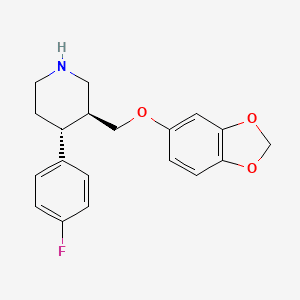
Pharmacotherapeutic group: Antidepressants – selective serotonin reuptake inhibitors, ATC code: NO6A B05.
Mechanism of Action
Paroxetine is a potent and selective inhibitor of 5–hydroxytryptamine (5–HT, serotonin) uptake and its antidepressant action and effectiveness in the treatment of OCD, Social Anxiety disorder / Social Phobia, General Anxiety Disorder, Post–Traumatic Stress Disorder and Panic Disorder is thought to be related to its specific inhibition of 5–HT uptake in brain neurones.
Paroxetine is chemically unrelated to the tricyclic, tetracyclic and other available antidepressants.
Paroxetine has low affinity for muscarinic cholinergic receptors and animal studies have indicated only weak anticholinergic properties.
In accordance with this selective action,
in vitro
studies have indicated that, in contrast to tricyclic antidepressants, paroxetine has little affinity for alpha1, alpha2 and beta–adrenoceptors, dopamine (D2), 5–HT1 like, 5–HT2 and histamine (H1) receptors. This lack of interaction with post–synaptic receptors
in vitro
is substantiated by
in vivo
studies which demonstrate lack of CNS depressant and hypotensive properties.
Pharmacodynamic Effects
Paroxetine does not impair psychomotor function and does not potentiate the depressant effects of ethanol.
As with other selective 5–HT uptake inhibitors, paroxetine causes symptoms of excessive 5–HT receptor stimulation when administered to animals previously given monoamine oxidase (MAO) inhibitors or tryptophan.
Behavioural and EEG studies indicate that paroxetine is weakly activating at doses generally above those required to inhibit 5–HT uptake. The activating properties are not “amphetamine–like” in nature.
Animal studies indicate that paroxetine is well tolerated by the cardiovascular system. Paroxetine produces no clinically significant changes in blood pressure, heart rate and ECG after administration to healthy subjects.
Studies indicate that, in contrast to antidepressants which inhibit the uptake of noradrenaline, paroxetine has a much reduced propensity to inhibit the antihypertensive effects of guanethidine.
In the treatment of depressive disorders, paroxetine exhibits comparable efficacy to standard antidepressants.
There is also some evidence that paroxetine may be of therapeutic value in patients who have failed to respond to standard therapy.
Morning dosing with paroxetine does not have any detrimental effect on either the quality or duration of sleep. Moreover, patients are likely to experience improved sleep as they respond to paroxetine therapy.
Adult suicidality analysis
A paroxetine-specific analysis of placebo controlled trials of adults with psychiatric disorders showed a higher frequency of suicidal behaviour in young adults (aged 18-24 years) treated with paroxetine compared with placebo (2.19% vs 0.92%). In the older age groups, no such increase was observed. In adults with major depressive disorder (all ages), there was an increase in the frequency of suicidal behaviour in patients treated with paroxetine compared with placebo (0.32% vs 0.05%); all of the events were suicide attempts. However, the majority of these attempts for paroxetine (8 of 11) were in younger adults (see also section 4.4).
Dose response
In the fixed dose studies there is a flat dose response curve, providing no suggestion of advantage in terms of efficacy for using higher than the recommended doses. However, there are some clinical data suggesting that up-titrating the dose might be beneficial for some patients.
Long-term efficacy
The long-term efficacy of paroxetine in depression has been demonstrated in a 52 week maintenance study with relapse prevention design: 12% of patients receiving paroxetine (20 –40 mg daily) relapsed, versus 28% of patients on placebo.
The long-term efficacy of paroxetine in treating obsessive compulsive disorder has been examined in three 24 week maintenance studies with relapse prevention design. One of the three studies achieved a significant difference in the proportion of relapsers between paroxetine (38%) compared to placebo (59%).
The long-term efficacy of paroxetine in treating panic disorder has been demonstrated in a 24 week maintenance study with relapse prevention design: 5% of patients receiving paroxetine (10-40 mg daily) relapsed, versus 30% of patients on placebo. This was supported by a 36 week maintenance study.
The long-term efficacy of paroxetine in treating social anxiety disorder and generalised anxiety disorder and Post-Traumatic Stress Disorderhas not been sufficiently demonstrated.
Adverse Events from Paediatric Clinical Trials
In short-term (up to 10-12 weeks) clinical trials in children and adolescents, the following adverse events were observed in paroxetine treated patients at a frequency of at least 2% of patients and occurred at a rate at least twice that of placebo: increased suicidal related behaviours (including suicide attempts and suicidal thoughts), self-harm behaviours and increased hostility. Suicidal thoughts and suicide attempts were mainly observed in clinical trials of adolescents with Major Depressive Disorder. Increased hostility occurred particularly in children with obsessive compulsive disorder, and especially in younger children less than 12 years of age. Additional events that were more often seen in the paroxetine compared to placebo group were: decreased appetite, tremor, sweating, hyperkinesia, agitation, emotional lability (including crying and mood fluctuations).
In studies that used a tapering regimen, symptoms reported during the taper phase or upon discontinuation of paroxetine at a frequency of at least 2% of patients and occurred at a rate at least twice that of placebo were: emotional lability (including crying, mood fluctuations, self-harm, suicidal thoughts and attempted suicide), nervousness, dizziness, nausea and abdominal pain (see section 4.4 Special warnings and precautions for use).
In five parallel group studies with a duration of eight weeks up to eight months of treatment, bleeding related adverse events, predominantly of the skin and mucous membranes, were observed in paroxetine treated patients at a frequency of 1.74% compared to 0.74% observed in placebo treated patients.