This information is for educational purposes only. It is not intended as medical advice. Always consult a qualified healthcare professional.
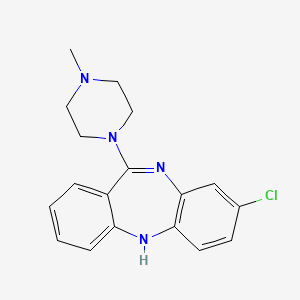
Clozapine is an antipsychotic and sedative agent belonging to the group of atypical antipsychotics, used for the treatment of treatment-resistant schizophrenia and for the long-term reduction of suicidal behavior in schizophrenia and schizoaffective disorder. An additional indication is psychosis associated with Parkinson's disease. Its effects are based on interactions with neurotransmitter systems in the central nervous system, including antagonism at dopamine and serotonin receptors. The tablets are taken once or twice daily regardless of meals. The most common possible adverse effects include drowsiness, sedation, dizziness, sometimes significant weight gain, constipation, excessive salivation, and rapid heart rate. Clozapine may prolong the QT interval and can occasionally cause potentially life-threatening agranulocytosis. It is a substrate of CYP450 isoenzymes.
Clozapine (ATC N05AH02) has sedative and antipsychotic properties. Its effects are based on interactions with various neurotransmitter systems. Clozapine is an antagonist at dopamine D2 receptors, alpha-adrenoceptors, muscarinic receptors (anticholinergic), histamine receptors (antihistaminic), and serotonin receptors (5-HT2A, antiserotonergic). The half-life is approximately 12 hours.
Mechanism of action of antipsychotics, click to enlarge. Illustration © PharmaWiki