USDailyMed:Albendazole
AU:D
P02CA03(WHO)QP52AC11(WHO)
AU:S4(Prescription only)CA:℞-onlyUK:POM(Prescription only)US:℞-only(for humans; veterinary suspension and paste are both OTC)
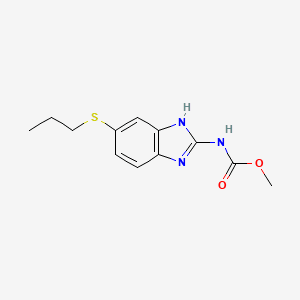
methyl [6-(propylsulfanyl)-1H-benzimidazol-2-yl]carbamate
54965-21-8Y
2082
DB00518Y
1998Y
F4216019LN
D00134Y
CHEBI:16664Y
ChEMBL1483Y
007895
DTXSID0022563
Interactive image
CCCSc2ccc1nc(NC(=O)OC)[nH]c1c2
InChI=1S/C12H15N3O2S/c1-3-6-18-8-4-5-9-10(7-8)14-11(13-9)15-12(16)17-2/h4-5,7H,3,6H2,1-2H3,(H2,13,14,15,16)YKey:HXHWSAZORRCQMX-UHFFFAOYSA-NY
Albendazoleis a broad-spectrumantihelminticandantiprotozoalagent of thebenzimidazoletype.It is used for the treatment of a variety ofintestinal parasite infections, includingascariasis,pinworm infection,hookworm infection,trichuriasis,strongyloidiasis,taeniasis,clonorchiasis,opisthorchiasis,cutaneous larva migrans,giardiasis, andgnathostomiasis, among other diseases.
Common side effects includenausea, abdominal pain, andheadache.Rare but potentially serious side effects includebone marrow suppressionwhich usually improves on discontinuing the medication.Liver inflammationhas been reported and those with prior liver problems are at greater risk.It ispregnancy categoryD in Australia, meaning it may cause harm if taken by pregnant women.
Albendazole was developed in 1975.It is on theWorld Health Organization's List of Essential Medicines.Albendazole is available in afixed-dose combinationwithivermectin.