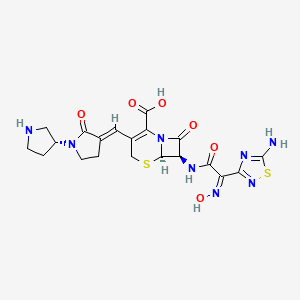
Pharmacotherapeutic group: Other cephalosporins, ATC code: J01DI01
Mechanism of action
Ceftobiprole exerts bactericidal activity through binding to important penicillin-binding proteins (PBPs) in susceptible species. In Gram-positive bacteria, including methicillin-resistant
Staphylococcus aureus
(MRSA), Ceftobiprole binds to PBP2a. Ceftobiprole has demonstrated in vitro activity against strains with divergent
mecA
homolog (
mecC or mecA
LGA251). Ceftobiprole also binds to PBP2b in
Streptococcus pneumoniae
(penicillin-intermediate), PBP2x in
S. pneumoniae
(penicillin resistant), and to PBP5 in
Enterococcus faecalis
.
Resistance
Ceftobiprole is inactive against strains of Enterobacteriaceae that express Ambler class A β‑lactamases, especially TEM, SHV and CTX-M type extended-spectrum β-lactamases (ESBL) and the KPC‑type carbapenemases, Ambler class B β-lactamases and Ambler class D β‑lactamases, especially ESBL variants and carbapenemases (OXA-48). Ceftobiprole is also inactive against strains that have high levels of expression of Ambler class C β‑lactamases.
Ceftobiprole is inactive against strains of
P. aeruginosa
that express enzymes belonging to Ambler class A (e.g., PSE-1), Ambler class B (e.g., IMP-1, VIM-1, VIM-2) and Ambler class D (e.g., OXA-10). It is also inactive against isolates that have acquired mutations in regulatory genes leading to de‑repressed levels of expression of the chromosomal Ambler class C β-lactamase, or over‑expression of the Mex XY efflux pump.
Ceftobiprole is inactive against strains of
Acinetobacter
spp. that express enzymes belonging to Ambler class A (e.g., VEB-1), Ambler class B (e.g., IMP-1, IMP-4) Ambler class D (e.g., OXA-25, OXA-26), or that have de-repressed levels of expression of the chromosomal Ambler class C β-lactamase.
Susceptibility testing breakpoints
Minimum inhibitory concentration (MIC) interpretive criteria for susceptibility testing have been established by the European Committee on Antimicrobial Susceptibility Testing (EUCAST) for ceftobiprole and are listed here: https://www.ema.europa.eu/documents/other/minimum-inhibitory-concentration-mic-breakpoints_en.xlsx.
PK/PD relationship
As with other beta-lactam antimicrobial agents, the percent time above the minimum inhibitory concentration (MIC) of the infecting organism over the dosing interval (%fT > MIC) has been shown to be the parameter that best correlates with the efficacy of ceftobiprole.
Clinical efficacy against specific pathogens
Efficacy has been demonstrated in clinical studies against the following pathogens in patients with HAP (not including VAP) and CAP that were susceptible to ceftobiprole in vitro:
Staphylococcus aureus
(including MRSA)
Streptococcus pneumoniae
(including MDRSP)
Escherichia coli
Klebsiella pneumoniae
Antibacterial activity against other relevant pathogens
Clinical efficacy has not been established against the following pathogens, although in vitro studies suggest that they would often be susceptible to ceftobiprole in the absence of an acquired mechanism of resistance:
Acinetobacter
spp.
Citrobacter
spp.
Enterobacter
spp.
Haemophilus influenzae
Klebsiella oxytoca
Moraxella catarrhalis
Morganella morganii
Proteus mirabilis
Providencia
spp.
Pseudomonas
spp.
Serratia
spp
.
In vitro
data indicate that the following species are not susceptible to ceftobiprole:
Chlamydophila (Chlamydia) pneumoniae
Burkholderia cepacia complex
Mycoplasma pneumoniae
Mycobacteria
Nocardia
spp.
Stenotrophomonas maltophilia
Data from clinical studies
Nosocomial pneumonia
Ceftobiprole demonstrated efficacy in a well-controlled randomised Phase 3 study in patients with HAP. Non-inferiority between ceftobiprole and the comparator group could not be demonstrated in patients with VAP (i.e., patients who develop pneumonia > 48 hours after onset of ventilation). In VAP, clinical cure rates in ceftobiprole treated patients were 37.7% in the ceftobiprole group (20 out of 53 patients) compared to 55.9% in the ceftazidime plus linezolid group (33 out of 59 patients), see also sections 4.1 and 4.4.
Paediatric population
The safety and effectiveness of ceftobiprole in the treatment of CAP has been established in paediatric patients 3 months to less than 18 years. Use of ceftobiprole in these age groups is supported by evidence from adequate and well-controlled study of ceftobiprole in adults, with additional pharmacokinetic, safety and efficacy data from paediatric trials.
⚠️ Warnings
Each vial is for single use only.
Zevtera must be reconstituted and then further diluted prior to infusion.
Step 1. Reconstitution
For adult and paediatric patients ≥ 12 years who require an infusion solution with a ceftobiprole concentration of 2 mg/mL, the lyophilized powder should be reconstituted with 10 mL of sterile water for injections or dextrose 50 mg/mL (5%) solution for injection.
For paediatric patients < 12 years who require an infusion solution with a ceftobiprole concentration of 4 mg/mL, the lyophilized powder must be reconstituted either with 10 mL dextrose 50 mg/mL (5%) solution for injection if further dilution with the same diluent solution (i.e., dextrose 50 mg/mL (5%) solution for injection) is used, or with 10 mL of water for injection if further dilution with sodium chloride 9 mg/mL (0.9%) solution for injection is used (see section 6.3 tables).
The vial should be shaken vigorously until complete dissolution, which in some cases may take up to 10 minutes. The volume of the resulting concentrate is approximately 10.6 mL. Any foam should be allowed to dissipate and the reconstituted solution should be inspected visually to ensure the product is in solution and particulate matter is absent. The reconstituted concentrate contains 50 mg/mL of ceftobiprole (as 66.7 mg/mL of ceftobiprole medocaril sodium) and must be further diluted prior to administration. It is recommended that the reconstituted solution be further diluted immediately. However, if this is not possible the reconstituted solution can be stored at room temperature for up to 1 hour, or in a refrigerator for up to 24 hours.
Step 2. Dilution (infusion solution)
Use in adult and paediatric patients ≥ 12 years
Preparation of 500 mg dose of Zevtera solution for infusion (2 mg/mL ceftobiprole)
10 mL of the reconstituted solution should be withdrawn from the vial and injected into a suitable container (e.g. PVC or PE infusion bags, glass bottles) containing 250 mL of sodium chloride 9 mg/mL (0.9%) solution for injection, dextrose 50 mg/mL (5%) solution for injection, or Lactated Ringer's solution for injection. The infusion solution should be gently inverted 5‑10 times to form a homogenous solution. Vigorous agitation should be avoided to prevent foaming.
In adults, the entire contents of the infusion bag should be infused to administer a 500 mg dose of Zevtera.
In paediatric patients ≥ 12 years, the volume to be administered should be calculated based on the patient body weight (see section 4.2) and must not exceed a maximum of 250 mL (500 mg dose).
Preparation of 250 mg dose of Zevtera solution for infusion for adult patients with severe renal impairment
5 mL of the reconstituted solution should be withdrawn from the vial and injected into a suitable container (e.g. PVC or PE infusion bags, glass bottles) containing 125 mL of sodium chloride 9 mg/mL (0.9%) solution for injection, dextrose 50 mg/mL (5%) solution for injection, or Lactated Ringer's solution for injection. The infusion solution should be gently inverted 5‑10 times to form a homogenous solution. Vigorous agitation should be avoided to prevent foaming. The entire contents of the infusion bag should be infused to administer a 250 mg dose of Zevtera.
Use in paediatric patients < 12 years
Preparation of Zevtera solution for infusion at a concentration of 4 mg/mL of ceftobiprole
Administration via infusion bags, bottles or syringes:
The reconstituted solution prepared with 10 mL dextrose 50 mg/mL (5%) solution for injection must be diluted with the same diluent solution (i.e
.,
dextrose 50 mg/mL (5%) solution for injection). The reconstituted solution prepared with 10 mL water for injection solution must be diluted with sodium chloride 9 mg/mL (0.9%) solution for injection.
10 mL should be withdrawn from an infusion container (e.g., PVC or PE infusion bags, glass bottles) containing 125 mL of diluent solution and replaced with 10 mL of the reconstituted solution withdrawn from the vial. The infusion solution should be gently inverted 5–10 times to form a homogenous solution. Vigorous agitation should be avoided to prevent foaming. The volume to be administered should be calculated based on the patient body weight (see section 4.2) and must not exceed a maximum of 125 mL (500 mg dose).
For administration via a 50 mL syringe if the calculated dose does not exceed 200 mg, 4 mL of the reconstituted solution (equivalent to 200 mg ceftobiprole) prepared with dextrose 50 mg/mL (5%) solution for injection or water for injection should be withdrawn from the vial and diluted with 46 mL of the appropriate infusion solution diluent (see section 6.3). The infusion solution should be gently inverted 5–10 times to form a homogenous solution. Vigorous agitation should be avoided to prevent foaming. The volume to be administered should be calculated based on the patient body weight (see section 4.2) and must not exceed a maximum of 50 mL (200 mg dose).
Appearance of diluted solution
The solution for infusion should be clear to slightly opalescent and yellowish in colour. The solution for infusion should be inspected visually for particulate matter prior to administration, and discarded if particulate matter is visible.
Detailed information on the time by which reconstitution, dilution and infusion must complete is provided in section 6.3.
Disposal
Any unused medicinal product or waste material should be disposed of in accordance with local requirements.