This information is for educational purposes only. It is not intended as medical advice. Always consult a qualified healthcare professional.
INTROPIN — Description, Dosage, Side Effects | PillsCard
OTC
INTROPIN
концентрат за инфузионен разтвор
INN: Dopamine
Data updated: 2026-04-11
Available in:
🇬🇧🇵🇹🇷🇴🇷🇺
Form
концентрат за инфузионен разтвор
Dosage
—
Route
—
Storage
—
About This Product
Manufacturer
User Reviews
Reviews reflect personal experiences and are not medical advice. Always consult your doctor.
Admeda Arzneimittel GmbH (BG)
ATC Code
C01CA 4
Source
BDA
DA,2-(3,4-Dihydroxyphenyl)ethylamine,3,4-Dihydroxyphenethylamine,3-Hydroxytyramine,Oxytyramine,Intropin,Revivan
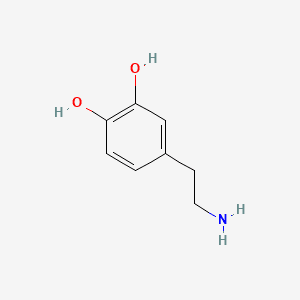
4-(2-Aminoethyl)benzene-1,2-diol
51-61-662-31-7(hydrochloride)
681
940
DB00988
661
VTD58H1Z2X
C03758
DTXSID6022420
Interactive image
NCCc1cc(O)c(O)cc1
InChI=1S/C8H11NO2/c9-4-3-6-1-2-7(10)8(11)5-6/h1-2,5,10-11H,3-4,9H2Key:VYFYYTLLBUKUHU-UHFFFAOYSA-N
Dopamine(DA, a contraction of3,4-dihydroxyphenethylamine) is aneuromodulatorymoleculethat plays several important roles in cells. It is anorganic chemicalof thecatecholamineandphenethylaminefamilies. It is anaminesynthesized by removing acarboxyl groupfrom a molecule of itsprecursor chemical,L-DOPA, which issynthesizedin thebrainandkidneys. Dopamine is also synthesized in plants and most animals. In the brain, dopamine functions as aneurotransmitter—a chemical released byneurons(nerve cells) to send signals to other nerve cells. The brain includes several distinctdopamine pathways, one of which plays a major role in the motivational component ofreward-motivated behavior. The anticipation of most types of rewards increases the level of dopamine in the brain,and manyaddictivedrugsincrease dopamine release or block itsreuptakeinto neurons following release.Other brain dopamine pathways are involved inmotor controland in controlling the release of various hormones. These pathways andcell groupsform a dopamine system which isneuromodulatory.
Inpopular cultureand media, dopamine is often portrayed as the main chemical of pleasure, but the current opinion inpharmacologyis that dopamine instead confersmotivational salience;in other words, dopamine signals the perceived motivational prominence (i.e., the desirability or aversiveness) of an outcome, which in turn propels the organism's behavior toward or away from achieving that outcome.
Outside the central nervous system, dopamine functions primarily as a localparacrinemessenger. In blood vessels, it inhibitsnorepinephrinerelease and acts as avasodilator; in the kidneys, it increases sodium excretion and urine output; in the pancreas, it reduces insulin production; in the digestive system, it reducesgastrointestinal motilityand protectsintestinal mucosa; and in the immune system, it reduces the activity oflymphocytes. With the exception of the blood vessels, dopamine in each of these peripheral systems is synthesized locally and exerts its effects near the cells that release it.
Several important diseases of the nervous system are associated with dysfunctions of the dopamine system, and some of the key medications used to treat them work by altering the effects of dopamine.Parkinson's disease, a degenerative condition causingtremorand motor impairment, is caused by a loss of dopamine-secreting neurons in an area of themidbraincalled thesubstantia nigra. Its metabolic precursor L-DOPA can be manufactured;Levodopa, a pure form of L-DOPA, is the most widely used treatment for Parkinson's.There is evidence thatschizophreniainvolves altered levels of dopamine activity, and mostantipsychotic drugsused to treat this aredopamine antagonistswhich reduce dopamine activity.Similar dopamine antagonist drugs are also some of the most effectiveanti-nausea agents.Restless legs syndromeandattention deficit hyperactivity disorder(ADHD) are associated with decreased dopamine activity.Dopaminergicstimulantscan be addictive in high doses, but some are used at lower doses to treat ADHD.Dopamineitself is available as a manufactured medication forintravenous injection. It is useful in the treatment ofsevere heart failureorcardiogenic shock.In newborn babies it may be used forhypotensionandseptic shock.
⚠️ Warnings
• Caution should be exercised in patients with history of thickening and hardening of arteries, Raynaud's disease, Buerger's disease, diabetic endarteritis, increase in diastolic pressure, who are taking other medications, any allergy, during pregnancy and breastfeeding.
• Monitor urine flow, cardiac output and blood pressure regularly while taking this medication.
• Blood volume should be corrected before infusion of this medication.