This information is for educational purposes only. It is not intended as medical advice. Always consult a qualified healthcare professional.
OTC
POTASSIUM LACTATE
песари
INN: Lactic acid
Data updated: 2026-04-11
Available in:
🇩🇪🇬🇧🇵🇹🇹🇷
Form
песари
Dosage
—
Route
—
Storage
—
About This Product
Manufacturer
User Reviews
Reviews reflect personal experiences and are not medical advice. Always consult your doctor.
Dr. August Wolff GmbH & Co. (BG)
ATC Code
G01AD 1
Source
BDA
Lactic acidMilk acid
50-21-5Y79-33-4(L)Y10326-41-7(D)Y
Interactive image
CHEBI:422Y
ChEMBL330546Y
96860Y
200-018-0
2932
D00111C00186C00256
612
OD2800000
3B8D35Y7S4YF9S9FFU82N(L)Y3Q6M5SET7W(D)Y
DTXSID7023192
InChI=1S/C3H6O3/c1-2(4)3(5)6/h2,4H,1H3,(H,5,6)/t2-/m0/s1YKey: JVTAAEKCZFNVCJ-REOHCLBHSA-NY
CC(O)C(=O)O
acetic acidglycolic acidpropionic acid3-hydroxypropanoic acidmalonic acidbutyric acidhydroxybutyric acid
1-propanol2-propanolpropionaldehydeacroleinsodium lactateethyl lactate
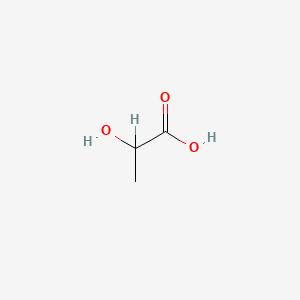
Lactic acidis anorganic acidwith the molecular formulaC3H6O3. In its solid state, it is white andmisciblewith water.When dissolved, it forms a colorless solution. Production includes both artificial synthesis and natural sources. Lactic acid is analpha-hydroxy acid(AHA) due to the presence of ahydroxylgroup adjacent to thecarboxylgroup. It is a synthetic intermediate in manyorganic synthesisindustries and in variousbiochemicalindustries. Theconjugate baseof lactic acid is calledlactate(or the lactate anion). The name of the derivedacyl groupislactoyl.
In solution, it can ionize by a loss of a proton to produce the lactateionCH3CH(OH)CO2–, also known as 2-hydroxypropanoate. Compared toacetic acid, itspKais 1 unit less, meaning that lactic acid is ten times more acidic than acetic acid. This higher acidity is the consequence of intramolecular hydrogen bonding between the α-hydroxyl and the carboxylate group.
Lactic acid ischiral, consisting of twoenantiomers. One is known asL-lactic acid, (S)-lactic acid, or (+)-lactic acid, and the other, its mirror image, isD-lactic acid, (R)-lactic acid, or (−)-lactic acid. A mixture of the two in equal amounts is calledDL-lactic acid, orracemiclactic acid. Lactic acid ishygroscopic.DL-Lactic acid ismisciblewith water and with ethanol above its melting point, which is 16–18 °C (61–64 °F).D-Lactic acid andL-lactic acid have a higher melting point. Lactic acid produced by fermentation of milk is often racemic, although certain species of bacteria produce solelyD-lactic acid.On the other hand, lactic acid produced by fermentation in animal muscles has the (L) enantiomer and is sometimes called "sarcolactic" acid, from the Greeksarx, meaning "flesh".
In animals,L-lactate is constantly produced frompyruvatevia theenzymelactate dehydrogenase(LDH) in a process offermentationduring normalmetabolismandexercise.It does not increase in concentration until the rate of lactate production exceeds the rate of lactate removal, which is governed by a number of factors, includingmonocarboxylate transporters, concentration and isoform of LDH, and oxidative capacity of tissues.This reaction is reversible and redox-linked: LDH reduces pyruvate to lactate using NADH as an electron donor, simultaneously regeneratingNAD⁺required for glycolysis under anaerobic conditions.The concentration ofbloodlactate is usually1–2mMTooltip millimolarat rest, but can rise to over 20mM during intense exertion and as high as 25mM afterward.In addition to other biological roles,L-lactic acid is the primaryendogenousagonistofhydroxycarboxylic acid receptor 1(HCA1), which is aGi/o-coupledG protein-coupled receptor(GPCR).
In industry,lactic acid fermentationis performed bylactic acid bacteria, which convert simplecarbohydratessuch asglucose,sucrose, orgalactoseto lactic acid. These bacteria can also grow in themouth; theacidthey produce is responsible for thetoothdecay known ascavities.Inmedicine, lactate is one of the main components oflactated Ringer's solutionandHartmann's solution. Theseintravenousfluids consist ofsodiumandpotassiumcationsalong with lactate andchlorideanionsin solution with distilledwater, generally in concentrationsisotonicwithhumanblood. It is most commonly used for fluidresuscitationafter blood loss due totrauma,surgery, orburns.
Lactic acid is produced in human tissues when the demand for oxygen is limited by the supply. This occurs during tissueischemiawhen the flow of blood is limited as in sepsis or hemorrhagic shock. It may also occur when demand for oxygen is high, such as with intense exercise. The process oflactic acidosisproduces lactic acid, which results in anoxygen debt, which can be resolved or repaid when tissue oxygenation improves.
⚠️ Warnings
• For external use only.
• Caution needed for patients with history of any allergy; pregnancy and lactation.