Reviews reflect personal experiences and are not medical advice. Always consult your doctor.
Про Фармация ЕООД (BG)
ATC Code
C01CA 3
Source
BDA
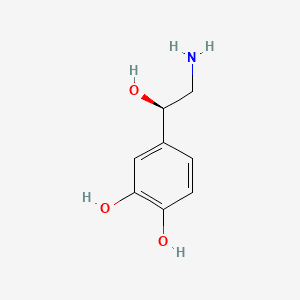
NE, NA,Noradrenaline,(R)-(–)-Norepinephrine,l-1-(3,4-Dihydroxyphenyl)-2-aminoethanol3,4,β-Trihydroxyphenethylamine
(R)-4-(2-amino-1-hydroxyethyl)benzene-1,2-diol
51-41-2Y
439260
505
DB00368
388394
X4W3ENH1CV
C00547
CHEBI:18357
ChEMBL1437
DTXSID5023378
Interactive image
NC[C@H](O)c1cc(O)c(O)cc1
InChI=1S/C8H11NO3/c9-4-8(12)5-1-2-6(10)7(11)3-5/h1-3,8,10-12H,4,9H2/t8-/m0/s1Key:SFLSHLFXELFNJZ-QMMMGPOBSA-N
Norepinephrine(NE), also callednoradrenaline(NA) ornoradrenalin, is anorganic chemicalin thecatecholaminefamily that functions in thebrainandbodyas ahormone,neurotransmitterandneuromodulator. The name "norepinephrine" (fromAncient Greekἐπῐ́(epí), "upon", andνεφρός(nephrós), "kidney") is usually preferred in the United States, whereas "noradrenaline" (fromLatinad, "near", andren, "kidney") is more commonly used in the United Kingdom and the rest of the world."Norepinephrine" is also theinternational nonproprietary namegiven tothe drug.Regardless of which name is used for the substance itself, parts of the body that produce or are affected by it are referred to asnoradrenergic.
The general function of norepinephrine is to mobilize the brain and body for action. Norepinephrine release is lowest during sleep, rises during wakefulness, and reaches much higher levels during situations of stress or danger, in the so-calledfight-or-flight response. In the brain, norepinephrine increases arousal and alertness, promotes vigilance, enhances formation and retrieval of memory, and focuses attention; it also increases restlessness and anxiety. In the rest of the body, norepinephrine increasesheart rateandblood pressure, triggers the release ofglucosefrom energy stores, increasesblood flowtoskeletal muscle, reduces blood flow to the gastrointestinal system, and inhibits voiding of the bladder andgastrointestinal motility.
In the brain, noradrenaline is produced innucleithat are small yet exert powerful effects on other brain areas. The most important of these nuclei is thelocus coeruleus, located in thepons. Outside the brain, norepinephrine is used as a neurotransmitter bysympathetic ganglialocated near thespinal cordor in theabdomen, as well asMerkel cellslocated in the skin. It is also released directly into the bloodstream by theadrenal glands. Regardless of how and where it is released, norepinephrine acts on target cells by binding to and activatingadrenergic receptorslocated on the cell surface.
A variety of medically important drugs work by altering the actions of noradrenaline systems.Noradrenalineitself is widely used as an injectable drug for the treatment of critically low blood pressure.Stimulantsoften increase, enhance, or otherwise act asagonistsof norepinephrine. Drugs such ascocaineandmethylphenidateact asreuptake inhibitorsof norepinephrine, as do someantidepressants, such as those in theSNRIclass. One of the more notable drugs in the stimulant class isamphetamine, which acts as a dopamine and norepinephrine analog, reuptake inhibitor, as well as an agent that increases the amount of globalcatecholaminesignaling throughout the nervous system by reversing transporters in thesynapses.Beta blockers, which counter some of the effects of noradrenaline by blocking beta-adrenergic receptors, are sometimes used to treat glaucoma, migraines and a range of cardiovascular diseases. β1Rs preferentially bind epinephrine, along with norepinephrine to a lesser extent and mediates some of their cellular effects in cardiac myocytes such as increased positive inotropy and lusitropy. β-blockers exert their cardioprotective effects through decreasing oxygen demand in cardiac myocytes; this is accomplished via decreasing the force of contraction during systole (negative inotropy) and decreasing the rate of relaxation during diastole (negative lusitropy), thus reducing myocardial energy demand which is useful in treating cardiovascular disorders accompanied by inadequate myocardial oxygen supply.Alpha blockers, which counter the effects of noradrenaline on alpha-adrenergic receptors, are occasionally used to treat hypertension and psychiatric conditions.Alpha-2 agonistsoften have a sedating and antihypertensive effect and are commonly used as anesthesia enhancers in surgery, as well as in treatment of drug oralcohol dependence. For reasons that are still unclear, some Alpha-2 agonists, such asguanfacine, have also been shown to be effective in the treatment of anxiety disorders andADHD. Many important psychiatric drugs exert strong effects on noradrenaline systems in the brain, resulting in effects that may be helpful or harmful.
⚠️ Warnings
•Not a substitute for replacement of blood, plasma, fluids, and/or electrolytes; correct volume depletion (loss of both water and salts from cell volume) prior to admin.
Identify and correct hypoxia (reduced oxygen content), hypercapnia (too much of CO2and acidosis prior to or during admin.
Avoid extravasations (leakage of a fluid) as tissue necrosis may occur.
Avoid giving the injection into leg veins since they are more often affected by diseases such as diabetes and arteriosclerosis.