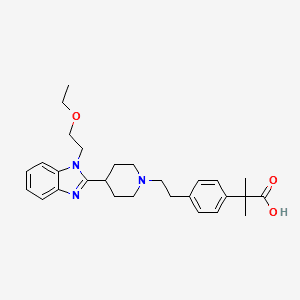
Pharmacotherapeutic group: Antihistamines for systemic use, other antihistamines for systemic use
ATC code R06AX29.
Mechanism of action
Bilastine is a non-sedating, long-acting histamine antagonist with selective peripheral H1 receptor antagonist affinity and no affinity for muscarinic receptors.
Bilastine inhibited histamine-induced wheal and flare skin reactions for 24 hours following single doses.
Clinical efficacy and safety
In clinical trials performed in adult and adolescent patients with allergic rhinoconjunctivitis (seasonal and perennial), bilastine 20 mg, administered once daily for 14-28 days, was effective in relieving symptoms such as sneezing, nasal discharge, nasal itching, nasal congestion, ocular itching, tearing and ocular redness. Bilastine effectively controlled symptoms for 24 hours.
In two clinical trials performed in patients with chronic idiopathic urticaria, bilastine 20 mg, administered once daily for 28days was effective in relieving the itching intensity and the number and size of wheals, as well as the patients discomfort due to urticaria. Patients improved their sleep conditions and their quality of life.
No clinically relevant prolongation of QTc interval or any other cardiovascular effect has been observed in the clinical trials performed with bilastine, even at doses of 200 mg daily (10 times the clinical dose) for 7 days in 9 subjects, or even when coadministered with P-gp inhibitors, such as ketoconazole (24 subjects) and erythromycin (24 subjects). Additionally a thorough QT study including 30 volunteers has been performed.
In controlled clinical trials at the recommended dose of 20 mg once daily, the CNS safety profile of bilastine was similar to placebo and the incidence of somnolence was not statistically different from placebo. Bilastine at doses of up to 40 mg q.d. did not affect psychomotor performance in clinical trials and did not affect driving performance in a standard driving test.
Elderly patients (≥ 65 years) included in phase II and III studies showed no difference in efficacy or safety with respect to younger patients. A post-authorization study in 146 elderly patients showed no differences in the safety profile with respect to the adult population.
Paediatric population
Adolescents (12 years to 17 years) were included in the clinical development. 128 adolescents received bilastine during the clinical studies (81 in double blind studies in allergic rhino-conjunctivitis). A further 116 adolescent subjects were randomised to active comparators or placebo. No differences in efficacy and safety between adults and adolescents were seen.
According to guidelines, the proved efficacy in adults and adolescents can be extrapolated to children, having demonstrated that the systemic exposure with 10 mg bilastine in children from 6 to 11 years with a body weight of at least 20 kg is equivalent to the exposure in adults with 20 mg bilastine (see section 5.2). The extrapolation from adult and adolescent data is deemed appropriate for this product as the pathophysiology of allergic rhino-conjunctivitis and urticaria is the same for all age groups.
In a 12-week controlled clinical trial with children aged 2-11 years (total 509 children, 260 treated with bilastine 10 mg: 58at age 2 to <6 years, 105 at age 6 to <9 years and 97 at 9 to <12 years and 249 treated with placebo: 58 at age 2 to <6years, 95 at age 6 to <9 years and 96 at 9 to <12 years), at the recommended paediatric dose of 10 mg once daily, the safety profile of bilastine (n = 260) was similar to placebo (n = 249), with adverse drug reactions seen in 5.8% and 8.0%of patients taking bilastine 10 mg and placebo, respectively. Both bilastine 10 mg and placebo showed a slight decrease in somnolence and sedation scores on the Paediatric Sleep Questionnaire during this study, with no statistically significant differences between treatment groups. In these children aged 2 to 11 years, no significant differences in QTc were observed following 10 mg bilastine daily compared with placebo. Quality of Life questionnaires specific for children with allergic rhinoconjunctivitis or chronic urticaria showed a general increase in scores over 12 weeks with no statistically significant difference between the bilastine and placebo arms. The total population of 509 children encompassed: 479 subjects with allergic rhinoconjunctivitis and 30 subjects diagnosed of chronic urticaria. 260 children received bilastine, 252 (96.9%) for allergic rhinoconjunctivitis and 8 (3.1%) for chronic urticaria. In analogy, 249 children received placebo, 227 (91.2%) for allergic rhinoconjunctivitis and 22 (8.8%) for chronic urticaria.
The European Medicines Agency has waived the obligation to submit the results of studies with bilastine in all subsets of the paediatric population below 2 years of age (see section 4.2 for information on paediatric use).
⚠️ Warnings
Any unused medicinal product or waste material should be disposed of in accordance with local requirements.