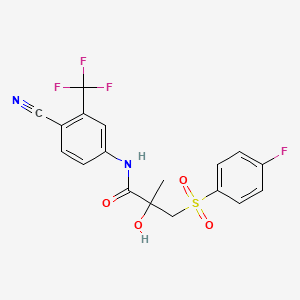
Pharmacotherapeutic group: Hormone antagonists and related agents, antiandrogens. ATC code: L02BB03.
Mechanism of action
Bicalutamide is a non-steroidal antiandrogen devoid of other endocrine activity. It binds to androgen receptors without activating gene expression, and thus inhibits the androgen stimulus. Regression of prostatic tumours results from this inhibition. Clinically, discontinuation of bicalutamide can result in 'antiandrogen withdrawal syndrome' in a subset of patients.
Clinical efficacy and safety
Bicalutamide 150 mg was studied as a treatment for patients with localised (T1-T2, N0 or NX, M0) or locally advanced (T3-T4, any N, M0; T1-T2, N+, M0) non-metastatic prostate cancer in a combined analysis of 3 placebo controlled double-blind studies in 8113 patients, where bicalutamide was given as immediate hormonal therapy or as adjuvant to radical prostatectomy or radiotherapy, (primarily external beam radiation). At 9.7 years median follow up, 36.6% and 38.17% of all bicalutamide and placebo-treated patients, respectively, had experienced objective disease progression.
A reduction in risk of objective disease progression was seen across most patient groups but was most evident in those at highest risk of disease progression. Therefore, clinicians may decide that the optimum medical strategy for a patient at low risk of disease progression, particularly in the adjuvant setting following radical prostatectomy, may be to defer hormonal therapy until signs that the disease is progressing.
No overall survival difference was seen at 9.7 years median follow up with 31.4% mortality (HR=1.01; 95% CI 0.94 to1.09). However, some trends were apparent in exploratory subgroup analyses.
Data on progression-free survival and overall survival data over time based on Kaplan-Meier estimates for patients with locally advanced disease are summarised in the following tables:
Table 2 Proportion of locally advanced disease patients with disease progression over time by therapy sub-group
Analysis population
Treatment Arm
Events (%) at 3 years
Events (%) at 5 years
Events (%) at 7 years
Events (%) at 10 years
Watchful waiting (n=657)
Bicalutamide 150 mg
19.7%
36.3%
52.1%
73.2%
placebo
39.8%
59.7%
70.7%
79.1%
Radiotherapy (n=305)
Bicalutamide 150 mg
13.9%
33.0%
42.1%
62.7%
placebo
30.7%
49.4%
58.6%
72.2%
Radical prostatectomy (n=1719)
Bicalutamide 150 mg
7.5%
14.4%
19.8%
29.9%
placebo
11.7%
19.4%
23.2%
30.9%
Table 3 Overall survival in locally advanced disease by therapy sub-group
Analysis population
Treatment Arm
Events (%) at 3 years
Events (%) at 5 years
Events (%) at 7 years
Events (%) at 10 years
Watchful waiting (n=657)
Bicalutamide 150 mg
14.2%
29.4%
42.2%
65.0%
placebo
17.0%
36.4%
53.7%
67.5%
Radiotherapy (n=305)
Bicalutamide 150 mg
8.2%
20.9%
30.0%
48.5%
placebo
12.6%
23.1%
38.1%
53.3%
Radical prostatectomy (n=1719)
Bicalutamide 150 mg
4.6%
10.0%
14.6%
22.4%
placebo
4.2%
8.7%
12.6%
20.2%
For patients with localised disease receiving bicalutamide alone, there was no significant difference in progression free survival. There was no significant difference in overall survival in patients with localised disease who received bicalutamide as adjuvant therapy, following radiotherapy (HR=0.98; 95% CI 0.80 to 1.20) or radical prostatectomy (HR=1.03; 95% CI 0.85 to 1.25). In patients with localised disease, who would otherwise have been managed by watchful waiting, there was also a trend toward decreased survival compared with placebo patients (HR=1.15; 95% CI 1.00 to 1.32). In view of this, the benefit-risk profile for the use of bicalutamide is not considered favourable in patients with localised disease.
In a separate programme, the efficacy of Bicalutamide 150 mg for the treatment of patients with locally advanced non-metastatic prostate cancer for whom immediate castration was indicated, was demonstrated in a combined analysis of 2 studies with 480 previously untreated patients with non-metastatic (M0) prostate cancer. At 56% mortality and a median follow-up of 6.3 years, there was no significant difference between bicalutamide and castration in survival (hazard ratio = 1.05 [CI 0.81 to 1.36]); however, equivalence of the two treatments could not be concluded statistically.
In a combined analysis of 2 studies with 805 previously untreated patients with metastatic (M1) disease at 43% mortality, Bicalutamide 150 mg was demonstrated to be less effective than castration in survival time (hazard ratio = 1.30 [CI 1.04 to 1.65]), with a numerical difference in estimated time to death of 42 days (6 weeks) over a median survival time of 2 years.
Bicalutamide is a racemate with its antiandrogen activity being almost exclusively in the R-enantiomer.
Paediatric population
No studies have been conducted in paediatric patients (see sections 4.3 and 4.6).
⚠️ Warnings
No special requirements.
Any unused product or waste material should be disposed of in accordance with local requirements.