Pharmacotherapeutic group: Immunosuppressants, selective immunosuppressants, ATC code: L04AA40
Mechanism of action
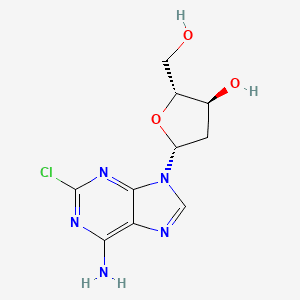
Cladribine is a nucleoside analogue of deoxyadenosine. A chlorine substitution in the purine ring protects cladribine from degradation by adenosine deaminase, increasing the intracellular residence time of the cladribine prodrug. Subsequent phosphorylation of cladribine to its active triphosphate form, 2‑chlorodeoxyadenosine triphosphate (Cd‑ATP), is particularly efficiently achieved in lymphocytes, due to their constitutively high deoxycytidine kinase (DCK) and relatively low 5'‑nucleotidase (5'‑NTase) levels. A high DCK to 5'‑NTase ratio favours the accumulation of Cd‑ATP, making lymphocytes particularly susceptible to cell death. As a result of a lower DCK/5'‑NTase ratio other bone marrow derived cells are less affected than lymphocytes. DCK is the rate limiting enzyme for conversion of the cladribine prodrug into its active triphosphate form, leading to selective depletion of dividing and non-dividing T and B cells.
The primary apoptosis-inducing mechanism of action of Cd‑ATP has direct and indirect actions on DNA synthesis and mitochondrial function. In dividing cells, Cd‑ATP interferes with DNA synthesis via inhibition of ribonucleotide reductase and competes with deoxyadenosine triphosphate for incorporation into DNA by DNA polymerases. In resting cells cladribine causes DNA single-strand breaks, rapid nicotinamide adenine dinucleotide consumption, ATP depletion and cell death. There is evidence that cladribine can also cause direct caspase-dependent and ‑independent apoptosis via the release of cytochrome c and apoptosis-inducing factor into the cytosol of non-dividing cells.
MS pathology involves a complex chain of events in which different immune cell types, including autoreactive T and B cells play a key role. The mechanism by which cladribine exerts its therapeutic effects in MS is not fully elucidated but its predominant effect on B and T lymphocytes is thought to interrupt the cascade of immune events central to MS.
Variations in the expression levels of DCK and 5'‑NTases between immune cell subtypes may explain differences in immune cell sensitivity to cladribine. Because of these expression levels, cells of the innate immune system are less affected than cells of the adaptive immune system.
Pharmacodynamic effects
Cladribine has been shown to exert long-lasting effects by preferentially targeting lymphocytes and the autoimmune processes involved in the pathophysiology of MS.
Across studies, the largest proportion of patients with grade 3 or 4 lymphopenia (<500 to 200 cells/mm
3
or <200 cells/mm
3
) was seen 2 months after the first cladribine dose in each year, indicating a time gap between cladribine plasma concentrations and the maximum haematological effect.
Across clinical studies, data with the proposed cumulative dose of 3.5 mg/kg body weight show a gradual improvement in the median lymphocyte counts back to the normal range at week 84 from the first dose of cladribine (approximately 30 weeks after the last dose of cladribine). The lymphocyte counts of more than 75% of patients returned to the normal range by week 144 from the first dose of cladribine (approximately 90 weeks after the last dose of cladribine).
Treatment with oral cladribine leads to rapid reductions in circulating CD4+ and CD8+ T cells. CD8+ T cells have a less pronounced decrease and a faster recovery than CD4+ T cells, resulting in a temporarily decreased CD4 to CD8 ratio. Cladribine reduces CD19+ B cells and CD16+/CD56+ natural killer cells, which also recover faster than CD4+ T cells.
Clinical efficacy and safety
Relapsing-remitting MS
Efficacy and safety of oral cladribine were evaluated in a randomised, double-blind, placebo-controlled clinical study (CLARITY) in 1,326 patients with relapsing-remitting MS. Study objectives were to evaluate the efficacy of cladribine versus placebo in reducing the annualised relapse rate (ARR) (primary endpoint), slowing disability progression and decreasing active lesions as measured by MRI.
Patients received either placebo (n = 437), or a cumulative dose of cladribine of 3.5 mg/kg (n = 433) or 5.25 mg/kg body weight (n = 456) over the 96‑week (2‑year) study period in 2 treatment courses. Patients randomised to the 3.5 mg/kg cumulative dose received a first treatment course at weeks 1 and 5 of the first year and a second treatment course at weeks 1 and 5 of the second year. Patients randomised to the 5.25 mg/kg cumulative dose received additional treatment at weeks 9 and 13 of the first year. The majority of patients in the placebo (87.0%) and the cladribine 3.5 mg/kg (91.9%) and 5.25 mg/kg (89.0%) treatment groups completed the full 96 weeks of the study.
Patients were required to have at least 1 relapse in the previous 12 months and to have a Kurtzke Expanded Disability Status Scale
(
EDSS) from range 0 to 5.5 including MRI lesions consistent with MS.. In the overall study population, the median age was 39 years (range 18 to 65), and the female to male ratio was approximately 2:1. The mean duration of MS prior to study enrolment was 8.7 years, and the median baseline neurological disability based on EDSS score across all treatment groups was 3.0 (range 0 to 6.0). Over two thirds of the study patients were treatment-naive for MS disease-modifying drugs (DMDs). The remaining patients were pre-treated with either interferon beta‑1a, interferon beta‑1b, glatiramer acetate or natalizumab.
Patients with relapsing-remitting MS receiving cladribine 3.5 mg/kg showed statistically significantly improvements in the annualised relapse rate, proportion of patients relapse-free over 96 weeks, proportion of patients free of sustained disability over 96 weeks and time to 3‑month EDSS progression compared to patients on placebo (see Table 3).
Table 3 Clinical outcomes in the CLARITY study (96 weeks)
Parameter
Placebo
(n = 437)
Cladribine cumulative dose
3.5 mg/kg
(n = 433)
5.25 mg/kg
(n = 456)
Annualised relapse rate (95% CI)
0.33 (0.29, 0.38)
0.14* (0.12, 0.17)
0.15* (0.12, 0.17)
Relative reduction (cladribine vs. placebo)
57.6%
54.5%
Proportion of patients relapse-free over 96 weeks
60.9%
79.7%
78.9%
Time to 3‑month EDSS progression, 10
th
percentile (months)
10.8
13.6
13.6
Hazard ratio (95% CI)
0.67 (0.48, 0.93)
p = 0.018
0.69 (0.49, 0.96)
p = 0.026
* p <0.001 compared to placebo
In addition, the cladribine 3.5 mg/kg treatment group was statistically significantly superior to placebo with regard to number and relative reduction of T1 Gd+ lesions, active T2 lesions and combined unique lesions as demonstrated in brain MRI over the entire 96 weeks of the study. Patients taking cladribine compared to the placebo treatment group had 86% relative reduction in the mean number of T1 Gd+ lesions (adjusted mean number for cladribine 3.5 mg/kg, and placebo groups were 0.12 and 0.91, respectively), 73% relative reduction in the mean number of active T2 lesions (adjusted mean number for cladribine 3.5 mg/kg, and placebo groups were 0.38 and 1.43, respectively) and 74% relative reduction in the mean number of combined unique lesions per patient per scan (adjusted mean number for cladribine 3.5 mg/kg, and placebo groups were 0.43 and 1.72, respectively) (p <0.001 across all 3 MRI outcomes).
Post-hoc analysis of time to 6‑month confirmed EDSS progression resulted in a 47% reduction of the risk of disability progression in the cladribine 3.5 mg/kg compared to placebo (hazard ratio = 0.53, 95% CI [0.36, 0.79], p <0.05); in the placebo group the 10
th
percentile was reached at 245 days, and not reached at all during the study period in the cladribine 3.5 mg/kg group.
As shown in Table 3 above, higher cumulative doses did not add any clinically meaningful benefit, but were associated with a higher incidence in ≥grade 3 lymphopenia (44.9% in the 5.25 mg/kg group vs. 25.6% in the 3.5 mg/kg group).
Patients who had completed the CLARITY study could be enrolled in CLARITY Extension. In this extension study, 806 patients received either placebo or a cumulative dose of cladribine 3.5 mg/kg (in a regimen similar to that used in CLARITY) over the 96‑week study period. The primary objective of this study was safety, while efficacy endpoints were exploratory.
The magnitude of the effect in reducing the frequency of relapses and slowing disability progression in patients receiving the 3.5 mg/kg dose over 2 years was maintained in years 3 and 4 (see section 4.2).
Secondary progressive MS with relapses
A supportive study in patients treated with cladribine as an add-on to interferon beta vs. placebo + interferon beta also included a limited number of patients with secondary progressive MS (26 patients). In these patients, treatment with cladribine 3.5 mg/kg resulted in a reduction of the annualised relapse rate compared to placebo (0.03
versus
0.30, risk ratio: 0.11, p <0.05). There was no difference in annualised relapse rate between patients with relapsing-remitting MS and patients with secondary progressive MS with relapses. An effect on disability progression could not be shown in either subgroup.
Patients with secondary progressive MS were excluded in the CLARITY study. However, a post-hoc analysis of a mixed cohort including CLARITY and ONWARD patients, defined by a baseline EDSS score of ≥3.5 as a proxy for secondary progressive MS, showed a similar reduction in annualised relapse rate compared to patients with an EDSS score below 3.
Paediatric population
The European Medicines Agency has waived the obligation to submit the results of studies with Cladribine Merck in all subsets of the paediatric population in multiple sclerosis (see section 4.2 for information on paediatric use).
⚠️ Warnings
Any unused medicinal product or waste material should be disposed of in accordance with local requirements.