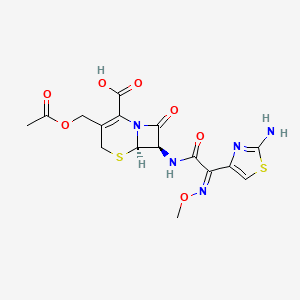
Pharmacotherapeutic group: Third-generation cephalosporin, ATC code: J01DD01
Mechanism of action
The bactericidal activity of cefotaxime results from the inhibition of bacterial cell wall synthesis (during the period of growth) caused by an inhibition of penicillinbinding proteins (PBPs) like transpeptidases.
Mechanism of resistance
A resistance to cefotaxime may be caused by following mechanisms:
• Inactivation by beta-lactamases. Cefotaxime can be hydrolysed by certain betalactamases, especially by extended-spectrum beta-lactamases (ESBLs) which can be found in strains of
Escherichia coli
or
Klebsiella pneumoniae
, or by chromosomal encoded inducible or constitutive beta-lactamases of the AmpC type which can be detected in
Enterobacter cloacae
. Therefore infections caused by pathogens with inducible, chromosomal encoded AmpC- beta-lactamases should not be treated with cefotaxime even in case of proven
in-vitro
susceptibility because of the risk of the selection of mutants with constitutive, derepressed AmpC- beta-lactamases-expression.
• Reduced affinity of PBPs to cefotaxime. The acquired resistance of Pneumococci and other Streptococci is caused by modifications of already existing PBPs as a consequence of a mutation process. In contrast to this concerning the methicillin- (oxacillin-) resistant
Staphylococcus
, the creation of an additional PBP with reduced affinity to cefotaxime is responsible for resistance.
• Inadequate penetration of cefotaxime through the outer cell membrane of gramnegative bacteria so that the inhibition of the PBPs is insufficient.
• The presence of transport mechanism (efflux pumps) being able to actively transport cefotaxime out of the cell. A complete cross resistance of cefotaxime occurs with ceftriaxone and partially with other penicillins and cephalosporins.
Breakpoints:
The following minimal inhibitory concentrations were defined for sensitive and resistant germs:
EUCAST (European Committee on Antimicrobial Susceptibility Testing) break points (2019-01- 01):Pathogen
Susceptible
Resistant
Enterobacteriaceae
≤ 1 mg/l
> 2 mg/l
Staphylococcus spp.
Note1
Note1
Streptococcus (group A, B, C,G)
Note2
Note2
Streptococcus pneumoniae
≤ 0.5 mg/l
> 2 mg/l
Viridans group streptococci
≤ 0.5 mg/l
>0.5 mg/l
Haemophilus influenzae
≤ 0.125 mg/l
> 0.125 mg/l
Moraxella catarrhalis
≤ 1 mg/l
> 2 mg/l
Neisseria gonorrhoeae
≤ 0.12 mg/l
> 0.12 mg/l
Neisseria meningitidis
≤ 0.12 mg/l***
> 0.12 mg/l
Not species-specific breakpoints****
≤ 1 mg/l
> 2 mg/l
Susceptible
Resistant
Enterobacteriaceae
< 1 mg/L
>2 mg/L
Staphylococcus sppHE
Note1
Note1
Streptococcus (group A, B, C, G
Note2
Note2
Streptococcus pneumoniae
≤0.5 mg/L
>2 mg/L
Viridans group streptococci
≤0.5 mg/L
>0.5 mg/L
Haemophilus influenzae
≤0.125 mg/L
>0.125 mg/L
Moraxella Catarrhalis
≤1 mg/L
>2mg/L
Neisseria gonorrhoeae
≤0.125 mg/L
>0.125 mg/L
Neisseria Meningitidis3
≤0.125 mg/L
>0.125 mg/L
Pasteurella multocida
≤0.03 mg/L
>0.03 mg/L
Kingella Kingae
≤0.125 mg/L
>0.125 mg/L
PK-PD (Non-species related) breakpoints
≤1mg/L
>2mg/L
HE = high exposition / high dose only for
S. aureus
(high dose of at least 3 x 2 g iv)
1
Susceptibility of staphylococci to cephalosporins is inferred from the cefoxitin susceptibility except for cefixime, ceftazidime, ceftazidime-avibactam, ceftibuten and ceftolozane-tazobactam which do not have breakpoints and should not be used for staphylococcal infections.
2
The susceptibility of
streptococcus
groups A, B, C and G to cephalosporins is inferred from the benzylpenicillin susceptibility.
3
Non-susceptible isolates are rare or not yet reported. The identification and antimicrobial susceptibility test result on any such isolate must be confirmed and the isolate sent to a reference laboratory.
Susceptibility
The prevalence of acquired resistance may vary geographically and with time for selected species and local information on resistance is desirable particularly when treating severe infections.
If the efficacy of cefotaxime is questionable due to the local prevalence of resistance, expert opinion should be sought regarding the choice of therapy. In particular in the case of severe infections or failure of therapy, a microbiological diagnosis including a verification of the germ and its susceptibility should be aspired.
COMMONLY SUSCEPTIBLE SPECIES
Gram-positive aerobe
Staphylococcus aureus (Methicillin-susceptible)
Streptococcus agalactiae
Streptococcus pneumoniae(incl. penicillin-resistant strains)
Streptococcus pyogenes
Gram-negative aerobes
Borrellia burgdorferi
Haemophilus influenzae
Moraxella catarrhalis
Neisseria gonorrhoeae
Neisseria meningitides
Proteus mirabilis
%
SPECIES FOR WHICH ACQUIRED RESISTANCE MAY BE A PROBLEM
Gram-positive aerobes
Staphylococcus aureus
Staphylococcus epidermidis
+
Staphylococcus haemolyticus
+
Staphylococcus hominis
+
Gram-negative aerobes
Citrobacter freundii
Enterobacter aerogenes
Enterobacter cloacae
Escherichia coli
%
Klebsiella oxytoca
%
Klebsiella pneumoniae
J
%
Morganella morganii
Proteus vulgaris
Serratia
marcescens
Anaerobes
Bacteroides fragilis
INHERENTLY RESISTANT SPECIES
Gram-positive aerobes
Enterococcus spp.
Listeria monocytogenes
Staphylococcus aureus (methicillin-resistant)
Gram-negative aerobes
Acinetobacter spp.
Pseudomonas aeruginosa
Stenotrophomonas maltophilia
Anaerobes
Clostridium difficile
Others
Chlamydia spp
Chlamydophila
spp.
Legionella pneumophila
Mycoplasma spp.
Treponema pallidum
+ In at least one region the resistance rate is > 50 %.
# In Intensive Care Units the resistance rate is < 10 %.
% Extended Spectrum Beta-Lactamase (ESBL) producing strains are always resistant
⚠️ Warnings
Cefotaxime is supplied as a white to slightly creamy powder, which when dissolved in Water for Injections Ph. Eur. forms a straw-coloured solution suitable for IV or IM injection. Variations in the intensity of colour of the freshly prepared solution do not indicate a change in potency or safety.
Whilst it is preferable to use only freshly prepared solutions for both intravenous and intramuscular injection, Cefotaxime is compatible with several commonly used intravenous infusion fluids:
- Water for Injections Ph. Eur.
- Sodium Chloride Injection BP.
- 5% Dextrose Injection BP.
- Dextrose and Sodium Chloride Injection BP.
- Compound Sodium Lactate Injection BP (Ringer-lactate Injection).
Any unused solution should be discarded.
Cefotaxime is also compatible with 1% lignocaine, however freshly prepared solutions should be used.
Cefotaxime is also compatible with metronidazole infusion (500mg/100ml). Some increase in colour of prepared solutions may occur on storage. However, provided the recommended storage conditions are observed, this does not indicate change in potency or safety.
This medicinal product is for single use only; Discard any contents remaining in the vial immediately after use.
The reconstituted solution is to be inspected visually for particulate matter and discoloration prior to administration. The solution should only be used if the solution is clear and free from particles.