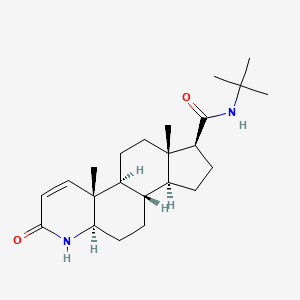
Pharmacotherapeutic group: 5α-reductase inhibitor. ATC code: D11AX10.
Mechanism of action
Finasteride is a competitive and specific inhibitor of type II 5α-reductase. Finasteride has no affinity for the androgen receptor and has no androgenic, anti-androgenic, oestrogenic, anti-oestrogenic, or progestational effects. Inhibition of this enzyme blocks the peripheral conversion of testosterone to the androgen DHT, resulting in significant decreases in serum and tissue DHT concentrations. Finasteride produces a rapid reduction in serum DHT concentration, reaching significant suppression within 24 hours of dosing.
Hair follicles contain type II 5α-reductase. In men with male pattern hair loss, the balding scalp contains miniaturised hair follicles and increased amounts of DHT. Administration of finasteride decreases scalp and serum DHT concentrations in these men. Men with a genetic deficiency of type II 5α-reductase do not suffer from male pattern hair loss. Finasteride inhibits a process responsible for miniaturisation of the scalp hair follicles, which can lead to reversal of the balding process.
Clinical efficacy and safety
Studies in men
Clinical studies were conducted in 1879 men aged 18 to 41 with mild to moderate, but not complete, vertex hair loss and/or frontal/mid-area hair loss. In the two studies in men with vertex hair loss (n=1553), 290 men completed 5 years of treatment with finasteride vs. 16 patients on placebo. In these two studies, efficacy was assessed by the following methods: (i) hair count in a representative 5.1cm
2
area of scalp, (ii) patient self-assessment questionnaire, (iii)investigator assessment using a seven point scale, and (iv) photographic assessment of standardised paired photographs by a blinded expert panel of dermatologists using a seven point scale.
In these 5- year studies men treated with finasteride improved compared to both baseline and placebo beginning as early as 3 months, as determined by both the patient and investigator assessments of efficacy. With regard to hair count, the primary endpoint in these studies, increases compared to baseline were demonstrated starting at 6 months (the earliest time point assessed) through to the end of the study. In men treated with finasteride these increases were greatest at 2 years and gradually declined thereafter to the end of 5 years; whereas hair loss in the placebo group progressively worsened compared to baseline over the entire 5 year period. In finasteride treated patients, a mean increase from baseline of 88 hairs [
p <0.01; 95% CI (77.9, 97.80; n=433]
in the representative 5.1 cm
2
area was observed at 2 years and an increase from baseline of 38 hairs
[p <0.01; 95% CI (20.8, 55.6); n=219]
was observed at 5years, compared with a decrease from baseline of 50 hairs
[p <0.01; 95% CI (-80.5, -20.6);n=47]
at 2 years and a decrease from baseline of 239 hairs
[p <0.01; 95% CI (-304.4, -173.4); n=15]
at 5 years in patients who received placebo. Standardised photographic assessment of efficacy demonstrated that 48% of men treated with finasteride for 5years were rated as improved, and an additional 42% were rated as unchanged. This is in comparison to 25% of men treated with placebo for 5 years who were rated as improved or unchanged. These data demonstrate that treatment with finasteride for 5 years resulted in a stabilisation of the hair loss that occurred in men treated with placebo.
An additional 48-week, placebo-controlled study designed to assess the effect of finasteride on the phases of the hair-growth cycle (growing phase [anagen] and resting phase [telogen]) in vertex baldness enrolled 212 men with androgenetic alopecia. At baseline and 48 weeks, total, anagen and telogen hair counts were obtained in a 1-cm
2
target area of the scalp. Treatment with finasteride led to improvements in anagen hair counts, while men in the placebo group lost anagen hair. At 48 weeks, men treated with finasteride showed net increases in total and anagen hair counts of 17hairs and 27 hairs, respectively, compared to placebo. This increase in anagen hair count, compared to total hair count, led to a net improvement in the anagen-to-telogen ratio of 47% at 48 weeks for men treated with finasteride, compared to placebo. These data provide direct evidence that treatment with finasteride promotes the conversion of hair follicles into the actively growing phase.
Studies in women
Lack of efficacy was demonstrated in post-menopausal women with androgenetic alopecia who were treated with finasteride in a 12 month, placebo-controlled study (n=137). These women did not show any improvement in hair count, patient self-assessment, investigator assessment, or ratings based on standardised photographs, compared with the placebo group.
⚠️ Warnings
Crushed or broken tablets should not be handled by women when they are or may potentially be pregnant because of the possibility of absorption of finasteride and subsequent potential risk to a male foetus (see 4.6 Pregnancy and lactation).
Finasteride are coated tablets and will prevent contact with the active ingredient during normal handling, provided that the tablets are not broken or crushed.
Any unused medicinal product or waste material should be disposed of in accordance with local requirements.