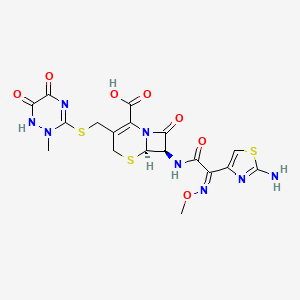
Pharmacotherapeutic group: Antibacterials for systemic use, Third-generation cephalosporins.
ATC code: J01DD04.
Mode of action
Ceftriaxone inhibits bacterial cell wall synthesis following attachment to penicillin binding proteins (PBPs). This results in the interruption of cell wall (peptidoglycan) biosynthesis, which leads to bacterial cell lysis and death.
Resistance
Bacterial resistance to ceftriaxone may be due to one or more of the following mechanisms:
• hydrolysis by beta-lactamases, including extended-spectrum beta-lactamases (ESBLs), carbapenemases and Amp C enzymes that may be induced or stably derepressed in certain aerobic Gram-negative bacterial species.
• reduced affinity of penicillin-binding proteins for ceftriaxone. • outer membrane impermeability in Gram-negative organisms.
• bacterial efflux pumps.
Susceptibility testing breakpoints
Minimum inhibitory concentration (MIC) breakpoints established by the European Committee on Antimicrobial Susceptibility Testing (EUCAST) are as follows:
Pathogen
Dilution Test
(MIC, mg/L)
Susceptible
Resistant
Enterobacteriaceae
≤ 1
> 2
Staphylococcus
spp.
a.
a.
Streptococcus
spp.
(
Groups A, B, C and G)
b.
b.
Streptococcus pneumoniae
≤ 0.5
c.
> 2
Viridans group
Streptococci
≤0.5
>0.5
Haemophilus influenzae
≤ 0.12
c.
> 0.12
Moraxella catarrhalis
≤ 1
> 2
Neisseria gonorrhoeae
≤ 0.12
> 0.12
Neisseria meningitidis
≤ 0.12
c.
> 0.12
Non-species related
≤ 1
d.
> 2
a. Susceptibility inferred from cefoxitin susceptibility.
b. Susceptibility inferred from penicillin susceptibility.
c. Isolates with a ceftriaxone MIC above the susceptible breakpoint are rare and, if found, should be re-tested and, if confirmed, should be sent to a reference laboratory.
d. Breakpoints apply to a daily intravenous dose of 1 g x 1 and a high dose of at least 2 g x 1.
Clinical efficacy against specific pathogens
The prevalence of acquired resistance may vary geographically and with time for selected species and local information on resistance is desirable, particularly when treating severe infections. As necessary, expert advice should be sought when the local prevalence of resistance is such that the utility of ceftriaxone in at least some types of infections is questionable.
Commonly susceptible species
Gram-positive aerobes
Staphylococcus aureus
(methicillin-susceptible)
£
Staphylococci coagulase-negative (methicillin-susceptible)
£
Streptococcus pyogenes
(Group A)
Streptococcus agalactiae
(Group B)
Streptococcus pneumoniae
Viridans Group
Streptococci
Gram-negative aerobes
Borrelia burgdorferi
Haemophilus influenzae
Haemophilus parainfluenzae
Moraxella
catarrhalis
Neisseria
gonorrhoea
Neisseria meningitidis
Proteus
mirabilis
Providencia
spp.
Treponema pallidum
Species for which acquired resistance may be a problem
Gram-positive aerobes
Staphylococcus epidermidis
+
Staphylococcus haemolyticus
+
Staphylococcus hominis
+
Gram-negative aerobes
Citrobacter
freundii
Enterobacter aerogenes
Enterobacter cloacae
Escherichia coli
%
Klebsiella pneumoniae
%
Klebsiella oxytoca
%
Morganella
morganii
Proteus vulgaris
Serratia
marcescens
Anaerobes
Bacteroides
spp
.
Fusobacterium
spp.
Peptostreptococcus
spp.
Clostridium perfringens
Inherently resistant organisms
Gram-positive aerobes
Enterococcus
spp.
Listeria monocytogenes
Gram-negative aerobes
Acinetobacter baumannii
Pseudomonas aeruginosa
Stenotrophomonas maltophilia
Anaerobes
Clostridium difficile
Others:
Chlamydia
spp.
Chlamydophila
spp.
Mycoplasma
spp.
Legionella
spp.
Ureaplasma urealyticum
£ All methicillin-resistant staphylococci are resistant to ceftriaxone.
+
Resistance rates >50% in at least one region
%
ESBL producing strains are always resistant
⚠️ Warnings
Concentrations for the intravenous injection: 100 mg/ml,
Concentrations for the intravenous infusion: 50 mg/ml
(Please refer to section 4.2 for further information).
Preparation of solutions for injection and infusion
The use of freshly prepared solutions is recommended. For storage conditions of the reconstituted medicinal product, see section 6.3.
Ceftriaxone should not be mixed in the same syringe with any drug other than 1% Lidocaine Hydrochloride solution (for intramuscular injection only).
The infusion line should be flushed after each administration.
Ceftriaxone 1 g Powder for Solution for Injection or Infusion
For IV injection 1 g Ceftriaxone is dissolved in 10 ml of water for injections; which produces a clear solution. The injection should be administered over 5 minutes, directly into the vein or via the tubing of an intravenous infusion.
For IM injection 1 g Ceftriaxone is dissolved in 3.5 ml of 1% Lidocaine Hydrochloride solution; which produces a clear solution. The solution should be administered by deep intramuscular injection. Dosages greater than 1 g should be divided and injected at more than one site.
The displacement volume of 1 g of Ceftriaxone is 0.71 ml in water for injections and 1% lidocaine hydrochloride solution. When adding 10 ml of water for injections, the final concentration of the reconstituted solution is 93.37 mg/ml. When adding 3.5 ml of 1% lidocaine hydrochloride solution, the final concentration of the reconstituted solution is 237.53 mg/ml.
Ceftriaxone 2 g Powder for Solution for Injection or Infusion
For IV infusion 2 g Ceftriaxone is dissolved in 40 ml of one of the following calciumfree infusion fluids: sodium chloride 0.9%, sodium chloride 0.45% + dextrose 2.5%, dextrose 5%, dextrose 10%, dextran 6% in dextrose 5%, hydroxyethly-starch 6 – 10%, water for injections; which produces a clear solution. The infusion should be administered over at least 30 minutes. See also the information in section 6.2.
The displacement volume of 2 g of Ceftriaxone is 1.37 ml in water for injections. When adding 40 ml of water for injections, the final concentration of the reconstituted solution is 48.34 mg/ml.
In neonates, intravenous doses should be given over 60 minutes to reduce the potential risk of bilirubin encephalopathy.