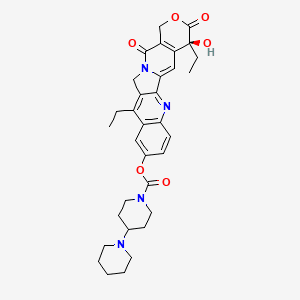
Pharmacotherapeutic group: other antineoplastic agents, irinotecan. ATC code: L01XX19
Experimental data
Irinotecan is a semisynthetic derivative of camptothecin. It is an antineoplastic agent acting as a specific inhibitor of DNA topoisomerase I. It is metabolised by carboxylesterases in most tissues to yield SN-38, which has been shown to be more active than irinotecan against purified topoisomerase I and more cytotoxic than irinotecan in several murine and human tumour cell lines. Inhibition of DNA topoisomerase I by irinotecan or SN-38 induces single-strand DNA lesions which block the DNA replication fork and are responsible for the cytotoxicity. This cytotoxic activity has been found to be time-dependent and S-phase specific.
In vitro, neither irinotecan nor SN-38 are significantly recognised by P-glycoprotein (MDR), and irinotecan exhibits cytotoxic activity against doxorubicin- and vinblastine-resistant cell lines.
In addition, irinotecan demonstrates a broad spectrum of in vivo antitumour activity in murine tumour models (P03 pancreatic ductal adenocarcinoma, MA16/C mammary adenocarcinoma, C38 and C51 colon adenocarcinoma) and against human xenografts (Co-4 colon adenocarcinoma, MX-1 mammary adenocarcinoma, ST-15 and SC-16 gastric adenocarcinoma). Irinotecan is also active against tumours expressing P-glycoprotein (MDR) (vincristine- and doxorubicin-resistant P388 leukaemia).
Beyond its antitumour activity, the most relevant pharmacological effect of irinotecan is inhibition of acetylcholinesterase.
Clinical data
Monotherapy in second-line treatment of metastatic colorectal cancer
More than 980 patients with metastatic colorectal cancer who had failed prior 5-FU therapy were enrolled in phase II/III clinical studies using a 3-weekly dosing schedule. The efficacy of irinotecan was evaluated in 765 patients with documented disease progression on 5-FU at study entry.
Progression-free survival at 6 months (%) / Survival at 12 months (%) / Median survival (months)
Phase III
Irinotecan versus best supportive care (BSC)
Irinotecan versus 5-FU
Irinotecan
BSC
p-values
Irinotecan
5-FU
p-values
n = 183
n = 90
n = 127
n = 129
NA
NA
p=0.0001
33.5*
26.7
p=0.03
36.2*
13.8
44.8*
32.4
p=0.0351
9.2*
6.5
p=0.0001
10.8*
8.5
p=0.0351
NA: Not applicable
*: Statistically significant difference
A total of 455 patients were enrolled in phase II clinical studies and treated on a 3-weekly dosing schedule. Thirty percent of patients were progression-free at 6 months and median survival was 9 months. Median time to progression was 18 weeks.
In addition, non-comparative phase II studies in 304 patients used a weekly dose of 125 mg/m2 administered as a 90-minute intravenous infusion for 4 consecutive weeks, followed by a 2-week rest period. In these studies, median time to progression was 17 weeks and median survival was 10 months. A similar safety profile was observed with the weekly dosing schedule in 193 patients receiving an initial dose of 125 mg/m2 compared with the 3-weekly schedule. Median time to onset of the first liquid stool was 11 days.
Combination therapy in first-line treatment of metastatic colorectal cancer
In combination with folinic acid and 5-fluorouracil
A phase III clinical study enrolled 385 previously untreated patients with metastatic colorectal cancer treated with either a 2-weekly schedule (see section 4.2) or a weekly schedule. On the 2-weekly schedule, irinotecan 180 mg/m2 was given on day 1, followed by an infusion of folinic acid (FA) (200 mg/m2 as a 2-hour intravenous infusion) and 5-FU (400 mg/m2 as an intravenous bolus, followed by 600 mg/m2 as a 22-hour intravenous infusion). On day 2, FA and 5-FU were administered again at the same doses and in the same manner. On the weekly schedule, irinotecan 80 mg/m2 was followed by an infusion of FA (500 mg/m2 as a 2-hour intravenous infusion) and then 5-FU (2,300 mg/m2 as a 24-hour intravenous infusion); this regimen was given for 6 weeks.
In the combination therapy study using the two regimens described above, the efficacy of irinotecan was assessed in 198 patients:
Combination regimen (n=198)
Weekly schedule (n=50)
2-weekly schedule (n=148)
Irin. + 5-FU/FA
5-FU/FA
Irin. + 5-FU/FA
5-FU/FA
Irin. + 5-FU/FA
5-FU/FA
Response rate (%) p-value
40.8*
23.1*
51.2*
2.6*
37.5*
21.6*
p<0.001
p=0.045
p=0.005
Median time to progression (months) p-value
6.7
4.4
7.2
6.5
6.5
3.7
p<0.001
NS
p=0.001
Median duration of response (months) p-value
9.3
8.8
8.9
6.7
9.3
9.5
NS
p=0.043
NS
Median duration of response and stabilisation (months) p-value
8.6
6.2
8.3
6.7
8.5
5.6
p<0.001
NS
p=0.003
Median time to treatment failure (months) p-value
5.3
3.8
5.4
5.0
5.1
3.0
p=0.0014
NS
p<0.001
Median survival (months) p-value
16.8
14.0
19.2
14.1
15.6
13.0
p=0.028
NS
p=0.041
Irin: irinotecan
5-FU: 5-fluorouracil; FA: folinic acid; NS: not significant
*: per-protocol population analysis
On the weekly schedule, severe diarrhoea occurred in 44.4% of patients treated with irinotecan in combination with 5-FU/FA and in 25.6% of patients treated with 5-FU/FA alone. Severe neutropenia (neutrophil count <500 cells/mm3) occurred in 5.8% of patients treated with irinotecan in combination with 5-FU/FA and in 2.4% of patients treated with 5-FU/FA alone.
In addition, the median time to definitive performance status deterioration was significantly longer in the irinotecan plus 5-FU/FA arm than in the 5-FU/FA alone arm (p=0.046).
Quality of life was assessed in this phase III study using the EORTC QLQ-C30 questionnaire. The time to definitive deterioration was consistently delayed in the irinotecan arms. Global health status/quality of life was slightly, though not significantly, better in the irinotecan combination arm, indicating that the efficacy of irinotecan combination therapy can be achieved without compromising quality of life.
In combination with cetuximab
EMR 62 202-013: This randomised study in patients with metastatic colorectal cancer who had not previously received treatment for metastatic disease compared the combination of cetuximab and irinotecan plus infusional 5-fluorouracil/folinic acid (5-FU/FA) (599 patients) with the same chemotherapy without cetuximab (599 patients). The proportion of patients with KRAS wild-type tumours among those with evaluable KRAS status was 64%.
Efficacy data from this study are summarised in the table below:
Overall population
KRAS wild-type tumour population
Variable/statistic
Cetuximab plus FOLFIRI (N=599)
FOLFIRI (N=599)
Cetuximab plus FOLFIRI (N=172)
FOLFIRI (N=176)
ORR
% (95% CI)
46.9 (42.9, 51.0)
38.7 (34.8, 42.8)
59.3 (51.6, 66.7)
43.2 (35.8, 50.9)
p-value
0.0038
0.0025
PFS
Hazard ratio (95% CI)
0.85 (0.726, 0.998)
p-value
0.0479
0.0167
CI = confidence interval; FOLFIRI = irinotecan plus infusional 5-FU/FA; ORR = objective response rate (patients with complete or partial response); PFS = progression-free survival
In combination with cetuximab after failure of irinotecan-containing cytotoxic therapy
The efficacy of the combination of irinotecan and cetuximab was assessed in two clinical studies. A total of 356 patients with EGFR-expressing metastatic colorectal cancer who had recently failed cytotoxic therapy including irinotecan and who had a minimum Karnofsky performance score of 60% — the majority having a score ≥80% — received combination therapy.
EMR 62 202-007: This randomised study compared the combination of irinotecan and cetuximab (218 patients) with cetuximab monotherapy (111 patients).
IMCL CP02-9923: This open-label, single-arm study evaluated combination therapy in 138 patients.
Results from these studies are summarised in the following table:
Study
n
ORR
DCR
PFS (months)
OS (months)
n [%]
95% CI
n [%]
95% CI
Median
95% CI
Median
95% CI
Cetuximab + irinotecan
EMR 62
218
50
17.5,
121
48.6,
4.1
2.8, 4.3
8.6
7.6, 9.6
202-007
(22.9)
29.1
(55.5)
62.2
IMCL
138
21
9.7,
84
52.2,
2.9
2.6, 4.1
8.4
7.2,
CP02-9923
(15.2)
22.3
(60.9)
69.1
10.3
Cetuximab
EMR 62
111
12
5.7,
36
23.9,
1.5
1.4, 2.0
6.9
5.6, 9.1
202-007
(10.8)
18.1
(32.4)
42.0
CI = confidence interval; DCR = disease control rate (patients with complete response, partial response, or stable disease for at least 6 weeks); ORR = objective response rate (patients with complete or partial response); OS = overall survival; PFS = progression-free survival
The efficacy of cetuximab in combination with irinotecan was greater than that of cetuximab monotherapy with respect to ORR, DCR, and PFS. No effect on overall survival was demonstrated in the randomised studies (hazard ratio 0.91, p=0.48).
In combination with bevacizumab
A phase III randomised, double-blind, active-controlled clinical study investigated bevacizumab in combination with irinotecan/5-FU/FA as first-line treatment of metastatic colorectal cancer (study AVF2107g). The addition of bevacizumab to irinotecan/5-FU/FA produced a statistically significant improvement in overall survival. Clinical benefit, as measured by overall survival, was observed across all pre-specified patient subgroups, including those defined by age, sex, performance status, location of primary tumour, number of organs involved, and duration of disease. Refer also to the bevacizumab Summary of Product Characteristics for further information.
Results of study AVF2107g are summarised in the following table:
Arm 1: Irinotecan/5-FU/FA/placebo
Arm 2: Irinotecan/5-FU/FA/bevacizumab a
Number of patients
411
402
Overall survival
Median [months]
15.6
20.3
95% confidence interval
14.29 – 16.99
18.46 – 24.18
Hazard ratio b
0.660
p-value
0.00004
Progression-free survival
Median [months]
6.2
10.6
Hazard ratio b
0.54
p-value
< 0.0001
Overall objective response rate
Rate [%]
34.8
44.8
95% confidence interval
30.2 – 39.6
39.9 – 49.8
p-value
0.0036
Duration of response
Median [months]
7.1
10.4
25th–75th percentile [months]
4.7 – 11.8
6.7 – 15.0
a 5 mg/kg every 2 weeks; b relative to the control arm.
In combination with capecitabine
Data from a randomised, controlled phase III study (CAIRO) support the use of capecitabine at a starting dose of 1,000 mg/m2 administered for 2 weeks every 3 weeks in combination with irinotecan as first-line treatment of patients with metastatic colorectal cancer. A total of 820 patients were randomised to receive either sequential treatment (n=410) or combination treatment (n=410). Sequential treatment consisted of first-line capecitabine (1,250 mg/m2 twice daily for 14 days), second-line irinotecan (350 mg/m2 on day 1), and third-line capecitabine (1,250 mg/m2 twice daily for 14 days) combined with oxaliplatin (130 mg/m2 on day 1). Combination treatment consisted of first-line capecitabine (1,000 mg/m2 twice daily for 14 days) combined with irinotecan (250 mg/m2 on day 1) (XELIRI), followed by second-line capecitabine (1,000 mg/m2 twice daily for 14 days) with oxaliplatin (130 mg/m2 on day 1). All treatment cycles were given at 3-week intervals.
In the first-line setting, median progression-free survival in the intention-to-treat population was 5.8 months (95% CI, 5.1–6.2 months) for capecitabine monotherapy and 7.8 months (95% CI, 7.0–8.3 months) for XELIRI (p=0.0002).
Data from an interim analysis of a multicentre, randomised, controlled phase III study (AIO KRK 0604) support the use of capecitabine at a starting dose of 800 mg/m2 administered for 2 weeks every 3 weeks in combination with irinotecan and bevacizumab as first-line treatment of patients with metastatic colorectal cancer. A total of 115 randomised patients received capecitabine in combination with irinotecan (XELIRI) and bevacizumab: capecitabine (800 mg/m2 twice daily for 2 weeks followed by a 7-day rest period), irinotecan (200 mg/m2 administered as a 30-minute infusion on day 1 every 3 weeks), and bevacizumab (7.5 mg/m2 administered as a 30- to 90-minute infusion on day 1 every 3 weeks); a total of 118 randomised patients received capecitabine in combination with oxaliplatin and bevacizumab: capecitabine (1,000 mg/m2 twice daily for 2 weeks followed by a 7-day rest period), oxaliplatin (130 mg/m2 administered as a 2-hour infusion on day 1 every 3 weeks), and bevacizumab (7.5 mg/m2 administered as a 30- to 90-minute infusion on day 1 every 3 weeks). Six-month progression-free survival in the intention-to-treat population was 80% (XELIRI plus bevacizumab) versus 74% (XELOX plus bevacizumab). Overall response (complete plus partial response) was 45% (XELOX plus bevacizumab) versus 47% (XELIRI plus bevacizumab).
Pharmacokinetic/pharmacodynamic data
The intensity of the major toxicities encountered with irinotecan (e.g. diarrhoea and neutropenia) is related to exposure (AUC) to the parent drug and to the SN-38 metabolite. In monotherapy, significant correlations were observed between the intensity of haematological toxicity (decrease in nadir leucocyte and neutrophil counts) or diarrhoea and the AUC values of both irinotecan and the SN-38 metabolite.
Patients with reduced UGT1A1 activity:
Uridine diphosphate-glucuronosyl transferase 1A1 (UGT1A1) is involved in the metabolic inactivation of SN-38, the active metabolite of irinotecan, to the inactive SN-38 glucuronide (SN-38G). The UGT1A1 gene is highly polymorphic, resulting in interindividual variability in metabolic capacity. One specific UGT1A1 gene variant involves a polymorphism in the promoter region known as the UGT1A1*28 variant. This variant, together with other congenital disorders of UGT1A1 expression (such as Crigler-Najjar and Gilbert's syndrome), is associated with reduced activity of this enzyme. Data from a meta-analysis suggest that patients with Crigler-Najjar syndrome (types 1 and 2) or those homozygous for the UGT1A1*28 allele (Gilbert's syndrome) are at increased risk of grade 3 and 4 haematological toxicity following administration of irinotecan at moderate or high doses (>150 mg/m2). The relationship between UGT1A1 genotype and the occurrence of irinotecan-induced diarrhoea has not been established.
Patients known to be homozygous for UGT1A1*28 should receive the standard starting dose of irinotecan; however, these patients should be monitored for haematological toxicity. A reduced starting dose of irinotecan should be considered in patients who experienced haematological toxicity with prior treatment. The exact reduction in starting dose for this patient population has not been established, and any subsequent dose modifications should be based on the patient's tolerance to therapy (see sections 4.2 and 4.4).
At present, there are insufficient data to assess the clinical utility of UGT1A1 genotyping.
⚠️ Warnings
Irinotecan should be used only in units specialised in the administration of cytotoxic chemotherapy and must be administered only under the supervision of a physician qualified in the use of cancer chemotherapy.
Given the nature and incidence of adverse reactions, irinotecan should be prescribed in the following cases only after the expected benefit of treatment has been weighed against the possible risks:
in patients with a risk factor, particularly those with a WHO performance status of 2;
in the few cases where patients are deemed unlikely to comply with the recommendations for managing adverse reactions (immediate need for prolonged anti-diarrhoeal treatment combined with high fluid intake as soon as delayed diarrhoea occurs). Close in-hospital monitoring is recommended for these patients.
When irinotecan is used as monotherapy, it is usually prescribed on a 3-weekly dosing schedule. A weekly dosing schedule may be considered in patients who require closer monitoring (see section 5) or who are at higher risk of severe neutropenia.
Delayed diarrhoea
Patients should be made aware of the risk of delayed diarrhoea, defined as diarrhoea occurring more than 24 hours after irinotecan administration and at any time prior to the next cycle. In monotherapy, the median time to onset of the first liquid stool was 5 days after the irinotecan infusion. Patients should promptly inform their physician of the onset of diarrhoea and immediately initiate appropriate treatment.
Patients at increased risk of diarrhoea include those with prior abdominal/pelvic radiotherapy, those with baseline leucocytosis, those with a performance status ≥2, and women. If left untreated, diarrhoea may be life-threatening, particularly when accompanied by neutropenia.
At the first occurrence of liquid stool, the patient should begin drinking large volumes of electrolyte-containing fluids, and appropriate anti-diarrhoeal therapy must be started immediately. Steps must be taken to ensure that the physician administering irinotecan also prescribes anti-diarrhoeal medication. Patients should obtain the prescribed medication on discharge from hospital so that diarrhoea can be treated as soon as it occurs. In addition, the patient must inform the physician or the centre administering irinotecan of the onset of diarrhoea.
Currently recommended treatment of diarrhoea consists of high-dose loperamide (4 mg initially, then 2 mg every 2 hours). This therapy must be continued for 12 hours after the last liquid stool and should not be modified. Treatment must be continued for at least 12 hours, but loperamide should under no circumstances be used at these doses for more than 48 hours, owing to the risk of paralytic ileus.
If diarrhoea is accompanied by severe neutropenia (neutrophil count <500/mm3), prophylactic broad-spectrum antibiotic therapy should be administered in addition to anti-diarrhoeal treatment.
In addition to antibiotic therapy, hospitalisation for management of diarrhoea is recommended in the following cases:
diarrhoea associated with fever;
severe diarrhoea (requiring parenteral rehydration);
diarrhoea persisting for more than 48 hours after initiation of high-dose loperamide therapy.
Loperamide should not be administered prophylactically, including in patients who experienced delayed diarrhoea during a previous cycle.
In patients who have experienced severe diarrhoea, dose reduction is recommended for subsequent cycles (see section 4.2).
Haematology
Weekly monitoring of complete blood counts is recommended during irinotecan treatment. Patients should be informed of the risk of neutropenia and the significance of fever. Febrile neutropenia (temperature >38°C and neutrophil count ≤1,000/mm3) must be treated urgently in hospital with intravenous broad-spectrum antibiotics.
In patients with a history of severe haematological toxicity, dose reduction is recommended for subsequent cycles (see section 4.2).
Patients with severe diarrhoea are at increased risk of infection and haematological toxicity. A complete blood count should be performed in these patients.
Hepatic impairment
Liver function tests must be performed before initiation of treatment and before each subsequent treatment cycle.
Weekly monitoring of complete blood counts is required in patients with bilirubin levels 1.5 to 3 times the ULN, as these patients have reduced clearance of irinotecan (see section 5.2) and are therefore at increased risk of haematotoxicity. For patients with bilirubin levels greater than 3 times the ULN, see section 4.3.
Nausea and vomiting
Prophylactic antiemetic therapy is recommended before each administration of irinotecan. Nausea and vomiting are frequently reported. Patients with vomiting associated with delayed diarrhoea should be hospitalised as soon as possible.
Acute cholinergic syndrome
In the event of acute cholinergic syndrome (defined as early diarrhoea and certain other signs and symptoms such as sweating, abdominal cramps, miosis, and salivation), atropine sulfate (0.25 mg subcutaneously) should be administered, unless clinically contraindicated (see section 4.8).
Caution is advised in patients with asthma. In patients who experience an acute cholinergic syndrome, prophylactic atropine sulfate is recommended for subsequent administrations of irinotecan.
Respiratory disorders
Pulmonary infiltrates suggestive of interstitial lung disease have been observed uncommonly during irinotecan therapy. This may be fatal. Possible risk factors associated with the development of interstitial lung disease include the use of pneumotoxic medicinal products, radiotherapy, and the use of growth factors. Patients with these risk factors should be closely monitored prior to and during irinotecan therapy.
Extravasation
Although irinotecan is not known to be a vesicant, care should be taken to avoid extravasation, and the infusion site should be monitored for signs of inflammation. In the event of extravasation, flushing of the site and application of ice are recommended.
Cardiac disorders
Myocardial ischaemic events have been observed following irinotecan therapy, predominantly in patients with underlying cardiac disease, other known risk factors for cardiac disease, or prior cytotoxic chemotherapy (see section 4.8 Adverse reactions).
Therefore, patients with known risk factors should be closely monitored, and steps should be taken to minimise all modifiable risk factors (e.g. smoking, hypertension, and hyperlipidaemia).
Immunosuppressive effects/increased susceptibility to infections
Administration of live or attenuated vaccines to patients immunocompromised by chemotherapeutic agents, including irinotecan, may result in serious or fatal infections. Therefore, patients receiving irinotecan should not be vaccinated with live vaccines. Killed or inactivated vaccines may be administered; however, the response to such vaccines may be diminished.
Elderly patients
Owing to the increased frequency of decreased biological function, such as hepatic function, in elderly patients, dose adjustment of irinotecan should be undertaken with greater caution in this population (see section 4.2).
Chronic inflammatory bowel disease and/or intestinal obstruction
Patients should not be treated with irinotecan until resolution of the ileus (see section 4.3).
Patients with renal impairment
Clinical studies have not been conducted in this patient population (see sections 4.2 and 5.2).
Other
As this medicinal product contains sorbitol, it is not suitable for patients with hereditary fructose intolerance. In rare cases, patients who developed dehydration in association with diarrhoea and/or vomiting, or sepsis, have experienced renal impairment, hypotension, or circulatory collapse.
Effective contraception must be used during treatment and for at least 3 months after its discontinuation (see section 4.6).
Concomitant administration of irinotecan with strong inhibitors (e.g. ketoconazole) or inducers (e.g. rifampicin, carbamazepine, phenobarbital, phenytoin, St John's wort) of cytochrome P450 3A4 (CYP3A4) should be avoided, as this may affect the metabolism of irinotecan (see section 4.5).