Pharmacotherapeutic group: Other haematological agents, ATC code: B06AX05
Mechanism of action
Casgevy is a cellular therapy consisting of autologous CD34
+
human haematopoietic stem and progenitor cells edited by CRISPR/Cas9-technology. The guide RNA enables CRISPR/Cas9 to make a precise DNA double-strand break at the critical transcription factor binding site (GATA1) in the erythroid-specific enhancer region of the
BCL11A
gene. As a result of the editing, GATA1 binding is irreversibly disrupted and BCL11A expression reduced. Reduced BCL11A expression results in an increase in γ-globin expression and foetal haemoglobin protein production in erythroid cells, addressing the absent globin in transfusion-dependent β-thalassemia and the aberrant globin in sickle cell disease, which are the underlying causes of disease. In patients with transfusion-dependent β-thalassemia, γ-globin production corrects the α-globin to non-α-globin imbalance thereby reducing ineffective erythropoiesis and haemolysis and increasing total haemoglobin levels, eliminating the dependence on regular red blood cell transfusions. In patients with severe sickle cell disease, foetal haemoglobin expression reduces intracellular haemoglobin S concentration, preventing the red blood cells from sickling, thereby eliminating vaso-occlusive crises. Following successful engraftment, the effects of Casgevy are expected to be life-long.
Pharmacodynamic effects
Transfusion-dependent β-thalassemia
Allelic editing in the peripheral blood was detectable within 1 month after Casgevy infusion. At month 3 the mean (SD) proportion of alleles with intended genetic modification in peripheral blood was 65.6% (11.5%; n=41) and remained stable up to month 24. The mean (SD) proportion of alleles with intended genetic modification in CD34
+
cells of the bone marrow was 77.4% (11.8%; n=38) at month 6 (the first evaluation) and thereafter remained stable up to month 24.
Sickle cell disease
Allelic editing in the peripheral blood was detectable within 1 month after Casgevy infusion. At month 3 the mean (SD) proportion of alleles with intended genetic modification in peripheral blood was 71.5% (10.4%; n=29) and remained stable up to month 24. The mean (SD) proportion of alleles with intended genetic modification in CD34
+
cells of the bone marrow was 85.9% (8.3%; n=28) at month 6 (the first evaluation) and thereafter remained stable up to month 24.
Clinical efficacy and safety
The efficacy of Casgevy was evaluated in adolescent and adult patients with transfusion-dependent β-thalassemia or sickle cell disease in two on-going open-label, single-arm studies (study 111 and study 121) and one long-term follow-up study (study 131).
Refer to the UK Public Assessment Report on the MHRA website for details of cell mobilisation, apheresis, and myeloablative conditioning used in the clinical studies for Casgevy.
Transfusion-dependent β-thalassemia
Study 111 is an ongoing open-label, multicentre, single-arm study to evaluate the safety and efficacy of Casgevy in adult and adolescent patients with transfusion-dependent β-thalassemia. After completion of 24 months of follow-up in study 111, patients were invited to enrol in study 131, an ongoing long-term safety and efficacy study.
Patients were eligible for the study if they had a history of requiring at least 100 mL/kg/year or 10 units/year of red blood cell transfusions in the 2 years prior to enrolment. Patients were also required to have a Lansky or Karnofsky performance score of ≥ 80%.
Patients who had severely elevated iron in the heart (i.e., patients with cardiac T2* less than 10 msec by magnetic resonance imaging [MRI]) or advanced liver disease were excluded from the study. MRI of the liver was performed on all patients. Patients with MRI results demonstrating liver iron content ≥ 15 mg/g underwent liver biopsy for further evaluation. Patients with a liver biopsy demonstrating bridging fibrosis or cirrhosis were excluded.
The key demographics and baseline characteristics for patients eligible for the primary efficacy analysis in study 111 are shown in Table 5, below.
Table 5: Study 111 demographics and baseline characteristics (primary efficacy set)
Demographics and disease characteristics
Casgevy
Interim Analysis *
(N=42)
Age (years), n (%)
Adults (≥ 18 and ≤ 35 years)
Adolescents (≥ 12 and < 18 years)
29 (69.0%)
13 (31.0%)
All ages (≥ 12 and ≤ 35 years)
Median (min, max)
20 (12, 35)
Sex, n (%)
Female
21 (50.0%)
Male
21 (50.0%)
Race, n (%)
Asian
16 (38.1%)
White
17 (40.5%)
Multiracial
3 (7.1%)
Other
1 (2.4%)
Not collected
5 (11.9%)
Genotype, n (%)
β
0
/β
0
-like
†
25 (59.5%)
Non-β
0
/β
0
-like
17 (40.5%)
Baseline annualised Red Blood Cell transfusion volume (mL/kg)
Median (min, max)
201.0 (115.2, 330.9)
Baseline annualised Red Blood Cell transfusion episodes (number/year)
Median (min, max)
16.5 (10.5, 34.5)
Spleen intact, n (%)
30 (71.4%)
Baseline liver iron concentration (mg/g)
Median (min, max)
3.8 (1.2, 14.0)
Baseline cardiac iron T2* (msec)
Median (min, max)
34.8 (12.4, 61.1)
Baseline serum ferritin (pmol/L)
Median (min, max)
3157.0 (584.2, 10837.3)
* Analysis conducted based on April 2023 data cut
†
Low to no endogenous β-globin production (β
0
/β
0
,
β
0
/IVS-I-110 and IVS-I-110/IVS-I-110)
To maintain a total haemoglobin concentration ≥ 11 g/dL patients underwent red blood cell transfusions prior to mobilisation and apheresis. If transfusions were not continued to maintain haemoglobin at ≥ 11 g/dL after apheresis, they were reinitiated at least 60 days prior to the start of myeloablative conditioning to achieve the same target total haemoglobin levels.
Iron chelation therapy was discontinued at least seven days prior to initiation of myeloablative conditioning.
Casgevy administration
Patients were administered Casgevy with a median (min, max) dose of 8.0 (3.0, 19.7) × 10
6
CD34
+
cells/kg as an IV infusion.
Efficacy results – β-thalassemia
At the time of the interim analysis 54 patients had been administered Casgevy. Forty-two patients were eligible for the primary efficacy analysis. Twenty-three patients have completed study 111 and enrolled into a long-term follow-up study. The median (min, max) total duration of follow-up was 22.8 (2.1, 51.1) months from the time of Casgevy infusion.
39 of 42 patients achieved the primary outcome by maintaining an average Hb ≥9 g/dL without red blood cell transfusions for at least 12 consecutive months any time after Casgevy infusion.
Three patients did not achieve the primary outcome. These patients had reductions in annualised red blood cell transfusion frequency requirements of 73.4%, 82.4% and 96.0%, respectively, compared to baseline requirements.
Refer to the UK Public Assessment Report on the MHRA website for results of additional outcome measures.
Sickle Cell Disease
Study 121 is an ongoing open-label, multicentre, single-arm study to evaluate the safety and efficacy of Casgevy in adult and adolescent patients with sickle cell disease. After completion of 24 months of follow-up in study 121, patients were invited to enrol in study 131, an ongoing long-term safety and efficacy study.
Patients were eligible for the study if they had a history of at least 2 severe vaso-occlusive crisis events per year in the 2 years prior to screening, which were defined as:
• Acute pain event requiring a visit to a medical facility and administration of pain medications (opioids or intravenous non-steroidal anti-inflammatory drugs) or red blood cell transfusions
• Acute chest syndrome
• Priapism lasting > 2 hours and requiring a visit to a medical facility
• Splenic sequestration.
Patients with Hb
S/S
, Hb
S/β0
and Hb
S/β+
genotypes were eligible for inclusion. Patients were also required to have a Lansky or Karnofsky performance score of ≥ 80%.
Patients were excluded if they had advanced liver disease, history of untreated Moyamoya disease or presence of Moyamoya disease that in the opinion of the investigator put the patient at risk of bleeding. Patients aged 12 to 16 years were required to have normal transcranial doppler and patients aged 12 to 18 years were excluded if they had any history of abnormal transcranial doppler in the middle cerebral artery and the internal carotid artery.
The key demographics and baseline characteristics for patients eligible for the primary efficacy analysis in study 121 are shown in Table 6, below.
Table 6: Study 121 demographics and baseline characteristics (primary efficacy set)
Demographics and disease characteristics
Casgevy
Interim Analysis *
(N=29)
Age (years), n (%)
Adults (≥ 18 and ≤ 35 years)
23 (79.3%)
Adolescents (≥ 12 and < 18 years)
6 (20.7%)
All ages (≥ 12 and ≤ 35 years)
Median (min, max)
21 (12, 34)
Sex, n (%)
Male
16 (55.2%)
Female
13 (44.8%)
Race, n (%)
Black or African American
26 (89.7%)
White
1 (3.4%)
Other
2 (6.9%)
Genotype, n (%)
β
S
/β
S
28 (96.6%)
β
S
/β
0
1 (3.4%)
β
S
/β
+
0 (0%)
Annualised rate of severe vaso-occlusive crises in the 2 years prior to enrolment (events/year)
Median (min, max)
3.0 (2.0, 9.5)
Annualised rate of hospitalisations due to severe vaso-occlusive crises in the 2 years prior to enrolment (events/year)
Median (min, max)
2.0 (0.5, 8.5)
Annualised duration of hospitalisation due to severe vaso-occlusive crises in the 2 years prior to enrolment (days/year)
Median (min, max)
12.5 (2.0, 64.6)
Annualised units of Red Blood Cells transfused for Sickle Cell Disease-related indications in the 2 years prior to enrolment (units/year)
Median (min, max)
3.5 (0.0, 75.5)
* Analysis conducted based on April 2023 data cut
Patients underwent red blood cell exchange or simple transfusions to achieve a target haemoglobin S < 30% of total haemoglobin, while keeping total haemoglobin concentration ≤ 11 g/dL, for a minimum of eight weeks before the planned start of mobilisation. If exchange or simple transfusions were paused after apheresis, they were reinstated at least eight weeks prior to the start of myeloablative conditioning to achieve the same target total haemoglobin and Haemoglobin S (%) levels.
At initiation of red blood cell exchange or simple transfusions, disease modifying therapies were discontinued. Iron chelation therapy was discontinued at least seven days prior to myeloablative conditioning.
Casgevy administration
Patients were administered Casgevy with a median (min, max) dose of 4.0 (2.9, 14.4) × 10
6
CD34
+
cells/kg as an IV infusion.
Efficacy results – Sickle Cell Disease
At the time of the interim analysis 43 patients had been administered Casgevy. Twenty-nine patients were eligible for the primary efficacy analysis. Thirteen patients had completed study 121 and enrolled into a long-term follow-up study. The median (min, max) total duration of follow-up was 17.5 (1.2, 46.2) months from the time of Casgevy infusion.
28 of 29 patients achieved the primary outcome by not experiencing any severe vaso-occlusive crisis for at least 12 consecutive months after Casgevy infusion.
Refer to the UK Public Assessment Report on the MHRA website for results of additional outcome measures.
Paediatric population
The MHRA has deferred the obligation to submit the results of studies with Casgevy in one or more subsets of the paediatric population in β-thalassemia and sickle cell disease (see section 4.2 for information on paediatric use).
Conditional approval
This medicinal product has been authorised under a so-called 'conditional approval' scheme. This means that further evidence on this medicinal product is awaited. The Medicines and Healthcare products Regulatory Agency will review new information on this medicinal product at least every year and this Summary of Product Characteristics will be updated as necessary.
⚠️ Warnings
Precautions to be taken before handling or administering the medicinal product
Do not sample, alter, or irradiate the medicinal product. Irradiation could lead to inactivation of the product.
This medicinal product contains human blood cells. Healthcare professionals handling Casgevy should take appropriate precautions (wearing gloves, protective clothing and eye protection) to avoid potential transmission of infectious diseases.
Receipt and storage of Casgevy
• Casgevy is shipped to the treatment centre frozen in the vapour phase of liquid nitrogen.
• Confirm patient identifiers on the product label(s) and lot information sheet.
• If there are any concerns about the product or packaging upon receipt, contact Vertex at 0800-028-2616.
• Store in the vapour phase of liquid nitrogen at ≤ -135 ºC until ready for thaw and administration.
Preparation prior to administration
Preparation for the infusion
• Coordinate the timing of Casgevy thaw and infusion. Confirm the infusion time in advance and adjust the start time for thaw so that Casgevy is available for infusion when the patient is ready, as Casgevy must be administered within 20 minutes of thawing the vial. Thaw and infuse one vial at a time.
• Before thaw, confirm the patient's identity matches the patient information on the Casgevy vial(s). Do not remove the Casgevy vials from cryo-storage if the information on the patient-specific label does not match the intended patient.
• A dose of Casgevy may be contained in one or more cryopreserved patient-specific vial(s). Account for all vials and confirm each vial is within the expiry date using the accompanying lot information sheet.
• Inspect the vial(s) for any breaks or cracks prior to thawing. If a vial is compromised, do not infuse the contents. Call Vertex at 0800-028-2616.
• Assemble supplies needed to thaw and withdraw the product from the vial(s). With the exception of the water bath, these supplies are single use. Assemble sufficient supplies for each vial to be administered:
o
Water bath
o
Alcohol swabs
o
Vial adapter (to allow for needle-less extraction)
o
18 micron stainless steel filter
o
30 mL luer-lock syringe
o
0.9% sodium chloride (saline, 5 to 10 mL needed for each vial)
o
10 mL luer-lock syringe for saline rinse
Thawing the Casgevy vials
• When the dose consists of multiple vials, thaw and administer one vial at a time. While thawing a vial, remaining vials must remain in cryo-storage at ≤ -135 ºC.
• Thaw each vial at 37 ºC using a water bath. Ensure water bath temperature does not exceed 40 ºC.
• Thaw each vial holding the vial neck, gently agitating clockwise and counterclockwise. This can take between 10 to 15 minutes.
• Do not leave vial unattended during thaw.
• Thawing is complete when ice crystals are no longer visible in the vial.
• Remove vial from water bath immediately once thawed.
• The thawed product should appear as a translucent cell dispersion, which may contain visible particles.
• Infuse within 20 minutes of thaw.
Administration of Casgevy
Casgevy is for autologous use only. The patient's identity must match the patient identifiers on the Casgevy vial(s). Do not infuse Casgevy if the information on the patient-specific label does not match the intended patient.
A patient's dose may consist of multiple vials. All vials must be administered.
The entire volume of each vial provided should be infused. If more than one vial is provided, administer each vial completely before proceeding to thaw and infuse the next vial.
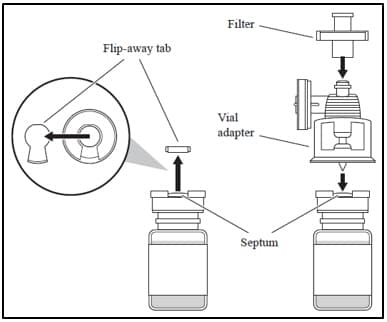
Attaching the vial adapter and filter
• Remove the flip-away tab of the vial cap; clean the septum with an alcohol swab.
• Remove the cap on the adapter spike.
• With the thumb and forefinger of both hands, push the adapter into the vial septum, applying equal pressure until you hear a single pop.
• Pull up on the adapter until you feel it lock.
• Attach the filter to the vial adapter.
Withdrawing Casgevy from the vial
• Attach an empty 30 mL syringe to the filter.
• Withdraw the entire vial product volume.
• Remove the product-filled syringe from the filter and set aside.
• Draw 5 to 10 mL of saline into the empty 10 mL syringe.
• Attach the saline-filled syringe to the filter.
• Inject the saline into the Casgevy vial and remove the empty syringe from the filter. Discard the empty syringe.
• Attach the product-filled syringe to the filter.
• Withdraw the contents of the vial into the product syringe, then remove the syringe from the filter.
• The optional product/patient identifier label can be peeled from the lot information sheet and affixed to the syringe.
Administration of Casgevy through a central venous catheter
• Casgevy must be administered within 20 minutes of product thaw.
• Perform a two-person confirmation and verification of patient's identification at the bedside prior to the infusion of each vial(s).
• Casgevy is administered as an intravenous bolus.
• The total volume of Casgevy administered within one hour must not exceed 2.6 mL/kg.
• Do not use an inline filter when infusing Casgevy.
• After administration of each vial of Casgevy, flush the primary line with 0.9% sodium chloride solution.
Repeat the steps listed above for each remaining vial.
After administration of Casgevy
• Monitor vital signs every 30 minutes from when the first vial of Casgevy is infused until 2 hours after the last vial of Casgevy is infused.
• Standard procedures for patient management after haematopoietic stem cell transplantation should be followed after Casgevy infusion.
• Irradiate any blood products required within the first 3 months after Casgevy infusion.
• Patients should not donate blood, organs, tissues, or cells at any time in the future.
Precautions to be taken for the disposal of the medicinal product
Unused medicinal product and all material that has been in contact with Casgevy (solid and liquid waste) should be handled and disposed of as potentially infectious waste in accordance with local guidelines on handling human-derived material.
Accidental exposure
In case of accidental exposure local guidelines on handling of human-derived material should be followed. Work surfaces and materials which have potentially been in contact with Casgevy must be decontaminated with appropriate disinfectant.