This information is for educational purposes only. It is not intended as medical advice. Always consult a qualified healthcare professional.
Tacrolimus — Description, Dosage, Side Effects | PillsCard
Rx
Tacrolimus
0,5 mg, Kapsułki o przedłużonym uwalnianiu, twarde
INN: Tacrolimusum
Available in:
🇨🇿🇩🇪🇬🇧🇯🇵🇵🇱🇵🇹🇸🇰🇹🇷
Form
Kapsułki o przedłużonym uwalnianiu, twarde
Dosage
0,5 mg
Route
doustna
Storage
Store and Dispense Tacrolimus capsules, USP should be stored at 20° to 25°C (68° to 77°F) [see USP Controlled Room Temperature]. 16.4 Handling and Disposal Tacrolimus can cause fetal harm. Tacrolimus capsules should not be opened or crushed. Avoid inhalation or direct contact with skin or mucous membranes of the powder contained in tacrolimus capsules. If such contact occurs, wash the skin thoroughly with soap and water; if ocular contact occurs, rinse eyes with water. In case a spill occurs, wipe the surface with a wet paper towel. Follow applicable special handling and disposal procedures1.
User Reviews
Reviews reflect personal experiences and are not medical advice. Always consult your doctor.
About This Product
Manufacturer
Astellas Pharma Europe B.V. (Irlandia)
Composition
Tacrolimus 0,5 mg
ATC Code
L04AD02
Source
URPL
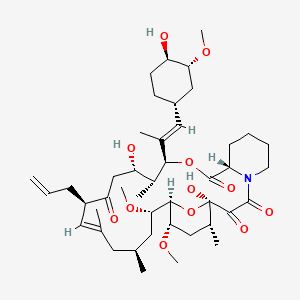
11 DESCRIPTION Tacrolimus USP, previously known as FK506, is the active ingredient in Tacrolimus capsules, USP. Tacrolimus is a calcineurin-inhibitor immunosuppressant produced by Streptomyces tsukubaensis . Chemically, tacrolimus USP is designated as 15,19-Epoxy-3H-pyrido[2,1-c][1,4]oxaazacyclotricosine-1,7,20,21(4H,23H)-tetrone 5,6,8,11,12,13,14,15,16,17,18,19,24,25,26,26a-hexadecahydro-5,19-dihydroxy-3-[2-(4-hy-droxy-3-methoxy cyclohexyl)-1-methylethenyl]-14,16-dimethoxy-4,10,12,18-tetramethyl-8- (2-propenyl)-, mono-hydrate, [3S [3R*,E(1S*,3S*,4S*)], 4S*,5R*,8S*,9E,12R*,-14R*,15S*,16R*,18S*,19S*,26aR*]]-; (-)- (3S,4R,5S,8R, 9E,12S,14S,15R,16S,18R,19R,26aS)-8-Allyl-5,6,8,11,12,13,14,15,16,17,18,19,24, 25,26,26ahexadecahydro- 5,19-dihydroxy-3-[(E)-2-[(1R,3R,4R)-4- hydroxy-3-methoxycyclohexyl]-1-methylvinyl]-14,16- dimethoxy-4,10,12,18-tetramethyl-15,19-epoxy-3Hpyrido[ 2,1-c][1,4] oxaazacyclotricosine-1,7,20,21(4H,23H)- te-trone, monohydrate. The chemical structure of tacrolimus is: Tacrolimus USP has an empirical formula of C 44 H 69 NO 12 •H 2 O and a formula weight of 822.03. Tacrolimus USP appears as white to off-white powder. It is soluble in methanol, ethanol, acetone, ethyl acetate and chloroform. Insoluble in water. Tacrolimus USP is available for oral administration as capsules (tacrolimus capsules USP) containing the equivalent of 0.5 mg, 1 mg or 5 mg of anhydrous tacrolimus USP. Inactive ingredients include lactose anhydrous NF, croscarmellose sodium NF, hypromellose USP, magnesium stearate NF. The 0.5 mg capsule shell contains ferric oxide yellow, gelatin NF and titanium dioxide USP, the 1 mg capsule shell contains gelatin NF and titanium dioxide USP, and the 5 mg capsule shell contains ferric oxide red, gelatin NF, and titanium dioxide USP. Contains no ingredient made from a gluten-containing grain (wheat, barley, or rye). The components of red ink used in Tacrolimus capsules USP, 0.5 mg and 1 mg are Shellac, Propylene glycol, Sodium hydroxide, Titanium dioxide, Povidone and FD&C Red Aluminium Lake. The components of white ink used in Tacrolimus capsules USP, 5 mg are Shellac, Propylene glycol, Ammonia solution, Titanium dioxide and Potassium Hydroxide. Tacrolimus capsules meet USP Organic Impurities, Procedure 2. FDA approved dissolution test specifications differ from USP.
⚠️ Warnings
WARNINGS WARNING Long-term Safety of Topical Calcineurin Inhibitors Has Not Been Established Although a causal relationship has not been established, rare cases of malignancy (e.g., skin and lymphoma) have been reported in patients treated with topical calcineurin inhibitors, including tacrolimus ointment. Therefore: • Continuous long-term use of topical calcineurin inhibitors, including tacrolimus ointment, in any age group should be avoided, and application limited to areas of involvement with atopic dermatitis. • Tacrolimus ointment is not indicated for use in children less than 2 years of age. Only 0.03% tacrolimus ointment is indicated for use in children 2-15 years of age. Prolonged systemic use of calcineurin inhibitors for sustained immunosuppression in animal studies and transplant patients following systemic administration has been associated with an increased risk of infections, lymphomas, and skin malignancies. These risks are associated with the intensity and duration of immunosuppression. Based on the information above and the mechanism of action, there is a concern about potential risk with the use of topical calcineurin inhibitors, including tacrolimus ointment. While a causal relationship has not been established, rare cases of skin malignancy and lymphoma have been reported in patients treated with topical calcineurin inhibitors, including tacrolimus ointment. Therefore: • Tacrolimus ointment should not be used in immunocompromised adults and children. • If signs and symptoms of atopic dermatitis do not improve within 6 weeks, patients should be re-examined by their healthcare provider and their diagnosis be confirmed (see PRECAUTIONS: General ). • The safety of tacrolimus ointment has not been established beyond one year of non-continuous use. (See CLINICAL PHARMACOLOGY , boxed WARNING , INDICATIONS AND USAGE , and DOSAGE AND ADMINISTRATION ).