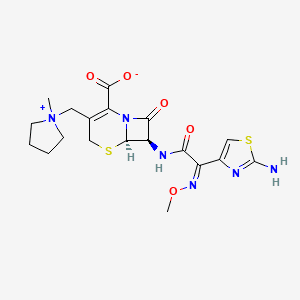
Pharmacotherapeutic group: Antibacterials for systemic use, other beta-lactam antibacterials, fourth generation cephalosporins ATC code: J01DE51
Mechanism of action
Cefepime exerts bactericidal activity by inhibiting peptidoglycan cell wall synthesis as a result of binding to and inhibition of penicillin-binding proteins (PBPs). Cefepime is generally stable to hydrolysis by class C AmpC and class D OXA-48 enzymes.
Enmetazobactam is a penicillanic acid sulfone beta-lactamase inhibitor structurally related to penicillin. Enmetazobactam binds to β-lactamases and prevents the hydrolysis of cefepime. It is active against class A ESBLs.
Enmetazobactam does not reliably inhibit the class A carbapenemase KPC and does not inhibit class B, class C or class D beta-lactamases.
Resistance
Bacterial resistance mechanisms that could potentially affect cefepime-enmetazobactam include mutant or acquired PBPs, decreased outer membrane permeability to either compound, active efflux of either compound, and β-lactamase enzymes refractory to inhibition by enmetazobactam and able to hydrolyse cefepime.
Antibacterial activity in combination with other agents
No antagonism was demonstrated in
in vitro
medicinal product combination studies with cefepime-enmetazobactam and azithromycin, aztreonam, clindamycin, daptomycin, doxycycline, gentamicin levofloxacin, linezolid, metronidazole, trimethoprim-sulfamethoxazole, or vancomycin.
Susceptibility testing breakpoints
MIC (minimum inhibitory concentration) interpretive criteria for susceptibility testing have been established by the European Committee on Antimicrobial Susceptibility Testing (EUCAST) for cefepime-enmetazobactam and are listed here: https://www.ema.europa.eu/documents/other/minimum-inhibitory-concentration-mic-breakpoints_en.xls
Pharmacokinetic/pharmacodynamic relationship
The antimicrobial activity of cefepime has been shown to best correlate with the percentage of time of the dosing interval in which the free active substance concentration was above the cefepime-enmetazobactam MIC (% fT >MIC). For enmetazobactam, the pharmacokinetic/pharmacodynamic (PK-PD) index is the percentage of time of the dosing interval in which the free active substance concentration was above a threshold concentration (% fT >C
T
).
Clinical efficacy against specific pathogens
Efficacy has been demonstrated in clinical studies against the pathogens listed under each indication that were susceptible to cefepime-enmetazobactam
in vitro
.
Complicated urinary tract infections including pyelonephritis
Gram-negative micro-organisms:
-
Escherichia coli
-
Klebsiella pneumoniae
-
Proteus mirabilis
Clinical efficacy has not been established against the following pathogens that are relevant to the approved indications, although
in vitro
studies suggest that they would be susceptible to cefepime and cefepime-enmetazobactam in the absence of acquired mechanisms of resistance:
Gram-negative micro-organisms:
-
Klebsiella aerogenes
-
Klebsiella oxytoca
-
Serratia marcescens
-
Citrobacter freundii
-
Citrobacter koseri
-
Providencia rettgeri
-
Providencia stuartii
-
Acinetobacter baumannii
-
Pseudomonas aeruginosa
-
Enterobacter cloacae
Gram-positive micro-organisms:
-
Staphylococcus aureus
(methicillin-susceptible only)
In vitro
data indicate that the following species are not susceptible to cefepime-enmetazobactam:
-
Enteroccocus
spp.
Paediatric population
The Medicines and Healthcare products Regulatory Agency has deferred the obligation to submit the results of studies with EXBLIFEP in one or more subsets of the paediatric population in the treatment of infections caused by gram-negative organisms (for the targeted indications 'Treatment of complicated urinary tract infections (cUTI), including acute pyelonephritis', 'Treatment of hospital-acquired pneumonia (HAP), including ventilator-associated pneumonia (VAP)' and 'Treatment of patients with bacteraemia that occurs in association with or is suspected to be associated with any of the above infections') (see section 4.2 for information on paediatric use).
⚠️ Warnings
This medicinal product is for intravenous infusion and each vial is for single use only.
Aseptic technique must be followed in preparing the infusion solution.
Preparation of doses
Cefepime-enmetazobactam is compatible with sodium chloride 9 mg/ml (0.9%) solution for injection, 5% glucose injection solution and a combination of glucose injection solution and sodium chloride injection solution (containing 2.5% glucose and 0.45% sodium chloride).
EXBLIFEP is supplied as a dry powder in a single-dose vial that must be reconstituted and further diluted prior to intravenous infusion as outlined below.
To prepare the required dose for intravenous infusion, reconstitute the vial as determined from
Table 3
below:
1. Withdraw 10 mL from an infusion bag of 250 mL (compatible injection solution) and reconstitute the cefepime-enmetazobactam vial.
2. Mix gently to dissolve. The reconstituted cefepime-enmetazobactam solution will have an approximate cefepime concentration of 0.20 g/mL and an approximate enmetazobactam concentration of 0.05 g/mL. The final volume is approximately 10 mL.
CAUTION: THE RECONSTITUTED SOLUTION IS NOT FOR DIRECT INJECTION.
The reconstituted solution must be diluted further,
immediately
, in an infusion bag of 250 mL (compatible injection solution) before intravenous infusion. To dilute the reconstituted solution, withdraw the full or partial reconstituted vial content and add it back into the infusion bag according to
Table 3
below.
3. The intravenous infusion of the diluted solution must be completed within 8 hours, if stored under refrigerated conditions (i.e., at 2° C to 8 °C; where it has been refrigerated for less than 6 hours, prior to being allowed to reach room temperature and then administered at room temperature over a period of 2 or 4 hours).
Table
3: Preparation of cefepime-enmetazobactam doses
Cefepime/enmetazobactam dose
Number of vials to reconstitute
Volume to withdraw from each reconstituted vial for further dilution
Final volume of infusion bag
2.5 g (2 g / 0.5 g)
1
Entire content
(approximately 10 mL)
250 mL
1.25 g (1 g / 0.25 g)
1
5.0 mL
(discard unused portion)
245 mL
0.625 g (0.5 g / 0.125 g)
1
2.5 mL
(discard unused portion)
242.5 mL
Inspect the vial before use. It must only be used if the solution is free from particles. Use only clear solutions.
Like other cephalosporins, cefepime-enmetazobactam solutions can develop a yellow to amber color, depending on storage conditions. However, this has no negative influence on the effect of the product.
The prepared solution should be administered via intravenous infusion.
Any unused medicinal product or waste material should be disposed of in accordance with local requirements.