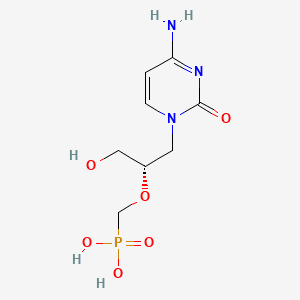
Pharmacotherapeutic group: Antivirals for systemic use, nucleosides and nucleotides excluding reverse transcriptase inhibitors, ATC code: J05AB12
General
Cidofovir is a cytidine analogue with
in vitro
and
in vivo
activity against human cytomegalovirus (HCMV). HCMV strains resistant to ganciclovir may still be susceptible to cidofovir.
Mechanism of action
Cidofovir suppresses HCMV replication by selective inhibition of viral DNA synthesis. Biochemical data support selective inhibition of HSV-1, HSV-2 and HCMV DNA polymerases by cidofovir diphosphate, the active intracellular metabolite of cidofovir.
Cidofovir diphosphate inhibits these viral polymerases at concentrations that are 8- to 600- fold lower than those needed to inhibit human cellular DNA polymerases alpha, beta, and gamma. Incorporation of cidofovir into viral DNA results in reductions in the rate of viral DNA synthesis.
Cidofovir enters cells by fluid-phase endocytosis and is phosphorylated to cidofovir monophosphate and subsequently to cidofovir diphosphate. Prolonged antiviral effects of cidofovir are related to the half-lives of its metabolites; cidofovir diphosphate persists inside cells with a half-life of 17-65 hours and a cidofovir phosphate-choline adduct has a half-life of 87 hours.
Antiviral activity
Cidofovir is active
in vitro
against HCMV, a member of the herpesviridae family. Antiviral activity is seen at concentrations significantly below those which cause cell death.
The
in vitro
sensitivity to cidofovir is shown in the following table:
Cidofovir inhibition of virus multiplication in cell culture
Virus
IC
50
(μM)
wild-type CMV isolates
0.7 (± 0.6)
ganciclovir-resistant CMV isolates
7.5 (± 4.3)
foscarnet-resistant CMV isolates
0.59 (± 0.07)
In vivo
activity against HCMV was confirmed with controlled clinical studies of cidofovir for the treatment of CMV retinitis in patients with AIDS, which demonstrated statistically significant delays in time to CMV retinitis progression for patients on cidofovir when compared to control patients. The median times to retinitis progression in the two efficacy studies (GS-93-106 and GS-93-105), were 120 days and not reached for the treatment arms vs. 22 days and 21 days for the untreated (deferred treatment) arms, respectively.
In study GS-93-107 conducted in patients who had relapsed after treatment with other agents, the median time to retinitis progression was 115 days.
Viral resistance
Following
in vitro
selection of ganciclovir-resistant HCMV isolates, cross-resistance between ganciclovir and cidofovir was seen with ganciclovir-selected mutations in the HCMV DNA polymerase gene but not with mutations in the UL97 gene. No cross-resistance between foscarnet and cidofovir was seen with foscarnet-selected mutants. Cidofovir-selected mutants had a mutation in the DNA polymerase gene and were cross-resistant to ganciclovir, but susceptible to foscarnet.
⚠️ Warnings
Method of preparation and administration
Cidofovir 75 mg/ml Concentrate for Solution for Infusion vials should be visually inspected for particulate matter and discolouration prior to administration.
With a syringe, transfer under aseptic conditions the appropriate dose of cidofovir from the vial to an infusion bag containing 100 ml 0.9% (normal) saline solution, and mix thoroughly. The entire volume should be infused intravenously into the patient at a constant rate over a period of 1 hour by use of a standard infusion pump. It should be administered by health care professionals adequately experienced in the care of AIDS patients.
The chemical and physical stability of Cidofovir 75 mg/ml Concentrate for Solution for Infusion admixed with saline has been demonstrated in glass bottles, in infusion bags composed of either polyvinyl chloride (PVC) or ethylene/propylene copolymer, and in PVC based vented IV administration sets. Other types of IV set tubing and infusion bags have not been studied.
Compatibility with Ringer's Solution, Lactated Ringer's Solution or bacteriostatic infusion fluids has not been evaluated.
Handling and disposal
Adequate precautions including the use of appropriate safety equipment are recommended for the preparation, administration and disposal of cidofovir. The preparation of cidofovir reconstituted solution should be done in a laminar flow biological safety cabinet. Personnel preparing the reconstituted solution should wear surgical gloves, safety glasses and a closed front surgical-type gown with knit cuffs. If cidofovir contacts the skin, wash membranes and flush thoroughly with water. Excess cidofovir and all other materials used in the admixture preparation and administration should be placed in a leak-proof, puncture-proof container for disposal. Any unused product or waste material should be disposed of in accordance with local requirements.
Obtaining probenecid
Probenecid is not supplied with cidofovir and should be obtained via the Marketing Authorisation Holder of probenecid. However, in case of difficulty in obtaining probenecid the local representative of the Marketing Authorisation Holder of Cidofovir 75 mg/ml Concentrate for Solution for Infusion should be contacted for information (see also sections 4.2 and 4.4).