This information is for educational purposes only. It is not intended as medical advice. Always consult a qualified healthcare professional.
Colistimethatum natricum Noridem — Description, Dosage, Side Effects | PillsCard
OTC
Colistimethatum natricum Noridem
1000000 j.m., Proszek do sporządzania roztworu do nebulizacji
INN: Colistimethatum natricum
Data updated: 2026-04-11
Available in:
🇨🇿🇩🇪🇬🇧🇫🇷🇵🇱🇸🇰🇺🇦
Form
Proszek do sporządzania roztworu do nebulizacji
Dosage
1000000 j.m.
Route
—
Storage
—
User Reviews
Reviews reflect personal experiences and are not medical advice. Always consult your doctor.
About This Product
Manufacturer
Noridem Enterprises Ltd.
ATC Code
J01XB01
Source
URPL
Pharmacotherapeutic group: antibacterials for systemic use, other antibacterials.
ATC Code: J01XB01
Mechanism of action
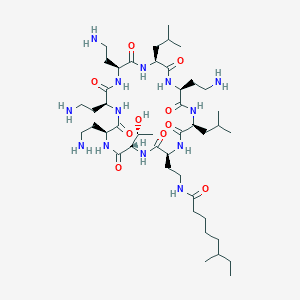
Colistimethate sodium (CMS) is a cyclic polypeptide antibacterial active substance that is derived from
Bacillus
polymyxa var. colistinus
and belongs to the polymyxin group. Polymyxins work by damaging the cell membrane and the resulting physiological effects are lethal to the bacterium. Polymyxins are selective for Gram-negative bacteria that have a hydrophobic outer membrane.
Resistance
Resistant bacteria are characterised by modification of the phosphate groups of lipopolysaccharide, which become substituted with ethanolamine or aminoarabinose. Naturally resistant Gram-negative bacteria, such as
Proteus mirabilis
and
Burkholderia cepacia
, show complete substitution of their lipid phosphate by ethanolamine or aminoarabinose.
Cross resistance
Cross resistance between colistimethate sodium and polymyxin B is expected. Since the mechanism of action of the polymyxins is different from that of other antibacterial agents, resistance to colistin and polymyxin by the above mechanism alone would not be expected to result in resistance to other drug classes.
The epidemiological cut off value for colistimethate sodium for
Pseudomonas aeruginosa,
distinguishing the wild type population from isolates with acquired resistance traits, is 4 mg/l.
Clinical efficacy
The Phase 3 clinical study was a randomised, open-label active comparator study comparing the efficacy of colistimethate sodium 1,662,500 IU dry powder for inhalation to tobramycin nebuliser solution for inhalation, 300 mg/5 ml, in 380 subjects with documented cystic fibrosis complicated by chronic pulmonary infection with
Pseudomonas aeruginosa
. The subjects were aged 6 years and above and had an FEV
1
% predicted of 25-75%. All subjects were also required to have successfully completed a minimum of two cycles of nebulised tobramycin solution run-in prior to randomisation. Subjects were randomised to receive either one 1,662,500 IU capsule of colistimethate sodium twice daily, or 300 mg of tobramycin, twice daily. It should be noted that treatment was not interrupted when patients received concomitant parenteral antibacterial active substances.
Efficacy was measured by the change in FEV
1
% predicted compared to baseline after a 24-week treatment period.
The results of the Intent-To-Treat (ITT) population for the primary efficacy outcome are shown below:
Change in FEV
1
(
% predicted
) from baseline
at Week 24 (ITT Population)
Patient group
Colobreathe
( Mean)
Tobramycin
( Mean)
Adjusted Treatment difference
95% CI
All patients using LOCF
-0.90 (n=183)
0.35 (n=190)
-0.97
-2.74, 0.86
Completed patients
0.39 (n=153)
0.78 (n=171)
-0.29
-2.21, 1.71
The data from the primary outcome parameter, change in FEV
1
% predicted, are not normally distributed. The adjusted treatment difference and 95% confidence interval have been back transformed from log transformed data. The ITT population excluded patients who had been treated but demonstrated no evidence of chronic infection.
The European Medicines Agency has deferred the obligation to submit the results of studies with Colobreathe in one or more subsets of the paediatric population in
Pseudomonas aeruginosa
pulmonary infection/colonisation in patients with cystic fibrosis (see section 4.2 for information on paediatric use).
⚠️ Warnings
Capsules: no special requirements for disposal. The Turbospin device should be discarded after completion of the treatment pack.
Colobreathe capsules should only be administered using the Turbospin inhaler device.
Taking Colobreathe using the Turbospin inhaler
The following instructions should be adhered to by the patient when taking Colobreathe:
Preparing the Turbospin
1.
Remove the cap. It comes away with a gentle pull.
2.
Unscrew the mouthpiece, exposing the chamber of the Turbospin inhaler.
3.
Remove a single capsule from the blister pack. Once you have removed the capsule it must be used immediately.
4.
Gently insert the capsule into the chamber with the widest end first. No force is required.
5.
Now replace the mouthpiece by screwing it back into place.
Piercing the capsule and inhaling the medicine
6.
To pierce the capsule:
• Hold the inhaler with the mouthpiece upright, gently push the piston upwards until the visible line is reached – you will feel resistance at this point and this will lock the capsule in place ready for piercing. Hold that position before continuing to follow through with the piercing.
• Now, with the capsule locked in place, continue pushing the piston as far as it will go and then release.
• The capsule is now pierced and the contents can be inhaled.
• Do
not
pierce the capsule more than once. You may see a small amount of powder released from the capsule chamber after the capsule is pierced, this is normal.
7.
Breathe out slowly. Place the mouthpiece between your lips and teeth. Ensure there is a seal between your lips and the mouthpiece. Take care not to cover the air slits with your fingers or mouth during inhalation.
8.
Then, breathe in slowly and deeply through your mouth at a rate sufficient for you to hear or feel the capsule spinning.
9.
Remove the Turbospin inhaler from your mouth and hold your breath for about 10 seconds or for as long as is comfortable, then breathe out slowly.
10.
If you do not hear the capsule spinning, the capsule may be stuck in the compartment. If this occurs, you can loosen the capsule by gently tapping the chamber of the inhaler. Do not try to loosen the capsule by repeatedly pressing the piston. If the capsule cannot be loosened and the powder cannot be inhaled, dispose of the broken capsule and any powder remaining in it and use another.
11.
Inhale the medicine again by repeating Steps 7 and 8 to ensure you have emptied the capsule.
12.
You can check whether the capsule is empty by unscrewing the mouthpiece and checking the capsule. If it is not empty, repeat steps 7, 8 and 9 until you have inhaled all of the contents.
13.
Once all the contents have been inhaled, rinse your mouth out well with water and spit out.
Removing the empty capsule from the Turbospin
14.
When the capsule is empty, unscrew the mouthpiece, then remove and discard the empty capsule.
Additional information
As you breathe in slowly, you suck air through the body of the Turbospin inhaler into the capsule chamber. The tiny particles of medicine in the capsule are picked up by the airflow and carried down your airway into your lungs.
Occasionally, very small pieces of the capsule shell can get into your mouth or airways.
• If this happens, you may be able to feel these pieces on your tongue or in your airways.
• The capsule shell is made of gelatin, which is harmless to humans if swallowed or inhaled.
• The chances of the capsule breaking into pieces are increased if the capsule is pierced more than once during Step 6.