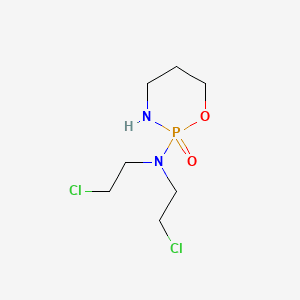
Pharmacotherapeutic group: Antineoplastic and Immunomodulating Agents; Antineoplastic agents. Alkylating agents. Nitrogen mustard analogues
ATC code: L01AA01.
Cyclophosphamide has been demonstrated to have a cytostatic effect in many tumour types.
Cyclophosphamide engages probably to the S-or G2-phase of the cell cycle.
It remains to be shown whether the cytostatic effect is entirely dependent on the alkylation of DNA or other mechanisms such as inhibition of chromatin transformation processes or inhibition of DNA polymerases play a role. The metabolite acrolein has no antineoplastic activity, but is responsible for the adverse urotoxic effect.
The immunosuppressive effect of cyclophosphamide is based on the fact that cyclophosphamide has an inhibitory effect on B-cells, CD4 + T-cells and to a lesser extent on CD8 +-T-cells. In addition, it is assumed that cyclophosphamide has an inhibitory effect on the suppressor that regulate the IgG2 class of antibodies.
Cross-resistance, especially with structurally related cytotoxic agents, e.g. ifosfamide, as well as other alkylating agents, cannot be excluded.
⚠️ Warnings
For each 100 mg of cyclophosphamide, 5 ml of solvent must be added for reconstitution.
The choice of diluent for reconstituting Cyclophosphamide containing cyclophosphamide depends on the route of administration to be used.
Direct injection:
If the solution is to be used for direct injection, Cyclophosphamide (containing cyclophosphamide) is reconstituted by adding 0.9% sterile sodium chloride solution.
Infusion:
If the solution is to be used for IV infusion, Cyclophosphamide (containing cyclophosphamide) is reconstituted by adding sterile water for injection or 0.9% sterile sodium chloride solution.
The following quantities of water for injections or sodium chloride 0.9 % are added to the vials containing Cyclophosphamide, Powder for Solution for Injection or Infusion
Vial of 500 mg: 25 ml
Vial of 1000 mg: 50 ml
Vial of 2000 mg: 100 ml
Injecting the solvent into the vial for injection creates an abnormally high pressure, which disappears as soon as the second sterile needle has been inserted in the rubber stop of the vial for injection. The powder easily dissolves when the vial for injection is shaken vigorously to produce a clear solution. If the powder does not immediately dissolve, continue to shake the vial vigorously for up to several minutes until complete dissolution of the powder. The solution must be administered as soon as possible following its reconstitution.
After reconstitution the solution is clear and colourless to light yellow. Please check the vial before further use. Only clear solutions must be used.
Cyclophosphamide, Powder for Solution for Injection or Infusion reconstituted in water for injection has an osmolality of 92 mOsm/kg.
Cyclophosphamide, Powder for Solution for Injection or Infusion reconstituted in 0.9% sodium chloride has an osmolality of 353 mOsm/kg and a pH of 4.6
Intravenous use
Intravenous administration should preferably be conducted as an infusion.
Infusion:
Reconstituted Cyclophosphamide should be further diluted in 5% dextrose or 0.9% sodium chloride injection prior to infusion.
Direct injection:
Please note that only Cyclophosphamide reconstituted in 0.9% sterile sodium chloride solution is suitable for bolus injection.
Cyclophosphamide (containing cyclophosphamide) reconstituted in water is hypotonic and should not be injected directly.
The rules and regulations for handling cytostatics in general must be observed when reconstituting or handling Cyclophosphamide. Reconstitution must, to the extent possible, be performed in a
laminar air flow safety
cabinet. The person handling the product must wear a protective mask and protective
gloves
. In case of spills, the area must be thoroughly rinsed with water. If Cyclophosphamide, Powder for Solution for Injection or Infusion is stored (e.g. during transport) at the temperature exceeding the maximum temperature, cyclophosphamide may melt. Vials for injections containing melted cyclophosphamide can be visually recognised. Cyclophosphamide is a white powder. M
elted cyclophosphamide
is a
clear or
yellowish viscous liquid (usually found as droplets in the affected vials.). Vials for injections containing melted cyclophosphamide may no longer be used.