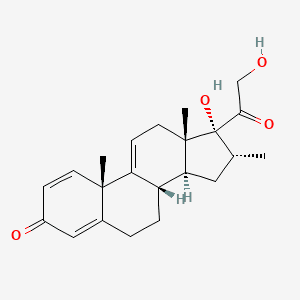
Pharmacotherapeutic group: glucocorticoids, ATC code: H02AB18 Mechanism of action
Vamorolone is a dissociative corticosteroid that selectively binds to the glucocorticoid receptor, resulting in anti-inflammatory effects through inhibition of NF-κB-mediated gene transcription, while leading to reduced activation of other gene transcriptions. In addition, vamorolone inhibits activation of the mineralocorticoid receptor by aldosterone. Due to its specific structure, vamorolone is unlikely to be a substrate of 11β-hydroxysteroid dehydrogenase and therefore does not undergo local tissue amplification. The exact mechanism of therapeutic action of vamorolone in patients with Duchenne muscular dystrophy is not known.
Pharmacodynamic effects
In clinical studies, treatment with vamorolone resulted in a dose-dependent decrease in morning cortisol levels. In clinical studies with vamorolone, dose-dependent increases in haemoglobin, haematocrit, and red blood cell, white blood cell, and lymphocyte counts were observed. No significant changes in mean neutrophil or immature granulocyte counts were observed. HDL cholesterol (high-density lipoprotein) and triglyceride values increased in a dose-dependent manner. Over up to 30 months of treatment, there was no significant effect on glucose metabolism.
Administration of vamorolone for 48 weeks did not result in decreased bone metabolism in clinical studies, as assessed by bone turnover markers, nor in significant decreases in lumbar spine mineralisation parameters, as assessed by dual-energy X-ray absorptiometry (DXA), unlike corticosteroids. The risk of bone fractures in patients with Duchenne muscular dystrophy treated with vamorolone has not been established.
Clinical efficacy and safety
The efficacy of AGAMREE in the treatment of Duchenne muscular dystrophy was evaluated in Study 1, which was a multicentre, randomised, double-blind, placebo- and active-controlled, parallel-group study lasting 24 weeks, followed by a double-blind extension phase. The study population consisted of 121 male paediatric patients with a confirmed diagnosis of Duchenne muscular dystrophy who were aged 4 to 7 years at the time of enrolment, were corticosteroid-naïve, and were ambulatory.
In Study 1, 121 patients were randomised to one of the following treatments: vamorolone 6 mg/kg/day (n = 30), vamorolone 2 mg/kg/day (n = 30), active comparator prednisone 0.75 mg/kg/day (n = 31), or placebo (n = 30). After 24 weeks (Period 1, primary efficacy analysis), patients receiving prednisone or placebo were re-randomised according to the original randomisation schedule for an additional 20 weeks of treatment (Period 2) to either the vamorolone 6 mg/kg/day group or the vamorolone 2 mg/kg/day group.
In Study 1, efficacy was assessed based on change in velocity in the Time to Stand Test (TTSTAND) at 24 weeks of treatment compared to baseline, comparing the vamorolone 6 mg/kg/day group with the placebo group. A pre-specified hierarchical analysis of relevant secondary endpoints examined change in TTSTAND velocity in the vamorolone 2 mg/kg/day group compared to the placebo group, and change from baseline in distance walked in the 6 Minute Walk Test (6MWT) in the vamorolone 6 mg/kg/day group and then the 2 mg/kg/day group compared to the placebo group.
Treatment with vamorolone at 6 mg/kg/day and then at 2 mg/kg/day resulted in statistically significant improvement compared to placebo in change in TTSTAND velocity and change in 6MWT distance walked, comparing baseline with 24 weeks of treatment (see Table 2). Study 1 was not designed to maintain the overall type I error rate when comparing the vamorolone dose groups with the prednisone group, and therefore the overall assessment of treatment differences (expressed as percentage change from baseline with 95% confidence intervals) is displayed for these endpoints in Figure 1.
Table 3: Analysis of change at Week 24 from baseline with vamorolone 6 mg/kg/day or 2 mg/kg/day compared to placebo (Study 1)
TTSTAND velocity (stands/s) / TTSTAND in seconds (s/stand)
Placebo
Vamorolone 2 mg/kg/day
Vamorolone 6 mg/kg/day
Prednisone 0.75 mg/kg/day
Baseline mean value stands/sBaseline mean value s/stand
0.205.555
0.186.07
0.195.97
0.224.92
Mean change at Week 24Stands/sImprovement in s/stand
-0.012-0.62
0.0310.31
0.0461.05
0.0661.24
Differences versus placebo* Stands/ss/stand
-
0.043(0.007; 0.079)0.927 (0.042;1.895)
0.059(0.022; 0.095)1.67 (0.684;2.658)
not assessed not assessed
p-value
-
0.020
0.002
not assessed
6MWT distance walked (in metres)
Placebo
Vamorolone 2 mg/kg/day
Vamorolone 6 mg/kg/day
Prednisone 0.75 mg/kg/day
Baseline mean value (m)
354.5
316.1
312.5
343.3
Mean change at Week 24
-11.4
+25.0
+24.6
+44.1
Differences versus placebo*
-
36.3(8.3; 64.4)
35.9(8.0; 63.9)
not assessed
p-value
-
0.011
0.012
not assessed
Mean changes and differences are model-based least-squares mean (LSM) values and mean differences.
Positive values indicate improvement from baseline. * LSM differences presented with 95% confidence interval (CI).
Figure 1 Comparison of vamorolone with prednisone in timed motor function tests based on analysis as percentage change from baseline (mITT-1 population)
TTSTAND velocity (VAM 6 mg/kg/day vs PDN)
Endpoint (comparison)
6MWT
(VAM 6 mg/kg/day vs PDN)
TTSTAND velocity (VAM 2 mg/kg/day vs PDN)
6MWT
(VAM 2 mg/kg/day vs PDN)
Difference in % (95% CI)
Test data are standardised using percentage change from baseline as the endpoint. Percentile changes are calculated according to the formula: (value at assessment – baseline value) / baseline value × 100%. VAM: vamorolone; PDN: prednisone.
All percentage change values for these two endpoints are entered into a single statistical model (MMRM).
For vamorolone 6 mg/kg/day, improvements in all tested parameters of lower limb function observed at Week 24 were largely maintained at Week 48. In contrast, the efficacy results for vamorolone 2 mg/kg/day were rather inconsistent, with deterioration of the relevant motor function parameters at Week 48, i.e. TTSTAND velocity and 6MWT results. These were clinically meaningful differences compared with vamorolone 6 mg/kg/day, but only minimal decreases in NSAA score.
In patients who were switched from prednisone 0.75 mg/kg/day (Period 1) to vamorolone 6 mg/kg/day (Period 2) during Study 1, the benefit in these motor function endpoints appeared to be maintained, whereas deterioration was observed in patients who were switched to vamorolone 2 mg/kg/day.
At study entry, children in the vamorolone groups were shorter in height (median -0.74 SD in height Z-score for the 2 mg/kg/day dose and -1.04 SD in height Z-score for the 6 mg/kg/day dose) than children receiving placebo (-0.54 SD) or prednisone 0.75 mg/kg/day (-0.56 SD). After 24 weeks, the change in height percentile and Z-score in children treated with vamorolone was similar to that in children receiving placebo, while these parameters decreased in children treated with prednisone. In Study 1, height percentiles and Z-scores did not decrease during vamorolone treatment over 48 weeks. When switching from prednisone after 24 weeks (Period 1) to vamorolone in Period 2, patients showed increases in mean and median height Z-scores up to Week 48.
⚠️ Warnings
Changes in endocrine function
Vamorolone causes changes in endocrine function, particularly with long-term use.
Patients with altered thyroid function or phaeochromocytoma may also be at increased risk of endocrine effects.
Risk of adrenal insufficiency
Administration of vamorolone leads to dose-dependent, reversible suppression of the hypothalamic-pituitary-adrenal (HPA) axis, which may result in secondary adrenal insufficiency that can persist for months after discontinuation of prolonged treatment. The degree of induced chronic adrenal insufficiency varies between individual patients and depends on the dose and duration of treatment.
In the event of increased stress or abrupt reduction or discontinuation of the vamorolone dose, acute adrenal insufficiency (also known as adrenal crisis) may occur, which can be fatal. Symptoms of adrenal crisis may include excessive fatigue, unexpected weakness, vomiting, dizziness, or confusion. The risk is mitigated by gradual dose tapering or discontinuation of treatment (see section 4.2).
During periods of increased stress, such as acute infection, traumatic injury, or surgery, patients should be monitored for signs of acute adrenal insufficiency, and treatment with AGAMREE should be temporarily supplemented with systemic hydrocortisone to prevent the risk of adrenal crisis.
No data are available on the effects of increasing the dose of AGAMREE in situations of increased stress.
Patients should be advised to carry a patient card containing important safety information regarding early recognition of adrenal crisis and its management.
Following abrupt discontinuation of glucocorticoid therapy, a steroid "withdrawal syndrome" may also occur, apparently unrelated to adrenocortical insufficiency. Symptoms of this syndrome include, for example, anorexia, nausea, vomiting, lethargy, headache, fever, arthralgia, desquamation, myalgia, and/or weight loss. These effects are thought to be caused by the abrupt change in glucocorticoid concentration rather than by low glucocorticoid levels.
Switching from glucocorticoid therapy to AGAMREE
Patients may be switched from oral glucocorticoid therapy (such as prednisone or deflazacort) to AGAMREE without the need for treatment interruption or prior glucocorticoid dose tapering. To reduce the risk of adrenal crisis, patients who have previously received long-term glucocorticoid therapy should be switched to AGAMREE at a dose of 6 mg/kg/day.
Weight gain
Vamorolone is associated with dose-dependent increased appetite and weight gain, particularly in the first months of treatment. Advice on an age-appropriate diet should be provided before and during treatment with AGAMREE, in accordance with general nutritional recommendations for patients with Duchenne muscular dystrophy.
Considerations for use in patients with altered thyroid function
Metabolic clearance of glucocorticoids may be decreased in patients with hypothyroidism and increased in patients with hyperthyroidism. It is not known whether this also applies to vamorolone; however, changes in the patient's thyroid function may require dose adjustment.
Ophthalmological effects
Administration of glucocorticoids may induce posterior subcapsular cataracts, glaucoma with possible damage to the optic nerves, and may increase the risk of secondary ocular infections caused by bacteria, fungi, or viruses.
The risk of ophthalmological effects with AGAMREE is not known. Increased risk of infections
Suppression of inflammatory response and immune system function may increase susceptibility to infections and the severity of infections. Latent infections may be activated, or intercurrent infections may be exacerbated. Clinical manifestations may often be atypical, and serious infections may be masked and may reach an advanced stage before being recognised.
These infections can be serious and sometimes fatal.
Although no increased incidence or severity of infections was observed with vamorolone in clinical studies, an increased risk of infections cannot be excluded given the limited long-term experience.
The development of infections should be monitored. Certain diagnostic and therapeutic measures should be applied in patients with signs of infection who are receiving long-term vamorolone treatment. Supplementary administration of hydrocortisone should be considered in patients with moderate or severe infections who are being treated with vamorolone.
Diabetes mellitus
Long-term corticosteroid treatment may increase the risk of diabetes mellitus.
No clinically significant changes in glucose metabolism were observed in clinical studies with vamorolone. Long-term data are limited. Blood glucose levels should be monitored regularly in patients receiving long-term vamorolone treatment.
Vaccination
Patients treated with glucocorticoids may have an altered response to live or live attenuated vaccines.
The risk associated with AGAMREE is not known.
Live attenuated or live vaccines should be administered at least 6 weeks before initiation of treatment with AGAMREE.
Patients who have not had chickenpox or have not been vaccinated against it should be vaccinated against varicella zoster virus before initiation of treatment with AGAMREE.
Thromboembolic events
Observational studies with glucocorticoids have demonstrated an increased risk of thromboembolism (including venous thromboembolism), particularly with higher cumulative glucocorticoid doses.
The risk associated with AGAMREE is not known. AGAMREE should be used with caution in patients who have or may be predisposed to thromboembolic disorders.
Anaphylaxis
Rare cases of anaphylaxis have occurred in patients treated with glucocorticoids.
Vamorolone is structurally similar to glucocorticoids, and caution should be exercised when treating patients with known hypersensitivity to glucocorticoids.
Hepatic impairment
Vamorolone has not been studied in patients with pre-existing severe hepatic impairment (Child-Pugh Class C) and must not be used in these patients (see section 4.3).
Concomitant use with other medicinal products
UGT substrates
The potential for drug interactions with UGT substrates has not been fully evaluated; therefore, the use of all UGT substrate inhibitors as concomitant therapy should be avoided, and if their use is medically necessary, they should be used with caution.
Excipients
Sodium benzoate
This medicinal product contains 1 mg of sodium benzoate per ml, corresponding to 100 mg/100 ml.
Sodium
This medicinal product contains less than 1 mmol (23 mg) of sodium per 7.5 ml, that is to say essentially "sodium-free".