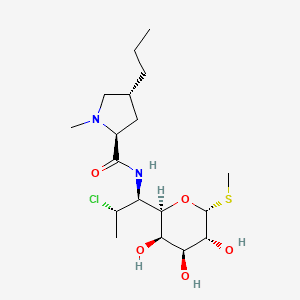
Pharmacotherapeutic group: gynecological anti-infective, ATC code: G01AA10
Clindamycin is a lincosamide antibiotic that inhibits protein synthesis at the bacterial ribosome. It binds preferentially to the 50S ribosomal subunit and interferes with translation.
Although clindamycin is inactive in vitro, rapid in vivo hydrolysis converts the compound into antibacterially active clindamycin.
Like most protein-synthesis inhibitors, clindamycin acts predominantly bacteriostatically, and its efficacy depends on the duration for which the active substance concentration remains above the MIC of the infecting organism.
Resistance to clindamycin is most commonly caused by modification of the target site on the ribosome, usually by chemical modification of RNA bases or by point mutations in RNA or, occasionally, in proteins. In some organisms this modification may produce cross-resistance among lincosamides, macrolides, and streptogramins B. In certain cases, strains carrying these modifications appear susceptible to clindamycin, but resistance is inducible following exposure to macrolides. Less commonly, resistance may be mediated by active efflux or by chemical modification of the antibiotic. Cross-resistance between clindamycin and lincomycin has been demonstrated.
Clindamycin shows in vitro activity against most strains of the following organisms that have been reported in association with bacterial vaginosis:
Bacteroides spp.
Gardnerella vaginalis
Mobiluncus spp.
Mycoplasma hominis
Peptostreptococcus spp.
Bacterial culture and susceptibility testing are not routinely performed to establish the diagnosis or guide the treatment of bacterial vaginosis. A standard procedure for determining the susceptibility of the potential bacterial vaginosis pathogens Gardnerella vaginalis and Mobiluncus spp. has not been defined. The EUCAST clindamycin breakpoint for gram-positive and gram-negative anaerobes is ≤ 4 mg/L. However, these breakpoints are intended to guide systemic rather than local antibiotic therapy.
⚠️ Warnings
Before initiating treatment with clindamycin, it may be necessary to investigate other infections with appropriate laboratory tests, including Trichomonas vaginalis, Candida albicans, Chlamydia trachomatis, and gonococcal infections.
Use of clindamycin may result in overgrowth of non-susceptible microorganisms, particularly yeasts.
Symptoms suggestive of pseudomembranous colitis may occur during or after antimicrobial therapy (see section 4.8). Pseudomembranous colitis has been reported with nearly all antibacterial agents, including clindamycin, and its severity may range from mild to life-threatening. It is therefore important to consider this possibility in patients who develop diarrhoea following antibacterial therapy. Moderate cases may resolve after discontinuation of the drug.
Treatment with clindamycin must be discontinued if pseudomembranous colitis develops. Appropriate antibacterial therapy should be initiated. Agents that inhibit peristalsis are contraindicated in this situation.
Caution is advised when clindamycin is prescribed to patients with inflammatory bowel disease, such as Crohn's disease or ulcerative colitis.
For all vaginal infections, sexual intercourse during treatment with DALACIN vaginal cream is not recommended.
Latex condoms and diaphragms may be weakened on exposure to the suppository base used in clindamycin vaginal cream. Use of such devices within 72 hours of treatment with clindamycin vaginal cream is not recommended, as it may be associated with reduced contraceptive efficacy or reduced protection against sexually transmitted diseases.
The use of other vaginal products (such as tampons or douches) during treatment with clindamycin vaginal cream is not recommended.
Safety and efficacy studies of clindamycin vaginal cream have not been conducted in the following populations: pregnant women, breastfeeding women, and patients with hepatic impairment, immunodeficiency, or colitis.
Paediatric population:
The safety and efficacy of the product in paediatric patients have not been evaluated.
Excipients:
This product contains propylene glycol, cetostearyl alcohol, benzyl alcohol, and polysorbate 60 (see section 2). Cetostearyl alcohol may cause local skin reactions (e.g. contact dermatitis). Benzyl alcohol may cause allergic reactions and mild local irritation. Polysorbate 60 may cause allergic reactions.