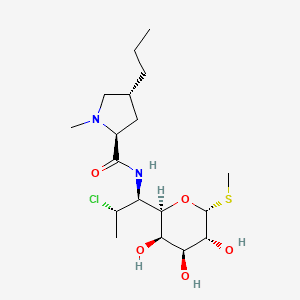
Pharmacotherapeutic group: anti-acne preparations, anti-infectives for treatment of acne, ATC code: D10AF01
Mechanism of action
Clindamycin is a lincosamide antibiotic that inhibits bacterial protein synthesis. It binds to the 50S ribosomal subunit and affects both ribosome assembly and the translational process. Although clindamycin phosphate is inactive *in vitro*, rapid *in vivo* hydrolysis converts the compound to clindamycin, which exerts antibacterial activity.
Clindamycin has demonstrated *in vitro* activity against isolates of the following microorganisms:
Anaerobic gram-positive non-spore-forming bacteria, including:
*Propionibacterium acnes*.
Pharmacodynamic effects
Efficacy is related to the duration of time during which the drug concentration exceeds the minimum inhibitory concentration (MIC) of the pathogen (%T/MIC).
Resistance
Resistance to clindamycin in *Propionibacterium acnes* may result from mutations at the rRNA antibiotic binding site or from methylation of specific nucleotides in the 23S RNA of the 50S ribosomal subunit. These alterations may confer cross-resistance to macrolides and streptogramins B (MLSB phenotype). Macrolide-resistant isolates should be tested for inducible clindamycin resistance using the D-test.
Cross-resistance between clindamycin and lincomycin has been demonstrated.
The prevalence of acquired resistance may vary by geographical location and over time for selected species, and local information on resistance is desirable, particularly when treating severe infections. Where necessary, expert advice should be sought when the local prevalence of resistance is such that the utility of the agent in at least some types of infection is questionable. Particularly in severe infections or treatment failure, microbiological diagnosis with verification of the pathogen and its susceptibility to clindamycin is recommended.
Resistance is usually defined on the basis of susceptibility interpretive criteria (breakpoints) established by regulatory bodies such as CLSI (Clinical and Laboratory Standards Institute) or EUCAST (European Committee on Antimicrobial Susceptibility Testing) for systemically administered antibiotics. These breakpoints may be less relevant for topically administered clindamycin. Although clindamycin is not specifically addressed, EUCAST suggests that resistance for topically applied antimicrobial agents be defined using epidemiological cut-off values (ECOFFs) rather than the clinical breakpoints set for systemic use. However, MIC distributions and ECOFFs for *P. acnes* have not been published by EUCAST.
Based on correlations between clinical outcomes in patients with acne and the clindamycin MIC for their *P. acnes* isolates, values ≤ 256 mg/L are considered susceptible for topical administration of clindamycin.
CLSI has published MIC ranges for a limited number (58) of unique clinical *P. acnes* isolates collected between 2010 and 2012 in US hospitals. 91% of these isolates were susceptible to clindamycin (MIC ≤ 8 mg/L). A recent Belgian surveillance study (2011–2012) of anaerobic bacteria included 22 *P. acnes* isolates, 95.5% of which were susceptible to clindamycin. An earlier European surveillance study, which included 304 *P. acnes* isolates, reported a 15% rate of resistance to clindamycin. However, that study applied a breakpoint of 0.12 mg/L; had the current breakpoint of 4 mg/L been applied, no isolates would have been classified as resistant.
Breakpoints
CLSI and EUCAST breakpoints for gram-positive anaerobic bacteria are shown below. Although the two organisations report different values, the resistance breakpoint is the same, since CLSI recognises an intermediate susceptibility category (4 mg/mL). As noted above, the breakpoints are based on use in systemic infections.
EUCAST breakpoints for systemically administered clindamycin
Pathogen
Susceptible
Resistant
Gram-positive anaerobic bacteria (except *Clostridium difficile*)
≤ 4 mg/L
> 4 mg/L
CLSI breakpoints for systemically administered clindamycin
Pathogen
Susceptible
Resistant
Anaerobes
≤ 2 mg/L
> 8 mg/L
⚠️ Warnings
Orally and parenterally administered clindamycin, like many other antibiotics, has been associated with severe diarrhoea and pseudomembranous colitis (see section 4.8). Use of the topical formulation of clindamycin results in absorption of the antibiotic from the skin surface. Diarrhoea and colitis have been reported rarely in connection with the use of Dalacin T.
For this reason, the prescriber should be alert to the potential onset of antibiotic-associated diarrhoea or colitis. If severe or prolonged diarrhoea occurs, use of Dalacin T should be discontinued immediately and appropriate diagnostic and therapeutic measures initiated.
Diarrhoea, colitis, and pseudomembranous colitis have been observed to occur up to several weeks after discontinuation of oral or parenteral clindamycin therapy.
Dalacin T 1% cutaneous emulsion contains an alcohol base and may cause burning and irritation of the eyes, mucous membranes, and broken skin.
Dalacin T 1% cutaneous emulsion contains cetyl alcohol and stearyl alcohol, which may cause local skin reactions (e.g. contact dermatitis).
Hypersensitivity to methyl parahydroxybenzoate (methylparaben)
May cause allergic reactions (possibly delayed).