This information is for educational purposes only. It is not intended as medical advice. Always consult a qualified healthcare professional.
Rose bengal sodium I 125 — Description, Dosage, Side Effects | PillsCard
OTC
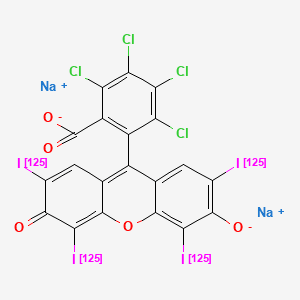
Rose bengal sodium I 125
INN: Rose bengal sodium I 125
Data updated: 2026-04-18
Available in:
🇩🇪🇬🇧
Form
—
Dosage
—
Route
—
Storage
—
About This Product
ATC Code
S01JA02
Source
User Reviews
Reviews reflect personal experiences and are not medical advice. Always consult your doctor.
KEGG
USDailyMed:Amiodarone
AU:C
C01BD01(WHO)
AU:S4(Prescription only)CA:℞-onlyUS:℞-only
(2-(2-butyl-1-benzofuran-3-yl)(4-{[2-(diethylamino)ethyl]oxy}-3,5-diiodophenyl)methanone
1951-25-3Y
2157
2566
DB01118Y
2072Y
N3RQ532IUT
D02910Y
CHEBI:2663Y
ChEMBL633Y
DTXSID7022592
Interactive image
CCN(CC)CCOc1c(I)cc(cc1I)C(=O)c2c3ccccc3oc2CCCC
InChI=1S/C25H29I2NO3/c1-4-7-11-22-23(18-10-8-9-12-21(18)31-22)24(29)17-15-19(26)25(20(27)16-17)30-14-13-28(5-2)6-3/h8-10,12,15-16H,4-7,11,13-14H2,1-3H3YKey:IYIKLHRQXLHMJQ-UHFFFAOYSA-NY
Amiodaroneis anantiarrhythmic medicationused to treat and prevent a number of types ofcardiac dysrhythmias.This includesventricular tachycardia,ventricular fibrillation, andwide complex tachycardia,atrial fibrillation, andparoxysmal supraventricular tachycardia.Evidence of benefit forcardiac arrestis poor.It can be given by mouth,intravenously, orintraosseously.When used by mouth, it can take a few weeks for effects to begin.
Common side effects include feeling tired, tremor, nausea, and constipation.As amiodarone can have serious side effects, it is mainly recommended only for significant ventricular arrhythmias.Serious side effects include lung toxicitysuch asinterstitial pneumonitis,liver problems, heart arrhythmias, vision problems,thyroid problems, and death.If taken duringpregnancyorbreastfeedingit can cause problems in the fetus or the infant.It is aclass III antiarrhythmic medication.It works partly by increasing the time before a heart cell can contract again.
Amiodarone was first made in 1961 and came into medical use in 1962 forchest pain believed to be related to the heart.It was pulled from the market in 1967 due to side effects.In 1974 it was found to be useful for arrhythmias and reintroduced.It is on theWorld Health Organization's List of Essential Medicines.It is available as ageneric medication.In 2023, it was the 218th most commonly prescribed medication in the United States, with more than 1million prescriptions.