This information is for educational purposes only. It is not intended as medical advice. Always consult a qualified healthcare professional.
OTC
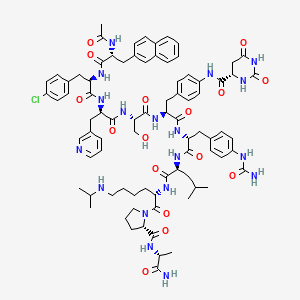
Degarelix Accord
80 mg, Proszek i rozpuszczalnik do sporządzania roztworu do wstrzykiwań
INN: Degarelixum
Data updated: 2026-04-13
Available in:
🇨🇿🇩🇪🇬🇧🇪🇸🇫🇷🇵🇱🇸🇰🇺🇦
Form
Proszek i rozpuszczalnik do sporządzania roztworu do wstrzykiwań
Dosage
80 mg
Route
podskórna
Storage
—
User Reviews
Reviews reflect personal experiences and are not medical advice. Always consult your doctor.
About This Product
Manufacturer
Accord Healthcare S.L.U. (Holandia)
Composition
Degarelixum 80 mg
ATC Code
L02BX02
Source
URPL
Pharmacotherapeutic group: Endocrine therapy, Other hormone antagonists and related agents, ATC code: L02BX02
Mechanism of action
Degarelix is a selective gonadotrophin releasing-hormone (GnRH) antagonist that competitively and reversibly binds to the pituitary GnRH receptors, thereby rapidly reducing the release of the gonadotrophins, luteinizing hormone (LH) and follicle stimulating hormone (FSH), and thereby reducing the secretion of testosterone (T) by the testes. Prostatic carcinoma is known to be androgen sensitive and responds to treatment that removes the source of androgen. Unlike GnRH agonists, GnRH antagonists do not induce a LH surge with subsequent testosterone surge/tumour stimulation and potential symptomatic flare after the initiation of treatment.
A single dose of 240 mg degarelix, followed by a monthly maintenance dose of 80 mg, rapidly causes a decrease in the concentrations of LH, FSH and subsequently testosterone. The serum concentration of dihydrotestosterone (DHT) decreases in a similar manner to testosterone.
Degarelix is effective in achieving and maintaining testosterone suppression well below medical castration level of 0.5 ng/ml. Maintenance monthly dosing of 80 mg resulted in sustained testosterone suppression in 97% of patients for at least one year. No testosterone microsurges were observed after re-injection during degarelix treatment. Median testosterone levels after one year of treatment were 0.087 ng/ml (interquartile range 0.06-0.15) N=167.
Results of the confirmatory Phase III study
The efficacy and safety of degarelix was evaluated in an open-label, multi-centre, randomised, active comparator controlled, parallel-group study. The study investigated the efficacy and safety of two different degarelix monthly dosing regimens with a starting dose of 240 mg (40 mg/ml) followed by monthly doses subcutaneous administration of 160 mg (40 mg/ml) or 80 mg (20 mg/ml), in comparison to monthly intramuscular administration of 7.5 mg leuprorelin in patients with prostate cancer requiring androgen deprivation therapy. In total 620 patients were randomised to one of the three treatment groups, of which 504 (81%) patients completed the study. In the degarelix 240/80 mg treatment group 41 (20%) patients discontinued the study, as compared to 32 (16%) patients in the leuprorelin group.
Of the 610 patients treated
• 31% had localised prostate cancer
• 29% had locally advanced prostate cancer
• 20% had metastatic prostate cancer
• 7% had an unknown metastatic status
• 13% had previous curative intent surgery or radiation and a rising PSA
Baseline demographics were similar between the arms. The median age was 74 years (range 47 to 98 years). The primary objective was to demonstrate that degarelix is effective with respect to achieving and maintaining testosterone suppression to below 0.5 ng/ml, during 12 months of treatment.
The lowest effective maintenance dose of 80 mg degarelix was chosen.
Attainment of serum testosterone (T) ≤0.5 ng/ml
FIRMAGON is effective in achieving fast testosterone suppression, see Table 2.
Table 2: Percentage of patients attaining T≤0.5 ng/ml after start of treatment.
Time
Degarelix 240/80 mg
Leuprorelin 7.5 mg
Day 1
52%
0%
Day 3
96%
0%
Day 7
99%
1%
Day 14
100%
18%
Day 28
100%
100%
Avoidance of testosterone surge
Surge was defined as testosterone exceeding baseline by ≥15% within the first 2 weeks.
None of the degarelix-treated patients experienced a testosterone surge; there was an average decrease of 94% in testosterone at day 3. Most of the leuprorelin-treated patients experienced testosterone surge; there was an average increase of 65% in testosterone at day 3. This difference was statistically significant (p<0.001).
Figure 1: Percentage change in testosterone from baseline by treatment group until day 28 (median with interquartile ranges).
The primary end-point in the study was testosterone suppression rates after one year treatment with degarelix or leuprorelin. The clinical benefit for degarelix compared leuprorelin plus anti-androgen in the initial phase of treatment has not been demonstrated.
Testosterone Reversibility
In a study involving patients with rising PSA after localised therapy (mainly radical prostatectomy and radiation) were administered FIRMAGON for seven months followed by a seven months monitoring period. The median time to testosterone recovery (>0.5 ng/mL, above castrate level) after discontinuation of treatment was 112 days (counted from start of monitoring period, i.e 28 days after last injection). The median time to testosterone >1.5 ng/mL (above lower limit of normal range) was 168 days.
Long-term effect
Successful response in the study was defined as attainment of medical castration at day 28 and maintenance through day 364 where no single testosterone concentration was greater than 0.5 ng/ml.
Table 3: Cumulative probability of testosterone ≤0.5 ng/ml from Day 28 to Day 364.
Degarelix 240/80 mg
N=207
Leuprorelin 7.5 mg
N=201
No. of responders
202
194
Response Rate
(confidence intervals)*
97.2%
(93.5; 98.8%)
96.4%
(92.5; 98.2%)
* Kaplan Meier estimates within group
Attainment of prostate specific antigen (PSA) reduction
Tumour size was not measured directly during the clinical trial programme, but there was an indirect beneficial tumour response as shown by a 95% reduction after 12 months in median PSA for degarelix.
The median PSA in the study at baseline was:
• for the degarelix 240/80 mg treatment group 19.8 ng/ml (interquartile range: P25 9.4 ng/ml, P75 46.4 ng/ml)
• for the leuprorelin 7.5 mg treatment group 17.4 ng/ml (interquartile range: P25 8.4 ng/ml, P75 56.5 ng/ml)
Figure 2: Percentage change in PSA from baseline by treatment group until day 56 (median with interquartile ranges).
This difference was statistically significant (p<0.001) for the pre-specified analysis at day 14 and day 28.
Prostate specific antigen (PSA) levels are lowered by 64% two weeks after administration of degarelix, 85% after one month, 95% after three months, and remained suppressed (approximately 97%) throughout the one year of treatment.
From day 56 to day 364 there were no significant differences between degarelix and the comparator in the percentage change from baseline.
Effect on prostate volume, disease related mortality and increased disease free survival
Neo-adjuvant androgen deprivation therapy prior to radiotherapy has been shown to impact prostate volume reduction, reduced disease related mortallity and increased disease free survival in patients with high-risk localised or locally advanced prostate cancer (RTOG 86-10, TROG 96-01, RTOG 92-02, and Mason M et al. Clinical Oncology 2013).
In a randomised parallel-arm, active-controlled, open-label trial, conducted in 244 men with a UICC prostate cancer TNM category T2 (b or c)/T3/T4, N0, M0, Gleason score >7, or prostate specific antigen >10ng/mL and a total prostate volume >30, three months therapy with degarelix (240/80 mg dose regimen) resulted in a 37% reduction in prostate volume as measured by trans-rectal ultrasound scan (TRUS) in patients requiring hormonal therapy prior to radiotherapy and in patients who were candidates for medical castration. The prostate volume reduction was similar to that attained with goserelin plus anti-androgen protection (Mason M et al. Clinical Oncology 2013).
Combination with radiotherapy
The effect of degarelix in combination with radiotherapy is based on an indirect comparison to the LHRH agonists efficacy data by using the clinical efficacy surrogate endpoints; testosterone suppression and PSA reduction demonstrating non- inferiority to LHRH agonists and indirectly establish efficacy.
In patients with locally advanced prostate cancer several randomised long-term clinical trials provide evidence for the benefit of androgen deprivation therapy (ADT) in combination with radiotherapy (RT) compared to RT alone (RTOG 85-31, RTOG 86-10, EORTC 22863).
Clinical data from a phase III clinical trial (EORTC 22961) in 970 patients with locally advanced prostate cancer (mainly T2c-T4 with some T1c to T2b patients with pathological regional nodal disease) have shown that radiotherapy followed by long- term therapy (3 years) is preferable to short-term therapy (6 months). Overall total mortality at 5 years in the short-term hormonal treatment and long-term hormonal treatment groups was 19.0% and 15.2% respectively, with a relative risk of 1.42 (an upper one sided 95.71% CI = 1.79; or two sided 95.71% CI = [1.09; 1.85], p = 0.65 for non-inferiority and p = 0.0082 for post-hoc test of difference between groups of treatment). The 5-year mortality specifically related to the prostate cancer in the short-term hormonal treatment and long-term hormonal treatment groups was 4.78% and 3.2% respectively, with a relative risk of 1.71 (95% CI = [1.14 to 2.57], p = 0.002).
The recommended duration of androgen deprivation therapy in medical guidelines for T3-T4 patients receiving radiotherapy is 2-3 years.
Evidence for the indication of high-risk localized prostate cancer is based on a number of published studies of radiotherapy combined with GnRH analogues. Clinical data from five published studies were analyzed (EORTC 22863, RTOG 85-31, RTOG 92-02, RTOG 86-10 and D'Amico et al., JAMA 2004), which all demonstrate a benefit for the combination of GnRH analogue with radiotherapy.
Clear difference of the respective study populations for the indications locally advanced prostate cancer and high-risk localized prostate cancer was not possible in the published studies.
Effect on QT/QTc intervals
In the confirmatory study comparing FIRMAGON to leuprorelin periodic electrocardiograms were performed. Both therapies showed QT/QTc intervals exceeding 450 msec in approximately 20% of the patients. From baseline to end of study the median change for FIRMAGON was 12.0 msec and for leuprorelin it was 16.7 msec.
Anti-degarelix antibodies
Anti-degarelix antibody development has been observed in 10% of patients after treatment with FIRMAGON for one year and 29% of patients after treatment with FIRMAGON for up to 5.5 years. There is no indication that the efficacy or safety of FIRMAGON treatment is affected by antibody formation after up to 5.5 years of treatment.
Paediatric population
The European Medicines Agency has waived the obligation to submit the results of studies with FIRMAGON in all subsets of the paediatric population (see section 4.2 for information on paediatric use).
⚠️ Warnings
The instructions for reconstitution must be followed carefully.
Administration of other concentrations is not recommended because the gel depot formation is influenced by the concentration. The reconstituted solution should be a clear liquid, free of undissolved matter.
NOTE:
THE VIALS SHOULD NOT BE SHAKEN
The pack contains one vial of powder and one pre-filled syringe with solvent that must be prepared for subcutaneous injection.
1.
Remove the cover from the vial adapter pack.
Attach the adapter to the powder vial by pressing the adapter down until the spike pushes through the rubber stopper and the adapter snaps in place.
2.
Prepare the pre-filled syringe by attaching the plunger rod.
3.
Remove the cap of the pre-filled syringe. Attach the syringe to the powder vial by screwing it on to the adapter.
Transfer all solvent to the powder vial.
4.
With the syringe still attached to the adapter, swirl gently until the liquid looks clear and without undissolved powder or particles. If the powder adheres to the side of the vial above the liquid surface, the vial can be tilted slightly.
Avoid shaking to prevent foam formation.
A ring of small air bubbles on the surface of the liquid is acceptable. The reconstitution procedure usually takes a few minutes but may take up to 15 minutes in some cases.
5.
Turn the vial upside down and draw up to the line mark on the syringe for injection.
Always make sure to withdraw the precise volume
and adjust for any air bubbles
.
Withdraw until the line marking at 4 ml.
6.
Detach the syringe from the vial adapter and attach the needle for deep subcutaneous injection to the syringe.
7.
Perform a deep subcutaneous injection. To do so: grasp the skin of the abdomen, elevate the subcutaneous tissue and insert the needle deeply at an angle of
not less than 45 degrees.
Inject
4 ml of FIRMAGON 80 mg
slowly, immediately after reconstitution.
8.
No injections should be given in areas where the patient will be exposed to pressure, e.g. around the belt or waistband or close to the ribs.
Do not inject directly into a vein. Gently pull back the plunger to check if blood is aspirated. If blood appears in the syringe, the medicinal product can no longer be used. Discontinue the procedure and discard the syringe and the needle (reconstitute a new dose for the patient).
Any unused medicinal product or waste material should be disposed of in accordance with local requirements.