This information is for educational purposes only. It is not intended as medical advice. Always consult a qualified healthcare professional.
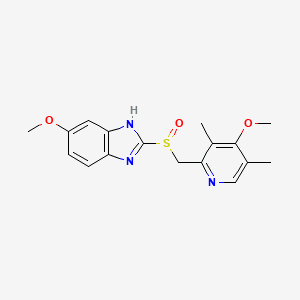
Omeprazole is an active substance from the group of proton pump inhibitors that inhibits gastric acid secretion. It is prescribed by physicians for conditions including gastroesophageal reflux disease and gastric and duodenal ulcers, among others. At the end of March 2010, omeprazole 10 mg was approved in Switzerland for over-the-counter use in the short-term treatment of reflux symptoms such as heartburn and acid regurgitation. Later, additional OTC medicines containing 20 mg were also approved. Omeprazole has a potential for drug interactions, for example with clopidogrel, because it inhibits CYP2C19. The most commonly observed adverse effects include gastrointestinal complaints and headache.
Omeprazole (ATC A02BC01) reduces gastric acid secretion by irreversibly (non-competitively) inhibiting the proton pump (H⁺/K⁺-ATPase) in the parietal cells of the stomach.
It does not act locally in the gastric lumen but is absorbed in the intestine and reaches the parietal cells via the systemic circulation. It is a prodrug and is only converted into its active form by acid in the canaliculi of the parietal cells, where it binds covalently to the proton pump, thereby inhibiting it.
Omeprazole is acid-labile and must be administered in enteric-coated dosage forms. The inhibition of gastric acid secretion is dose-dependent, and full effect — as with all proton pump inhibitors — is delayed, occurring within approximately 4 days.
Due to its covalent binding, omeprazole is effective for considerably longer than its short half-life of less than one hour would suggest, and for most patients a once-daily dose is therefore sufficient.
Mechanism of action of proton pump inhibitors, click to enlarge. Illustration © PharmaWiki