This information is for educational purposes only. It is not intended as medical advice. Always consult a qualified healthcare professional.
⚠️ Warnings
Recommendations for safe handling
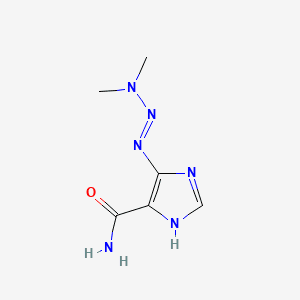
Dacarbazine is an antineoplastic agent and should be handled according to standard procedures for cytostatics that have mutagenic, carcinogenic and teratogenic effects. Before commencing, local cytotoxic guidelines should be referred to.
Dacarbazine should only be opened by trained staff and as with all cytotoxic agents; precautions should be taken to avoid exposing staff. Handling of cytotoxic medicinal products should be generally avoided during pregnancy. Preparation of solution for administration should be carried out in a designated handling area and working over a washable tray or disposable plastic-backed absorbent paper.
Suitable eye protection, disposable gloves, face mask and disposable apron should be worn. Syringes and infusion sets should be assembled carefully to avoid leakage (use of Luer lock fittings is recommended).
On completion, any exposed surface should be thoroughly cleaned and hands and face washed.
In the event of spillage, operators should put on gloves, face masks, eye-protection and disposable apron and mop up the spilled material with an absorbent material tapped in the area for that purpose. The area should then be cleaned and all contaminated material transferred to a cytotoxic spillage bag or bin or sealed for incineration.
Preparation for intravenous administration
Dacarbazine-solutions are prepared immediately before use.
Dacarbazine is sensitive to light exposure. During administration, the infusion container and administration set should be protected from exposure to daylight, e.g. by using light-resistant PVC-infusion sets. Normal infusion sets should be wrapped up in e.g. UV-resistant foils.
a) Preparation of Dacarbazine medac 100 mg:
Aseptically transfer 10 ml of water for injections into the vial and shake until a solution is obtained. This freshly prepared solution containing 10 mg/ml dacarbazine (density of the solution: ρ = 1.007 g/ml) is administered as a slow injection.
For preparation of Dacarbazine medac 100 mg for i.v. infusion the freshly prepared solution is further diluted with 200 – 300 ml 0.9 % sodium chloride or 5 % glucose solution for infusion. This solution is given as a short term infusion over a period between 15 – 30 minutes.
b) Preparation of Dacarbazine medac 200 mg:
Aseptically transfer 20 ml of water for injections into the vial and shake until a solution is obtained. This freshly prepared solution, containing10 mg/ml of dacarbazine, (density of the solution: ρ = 1.007 g/ml) is administered as a slow injection.
For preparation of Dacarbazine medac 200 mg for i.v. infusion the freshly prepared solution is further diluted with 200 – 300 ml 0.9 % sodium chloride or 5 % glucose solution for infusion. This solution is given as a short term infusion over a period between 15 – 30 minutes.
c) Preparation of Dacarbazine medac 500 mg:
Aseptically transfer 50 ml water for injections into the vial and shake until a solution is obtained. The resulting solution, containing 10 mg/ml of dacarbazine (density of solution: ρ = 1.007 g/ml) has to be further diluted with 200 – 300 ml sodium chloride or 5 % glucose solution for infusion. The obtained solution for infusion, containing 1.4 – 2.0 mg/ml of dacarbazine, is ready for i. v. infusion and should be given over a period between 20 – 30 minutes.
d) Preparation of Dacarbazine medac 1000 mg:
Aseptically transfer 50 ml water for injections into the vial and shake until a solution is obtained. The resulting solution, containing 20 mg/ml of dacarbazine (density of solution: ρ = 1.015 g/ml) has to be further diluted with 200 – 300 ml 0.9 % sodium chloride or 5 % glucose solution for infusion. The obtained solution for infusion, containing 2.8 – 4.0 mg/ml of dacarbazine, is ready for i. v. infusion and should be given over a period between 20 – 30 minutes.
Dacarbazine medac 100 mg (200 mg, 500 mg, 1000 mg) is for single use only.
The diluted solution for infusion should be visually inspected and only clear solutions practically free from particles should be used. Do not use the solution if particles are present.
Any solutions where the visual appearance has changed should be discarded.
Any unused medicinal product or waste material should be disposed of in accordance with local requirements.