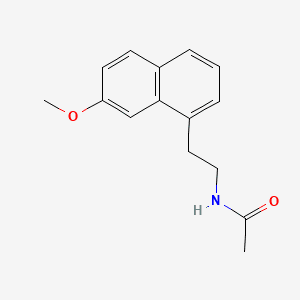
Pharmacotherapeutic group: Psychoanaleptics, other antidepressants, ATC-code: N06AX22
Mechanism of action
Agomelatine is a melatonergic agonist (MT
1
and MT
2
receptors) and 5-HT
2C
antagonist. Binding studies indicate that agomelatine has no effect on monoamine uptake and no affinity for α, β adrenergic, histaminergic, cholinergic, dopaminergic and benzodiazepine receptors.
Agomelatine resynchronises circadian rhythms in animal models of circadian rhythm disruption. Agomelatine increases noradrenaline and dopamine release specifically in the frontal cortex and has no influence on the extracellular levels of serotonin.
Pharmacodynamic effects
Agomelatine has shown an antidepressant-like effect in animal models of depression (learned helplessness test, despair test, chronic mild stress) as well as in models with circadian rhythm desynchronisation and in models related to stress and anxiety.
In humans, agomelatine has positive phase shifting properties; it induces a phase advance of sleep, body temperature decline and melatonin onset.
Clinical efficacy and safety
The efficacy and safety of agomelatine in major depressive episodes have been studied in a clinical programme including 7,900 patients treated with agomelatine.
Ten placebo controlled trials have been performed to investigate the short term efficacy of agomelatine in major depressive disorder in adults, with fixed dose and/or dose up-titration. At the end of treatment (over 6 or 8 weeks), significant efficacy of agomelatine 25-50 mg was demonstrated in 6 out of the ten short-term double-blind placebo-controlled trials. Primary endpoint was change in HAMD-17 score from baseline. Agomelatine failed to differentiate from placebo in two trials where the active control, paroxetine or fluoxetine showed assay sensitivity. Agomelatine was not compared directly with paroxetine and fluoxetine as these comparators where added in order to ensure assay sensitivity of the trials. In two other trials, it was not possible to draw any conclusions because the active controls, paroxetine or fluoxetine, failed to differentiate from placebo. However, in these studies it was not allowed to increase the start dose of either agomelatine, paroxetine or fluoxetine even if the response was not adequate.
Efficacy was also observed in more severely depressed patients (baseline HAM-D ≥ 25) in all positive placebo-controlled trials.
Response rates were statistically significantly higher with agomelatine compared with placebo.
Superiority (2 trials) or non-inferiority (4 trials) has been shown in six out of seven efficacy trials in heterogeneous populations of depressed adult patients versus SSRI/SNRI (sertraline, escitalopram, fluoxetine, venlafaxine or duloxetine) The anti-depressive effect was assessed with the HAMD-17 score either as primary or secondary endpoint.
The maintenance of antidepressant efficacy was demonstrated in a relapse prevention trial. Patients responding to 8/10-weeks of acute treatment with open-label agomelatine 25-50 mg once daily were randomised to either agomelatine 25-50 mg once daily or placebo for further 6-months. Agomelatine 25-50 mg once daily demonstrated a statistically significant superiority compared to placebo (p=0.0001) on the primary outcome measure, the prevention of depressive relapse, as measured by time to relapse. The incidence of relapse during the 6-months double-blind follow up period was 22% and 47% for agomelatine and placebo, respectively.
Agomelatine does not alter daytime vigilance and memory in healthy volunteers. In depressed patients, treatment with agomelatine 25 mg increased slow wave sleep without modification of REM (Rapid Eye Movement) sleep amount or REM latency. Agomelatine 25 mg also induced an advance of the time of sleep onset and of minimum heart rate. From the first week of treatment, onset of sleep and the quality of sleep were significantly improved without daytime clumsiness as assessed by patients.
In a specific sexual dysfunction comparative trial with remitted depressed patients, there was a numerical trend (not statistically significant) towards less sexual emergent dysfunction than venlafaxine for Sex Effects Scale (SEXFX) drive arousal or orgasm scores on agomelatine. The pooled analysis of trials using the Arizona Sexual Experience Scale (ASEX) showed that agomelatine was not associated with sexual dysfunction. In healthy volunteers agomelatine preserved sexual function in comparison with paroxetine.
Agomelatine had neutral effect on heart rate and blood pressure in clinical trials. In a trial designed to assess discontinuation symptoms by the Discontinuation Emergent Signs and Symptoms (DESS) check-list in patients with remitted depression, agomelatine did not induce discontinuation syndrome after abrupt treatment cessation.
Agomelatine has no abuse potential as measured in healthy volunteer studies on a specific visual analogue scale or the Addiction Research Center Inventory (ARCI) 49 check-list.
A placebo-controlled 8-week trial of agomelatine 25-50 mg/day in elderly depressed patients (≥ 65 years, N=222, of which 151 on agomelatine) demonstrated a statistically significant difference of 2.67 points on HAM-D total score, the primary outcome. Responder rate analysis favoured agomelatine. No improvement was observed in very elderly patients (≥75 years, N= 69, of which 48 on agomelatine).
Tolerability of agomelatine in elderly patients was comparable to that seen in the younger adults.
A specific controlled, 3-week trial has been conducted in patients suffering from major depressive disorder and insufficiently improved with paroxetine (a SSRI) or venlafaxine (a SNRI). When treatment was switched from these antidepressants to agomelatine, discontinuation symptoms arose after cessation of the SSRI or SNRI treatment, either after abrupt cessation or gradual cessation of the previous treatment. These discontinuation symptoms may be confounded with a lack of early benefit of agomelatine.
The percentage of patients with at least one discontinuation symptom one week after the SSRI/SNRI treatment stop, was lower in the long tapering group (gradual cessation of the previous SSRI/SNRI within 2 weeks) than in the short tapering group (gradual cessation of the previous SSRI/SNRI within 1 week) and in the abrupt substitution group (abrupt cessation): 56.1%, 62.6 % and 79.8% respectively.
Paediatric population
The European Medicines Agency has deferred the obligation to submit the results of studies with reference medicinal product containing agomelatine in one or more subsets of the paediatric population in the treatment of major depressive episodes (see section 4.2 for information on paediatric use).