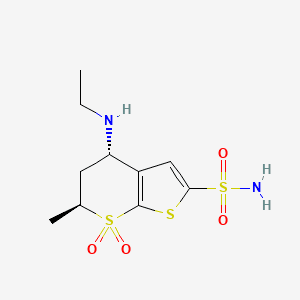
Pharmacotherapeutic group: Antiglaucoma preparations and miotics, Beta blocking agents, Timolol, combinations, ATC code: S01ED51
Mechanism of action
COSOPT is comprised of two components: dorzolamide hydrochloride and timolol maleate. Each of these two components decreases elevated intraocular pressure by reducing aqueous humor secretion, but does so by a different mechanism of action.
Dorzolamide hydrochloride is a potent inhibitor of human carbonic anhydrase II. Inhibition of carbonic anhydrase in the ciliary processes of the eye decreases aqueous humor secretion, presumably by slowing the formation of bicarbonate ions with subsequent reduction in sodium and fluid transport. Timolol maleate is a non-selective beta-adrenergic receptor blocking agent. The precise mechanism of action of timolol maleate in lowering intraocular pressure is not clearly established at this time, although a fluorescein study and tonography studies indicate that the predominant action may be related to reduced aqueous formation. However, in some studies a slight increase in outflow facility was also observed. The combined effect of these two agents results in additional intraocular pressure reduction (IOP) compared to either component administered alone.
Following topical administration, this medicinal product reduces elevated intraocular pressure, whether or not associated with glaucoma. Elevated intraocular pressure is a major risk factor in the pathogenesis of optic nerve damage and glaucomatous visual field loss. This medicinal product reduces intra-ocular pressure without the common side effects of miotics such as night blindness, accommodative spasm and pupillary constriction.
Pharmacodynamic effects
Clinical effects
Clinical studies of up to 15 months duration were conducted to compare the IOP-lowering effect of COSOPT b.i.d. (dosed morning and bedtime) to individually- and concomitantly-administered 0.5% timolol and 2.0% dorzolamide in patients with glaucoma or ocular hypertension for whom concomitant therapy was considered appropriate in the trials. This included both untreated patients and patients inadequately controlled with timolol monotherapy. The majority of patients were treated with topical beta-blocker monotherapy prior to study enrollment. In an analysis of the combined studies, the IOP-lowering effect of COSOPT b.i.d. was greater than that of monotherapy with either 2% dorzolamide t.i.d. or 0.5% timolol b.i.d. The IOP-lowering effect of COSOPT b.i.d. was equivalent to that of concomitant therapy with dorzolamide b.i.d. and timolol b.i.d. The IOP-lowering effect of COSOPT b.i.d. was demonstrated when measured at various time points throughout the day and this effect was maintained during long-term administration.
Paediatric population
A 3 month controlled study, with the primary objective of documenting the safety of 2% dorzolamide hydrochloride ophthalmic solution in children under the age of 6 years has been conducted. In this study, 30 patients under 6 and greater than or equal to 2 years of age whose IOP was not adequately controlled with monotherapy by dorzolamide or timolol received COSOPT in an open label phase. Efficacy in those patients has not been established. In this small group of patients, twice daily administration of COSOPT was generally well tolerated with 19 patients completing the treatment period and 11 patients discontinuing for surgery, a change in medication, or other reasons.