This information is for educational purposes only. It is not intended as medical advice. Always consult a qualified healthcare professional.
ZADITEN 0,25 mg/ml COLIRIO EN SOLUCION EN ENVASE UNIDOSIS — Description, Dosage, Side Effects | PillsCard
OTC
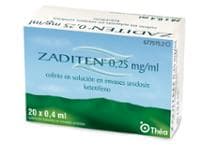
ZADITEN 0,25 mg/ml COLIRIO EN SOLUCION EN ENVASE UNIDOSIS
INN: ZADITEN
Data updated: 2026-04-11
Available in:
🇩🇪🇬🇧🇪🇸🇵🇹🇹🇷
Form
—
Dosage
—
Route
—
Storage
—
About This Product
Manufacturer
User Reviews
Reviews reflect personal experiences and are not medical advice. Always consult your doctor.
Laboratoires Thea (ES)
Source
CIMA_ES
USDailyMed:Ketotifen
AU:B1
R06AX17(WHO)S01GX08(WHO)
CA:℞-onlyUK:POM(Prescription only)US:OTC/Rx-only
4-(1-Methylpiperidin-4-ylidene)-4,9-dihydro-10H-benzo[4,5]cyclohepta[1,2-b]thiophen-10-one
34580-13-7Yas fumarate:34580-14-8
3827as fumarate:5282408
7206
DB00920Yas fumarate:DBSALT001856
3695Yas fumarate:4445563
X49220T18Gas fumarate:HBD503WORO
D08105Yas fumarate:D01332
CHEBI:92511as fumarate:CHEBI:31750
ChEMBL534Yas fumarate:ChEMBL1633
DTXSID7023190
Interactive image
O=C3c1sccc1C(\c2c(cccc2)C3)=C4/CCN(C)CC4
InChI=1S/C19H19NOS/c1-20-9-6-13(7-10-20)18-15-5-3-2-4-14(15)12-17(21)19-16(18)8-11-22-19/h2-5,8,11H,6-7,9-10,12H2,1H3YKey:ZCVMWBYGMWKGHF-UHFFFAOYSA-NYKey:YNQQEYBLVYAWNX-WLHGVMLRSA-N
Ketotifenis anantihistaminemedication and amast cell stabilizerused to treat allergic conditions such asconjunctivitis(pink eye),asthma, andhives. Ketotifen is available in ophthalmic (eye drops or drug-eluting contact lenses) and oral (tablets or syrup) forms: the ophthalmic form relieves eyeitchinessand irritation associated withseasonal allergies, while the oral form helps preventsystemic conditionssuch as asthma attacks and allergic reactions. In addition to treating allergies, ketotifen has shown efficacy in managing systemicmast cell diseasessuch asmastocytosisandmast cell activation syndrome(MCAS), which involve abnormal accumulation or activation ofmast cellsthroughout the body. Ketotifen is also used for other allergic-type conditions likeatopic dermatitis(eczema) andfood allergies.
Ketotifen acts by blocking theH1histamine receptors, which are found on various cells in the body, such assmooth muscle,endothelium, andnerve cells. This blocking prevents the binding of histamine to these receptors and thus reduces the symptoms of histamine-mediated reactions, such as itching, sneezing, wheezing, and swelling. Ketotifen also prevents the release of histamine and other inflammatory substances from immune cells (mast cells); this action helps reduce symptoms of conditions (including allergic conditions) by blocking the activation of these cells. In addition to itsantihistaminicactivity, ketotifen also functions as aleukotriene antagonist, which blocks inflammation-causing chemicals known asleukotrienes; it also acts as aphosphodiesterase inhibitorthat regulates blood vessel dilation.
Ketotifen can have side effects, including drowsiness, weight gain, dry mouth, irritability, increased nosebleeds when taken orally, and temporary burning or stinging sensations in the eyes when used in the ophthalmic form. Ketotifen has contraindications for individuals with certain medical conditions, such as acuteporphyriasorepilepsy. Controversies surrounding ketotifen include its classification as a first-generation or second-generation antihistamine due to varying criteria of classification.
In 2023, it was the 299th most commonly prescribed medication in the United States, with more than 400,000 prescriptions.